Join the Revolution!

When I first saw the video I’ve embedded below, it was via an email link from my department chair at work. It’s really cool when your boss’ boss passes stuff like this along!

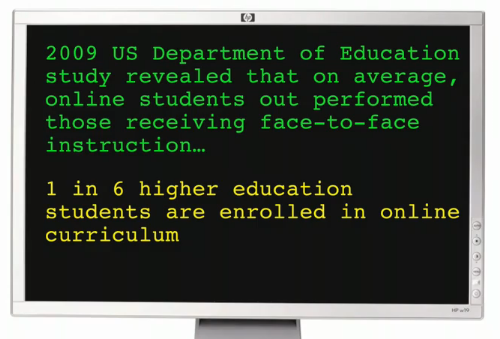
The video also includes a neat statistic that has particular relevance for SMUG and SMUGgles, as captured in this screen shot:

OnlineLearningDeptEducation

Sort of tells me we’re on the right track with SMUG; getting hands-on, online training in social media, using revolutionary tools to learn a revolutionary subject.

Oh yeah, and it’s free.

So here’s the video; you may have seen it, or you may feel like you have anyway. The same music track has been used in at least one similar video, and I’ve seen various versions over the last three years.

A previous video of this genre made the comparison of “If MySpace were a country, it would be the fourth largest…” That was so 2006. This newest version has at least been updated to reflect Facebook’s ascendancy in the English-language general-purpose social networking ecosystem.

But don’t let the fact that you may have seen something like this keep you from clicking the “play” button below. This version has some interesting facts and factoids that will help you in making the case for social media in your organization.

If you want to get hands-on experience with these powerful tools, enroll in SMUG and join the revolution.

RAQ: How can I update both Twitter and Facebook?

Here’s a question from yesterday (I’m paraphrasing):

I don’t do a very good job of keeping either Twitter or my Facebook status updated. Is there a way I can do both at the same time, or use Twitter to update Facebook?

Answer:

Twitter 110, which was developed more than a year ago, lists some options for this. One limitation though, and the reason I quit having Twitter automatically update my Facebook status, is that I tend to tweet a lot and often have replies, for example, that would not make sense to Facebook users who haven’t been part of the conversation. So my kids used to tell me, “Dad, your Facebook status is always really boring.” Or weird.

If you spend more time in Facebook, you can use the Twitter application within Facebook to send your tweets.

But here’s the way I currently prefer to work, using Tweetdeck. In Tweetdeck I can incorporate both of the Twitter accounts with which I work (@LeeAase and @mayoclinic) as well as my Facebook profile. That way I don’t have to be in Facebook or on the Twitter Web interface, but can update both simultaneously.

So I can select just to have updates sent to my personal Twitter account:

Picture 1

…or I can select to go both to Twitter and Facebook:

Picture 2

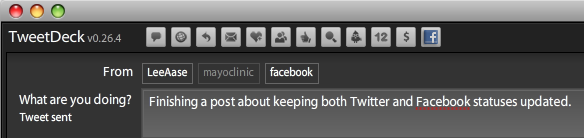
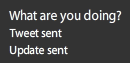
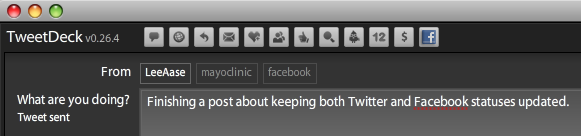
If I choose the latter, the Tweetdeck dashboard shows this:

Picture 5

And here’s what shows up on Facebook:

Picture 7

and on Twitter:

Picture 6

The nice part about having an application like Tweetdeck is that you can decide which messages are appropriate for which platform. And of course, as I say in Twitter 106 and in Twitter 152: Tweetcamp III, Tweetdeck or an application like it greatly increases your Twitter productivity.

I still don’t update my Facebook status as frequently as I should, but Tweetdeck makes it easier to keep the status updated without having to go to the Facebook Web interface.

How do you keep Twitter and Facebook statuses updated? Or do you even try to do both?

Is all health care local?

This presentation from John Norris caught my eye on Twitter because of how he promoted it through a tweet:
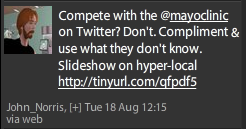
Picture 6

Give his presentation a review and then I’ll share some thoughts that he stirred in me (since I work for @mayoclinic, and particularly with our Twitter account.)

I think this slideshow has a ton of useful ideas for a hospital interested in using Twitter or similar tools effectively. Phil Baumann’s 140 Healthcare Uses for Twitter is another good read.

When John says “All healthcare is local” that’s true…except when it’s not, just as Tip O’Neill’s “All politics is local” was occasionally trumped by national issues.

I would instead say “All healthcare is personal.”

And social media platforms are, above all, personal.

Most of the healthcare people get is local. But sometimes they look outside of their local for specialized expertise. And part of the power of social media is that it makes that expertise available to a community that can be globally dispersed.

But as John points out, the social tools (including Twitter) can be extremely helpful for a local community, too. Just because a Twitter community can be global doesn’t mean it has to be, or that the only worthwhile Twitter efforts are those with thousands of followers.

Ed Bennett’s list of the hospitals with most Twitter followers was interesting and fun, but as he says, you shouldn’t read too much into it. A hospital with a few hundred followers could be providing a great service and interacting with that local community.

The point is to be of service to the community, whether it’s geographical or interest-based. If the information you provide is useful, and if you can interact with that community, the activity can be valuable both to you and to the people you serve.

For example, people might want to follow and interact with @mayoclinic AND their local hospital (e.g. @InnovisHealth in Fargo, ND), and maybe a service like John is providing in Corvallis, Oregon called @CorvallisHealth. They would be likely looking for different information from each source, and to have different conversations with each.

Twitter lets users (including each hospital/corporate user) decide on suitable goals that meet their objectives. As John suggests, don’t let someone else’s Twitter strategy have too much influence on you. Look at what Twitter can do, and what you can do with Twitter, and decide what makes sense for you.

Then go for it, without worrying about “competition.”

I’m looking forward to learning about lots of other innovative uses of Twitter at the Health Care Social Media Summit Mayo is hosting in October in Scottsdale, Ariz,, co-sponsored by Ragan Communications.

If you’re using Twitter in an interesting or different way, I’d love to hear about it and help spread the word about it. By sharing what you’re doing, you may spark ideas in others. Not that they would necessarily do the same thing exactly, but it may help them see connections they could make in their communities.

And since most health care is local, you can just feel good if someone in another community can gain from what you’ve learned.
Creativity and the MacGyver Mindset

Here’s an interesting story from our Mayo Clinic Medical Edge TV news feature about the nature of creativity, and how it doesn’t just apply to art and music:

It’s nice to have a Mayo Clinic neurologist validating and outlining more rigorously something I’ve felt intuitively, and that is consistent with what I call “The MacGyver Mindset.” MacGyver was extremely creative, finding ways to use what he had on hand to accomplish what he needed to do. (Yes, I realize he was a fictional character, but we can learn lessons from his approach.)

Dr. Caselli breaks down creativity into these core elements, which surprisingly have little to do with what would traditionally considered “creative” professions:

  1. Motivation
  2. Perception
  3. Execution
  4. Temperament, and
  5. Social Context

What I’m trying to do in SMUG is help create a social context in which mid-career professionals can perceive the value of using social media tools professionally, can be motivated to try and get training to help them execute. Not sure whether we can do anything about temperament, but hopefully we can influence the rest.

Creativity is extremely important. Every business that starts involves creativity: seeing a situation that is not what you want it to be, and figuring out how to get to the desired end. Likewise, a politician who (in the words of Bobby Kennedy) says “I dream of things that never where and ask ‘Why not?'” is being creative in imagining a desired future state.

How is SMUG helping you think — and act — more creatively?

A Present for Evelyn

Our family is in Grand Rapids, Michigan this weekend visiting my daughter Rachel, her husband Kyle and my granddaughter Evelyn, who turns one today.

Evelyn got to open one of her presents Saturday night when we arrived, as she sat in the lap of her Aunt Rebekah. This is one of those priceless moments that’s a great reason to have a Flip video camera (or something like it):

Because we won’t know the baby’s gender for at least several months, we’re thinking we will refer to him/her as “Thermie” for short.

If I would have know what the news was going to be, I would have been focusing more on Bekah than on Evelyn.

This is another example of how you can embed video from Facebook in a self-hosted WordPress blog, whereas you can’t in a WordPress.com blog.

Meanwhile, here’s the video we shot a year ago right now, when we welcomed Evelyn to the world. She’s changed quite a bit:

Lisa and I have been truly blessed, and are looking forward to Evelyn having a sibling and to becoming serial grandparents.