The governor of Kansas has realized (although belatedly) that his staff mishandled the case of a teen constituent and her disrespectful tweet.
TOPEKA, Kan. (AP) — When a high school senior tweeted that Kansas Gov. Sam Brownback “sucked,” among other invectives, reaction at the state Capitol led her principal to demand an apology. Instead, it was the Republican governor offering a mea culpa Monday, forced to admit to a self-described overreaction by his staff that subjected him to ridicule for efforts to police a teenager’s Internet musings.
A few basic lessons and observations I take from this story:
As Stephen Covey says, “Begin with the end in mind.” In this case the gubernatorial (one of the great words in U.S. English) staffers saw the offending tweet and started the chain of events that led to this outcome without really thinking ahead to what they wanted to accomplish. They contacted the Youth in Government program director, who contacted the principal, and the confrontation ensued. What was the best possible outcome the staffers hoped to achieve? Even if everything turned out exactly “right,” what did they think they would get? I doubt they took time to consider this.
Most social media conversations are more social than media. When Emma Sullivan tweeted her comment, she was mainly talking with friends. It didn’t seem she meant it as a profound political statement. This is the kind of conversation that has happened about politicians since the days of the Roman Senate. When comments are posted online, they obviously can be found by anyone. But especially in Twitter, where the half-life of a tweet is about 30 minutes, most are lost to the ether, just as the spoken word was for previous millennia. That’s why…
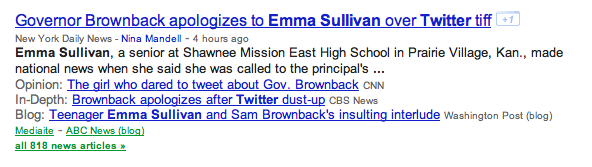
Sometimes the best response is no response. The original tweet from Emma Sullivan went to her 65 (or so) followers. A lot of them probably missed it. As of this writing she has 12,700 followers, and there have been more than 800 online stories.
Stick to correcting factual errors. Ms. Sullivan had expressed an opinion about Gov. Brownback that is not subject to verification. If she had made a statement that was clearly factually inaccurate (as opposed to being her personal opinion), his staff may have had a basis for requesting a retraction. Again, they would need to decide if the end they were trying to achieve was worthwhile, but at least it would not have been a guaranteed loser.
Social media can create the political equivalent of fibromyalgia. To be successful in politics, candidates need to develop what is often called a “thick skin.” They can’t get too upset at criticism. Having just spent three days watching way more TV than I would have preferred, because of a nasty bout of intestinal flu, I’ve learned more about fibromyalgia through seemingly endless direct-to-consumer ads. According to my friends at MayoClinic.com, fibromyalgia seems to have something to do with increased sensitivity of the brain to pain signals. It seems the increased listening ability afforded by social media also can make politicians (or companies) hypersensitive to the “pain” of criticism.
It’s good to listen through social media, and these tools give unprecedented ability to hear what constituents or customers have to say. Listening is a great place to start in your involvement, but the power of the tools makes it all the more important to consider carefully when you should be informed by what you hear, and when and how it is advisable to respond.
