Husband of one, father of six, grandfather of 15. Chancellor Emeritus, SMUG. Emeritus staff of Mayo Clinic. Founder of HELPcare and Administrator for HELPcare Clinic.
More evidence of continued economic difficulty for traditional media due to declining circulation and resulting loss of ad sales. This morning’s Minneapolis Star Tribune, reporting(registration required) on crosstown rival Pioneer Press, says the St. Paul paper has had a land rush for the buyouts offered to senior newsroom staffers.
Twenty-one senior members of the St. Paul Pioneer Press newsroom have been offered buyouts as part of the company’s decision to downsize in the wake of slumping ad sales, editor Thom Fladung said Thursday.
The number was higher than the 10 originally called for in the paper’s cost-cutting moves, because more staffers sought the buyouts, Fladung said.
“When you have a lot of veteran journalists come forward and they sincerely want [a buyout], then it’s incumbent on me to try really hard to give them that. I felt I owed them,” he said.
The 21 employees could rescind their buyout requests, but most are expected to be gone by today.
The Pioneer Presssays the cutbacks amount to 30 in total, including the 21 newsroom staff. The newsroom will be reduced by 10 percent.
The people taking buyouts “have been peers, coaches and friends to us,” he said in an e-mail to the newsroom. Today is the last day at the paper for the people taking buyouts. The package amounts to two weeks worth of pay for every year of service at the paper, up to 52 weeks.
Early next week Fladung said he’ll pass on more information about how the buyouts will affect the workers who remain. The changes will put a higher premium on communication in the newsroom and identifying the best stories, he said.
“This was so fast,” said Don Effenberger, 57, an editor at the paper with 28 years of experience. Employees had about three weeks to decide whether to take the buyout. Effenberger says he’s not retiring, though, and will look for another job.
In his short book/fable, Our Iceberg is Melting, which I reviewed here, John Kotter says complacency is the number one barrier to businesses making necessary changes in a rapidly changing environment. That point, and Kotter’s other 8 steps to successful transformation, are examined in more detail in his Leading Change, written in 1996. I picked up a used copy on Amazon and am reading it now. It is helpful background to his more recent book about the nomadic penguins, and I recommend it as well.
It seems the Pioneer Press (and senior newsroom staffers) are well beyond complacency. And earlier this week, Ford announced that 38,000 hourly employees had accepted buyouts, and in October NBC announced 700 job cuts. It seems a sense of urgency to find new ways of providing value to consumers, combined with reasonable means of getting paid for it, would behoove us all. As I’ve said before, whatever you think of the climatological phenomenon of global warning, from an economic perspective it’s here already. Icebergs are melting everywhere.
Chris Anderson is starting a writing project in Wired on the new trend in business away from the traditional mode of secrecy and limited disclosure, and toward what he calls “Radical Transparency.”
The default communications mode of companies has traditionally been top-down, with only executives and official spokespeople permitted to discuss company business in public. The standard rule, explicit or not, was “That which we choose not to announce is not to be spoken about.” Aside from some special exemptions, such as conferences where those employees trusted enough to go chatted guardedly with outsiders, employees were cautioned that what happened at work should stay at work. Loose lips sink ships, etc.
As Edelman has reported, “a person like me” is now the most trusted source of information, surpassing even doctors and academic experts. And thanks to the web it is now easier than ever to pick the brains of “people like me.”
I think this is one of those “it depends” situations, though. I agree that people generally trust the opinion of a rank-and-file employee more than a corporate spokesperson, but the credibility of a physician is still extremely high, especially a specialist speaking to an issue in which he or she has expertise.
In my work in media relations, we guard the credibility of both Mayo Clinic and our physicians by not putting them in a position to comment on something that isn’t in their area of special training. We also produce syndicated news content, which is reviewed not only by the subject expert being featured but also by a medical editor, so consumers aren’t just getting one person’s opinion, but a team consensus.
And, of course, we have federal patient privacy laws (which essentially codified what was our practice) that also limit what can be disclosed. Our policy always has been to protect patient privacy unless they choose to make their stories public. The real change now is the advent of blogging by patients and family members, with people telling the story of their health care experience directly to the world.
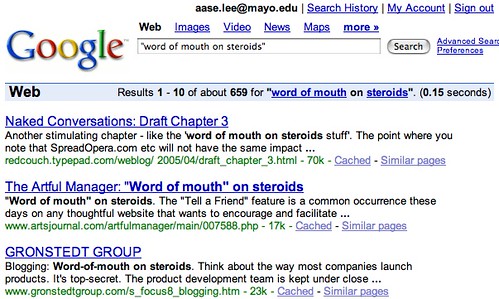
Word-of-mouth always has been an important way for people to learn about Mayo Clinic, either from patients or from physicians whose patients have come here. Patient blogs are, to borrow a phrase I found 659 times in a quick Google search:
“Word of Mouth on Steroids.”
And sites like CarePages and CaringBridge are specifically designed to make it easier for patients and their families to more efficiently stay in touch with concerned family and friends.
This is a trend that will only accelerate. Conversations that were formerly one-to-one will be taking place in a much more public arena, at least for some patients (or for businesses, customers) who choose to tell their stories. That makes it even more crucial for businesses and health care providers to at least be listening to what’s being said in blogs, and joining the conversation when appropriate.
Wired magazine has an outstanding feature on why Google spent $1.65 billion to buy YouTube, explaining that with a broken TV advertising model (shrinking audiences of people who skip the commercials with their TiVos) but still nets $67 billion a year in revenue, the YouTube price for a place where millions of people gather to watch “Monkeyvision” doesn’t seem such a huge price. The trick will be figuring out a way to incorporate advertising without killing what people love about YouTube.
The videos highlighted by Bob Garfield on the first page of the story (especially the Ball State University sportscaster and the Evolution of Dance) are worth the price of admission all by themselves. Actually, that’s part of the problem for on-line video so far. There isn’t any price of admission. The only price is the time it takes to watch. And as my former boss used to say, there is unlimited demand for free stuff.
The main point of Garfield’s story is that TV isn’t just threatened; the decline is inevitable. The only question is what will replace it and how its owners will find a way to make it profitable.
If you came here for my family Thankgiving/Christmas letter, just click here to go straight to it. Otherwise, taking a few minutes to read this post and watch the video below will put a smile on your face…and at the end you can scroll or click to our holiday greetings.
In keeping with the Thanksgiving theme, and on a much less serious note but one that is more in keeping with the general subject matter of this blog, here’s a blast from my teenage years made possible by YouTube:
I also recommend that you bookmark the Viral Video Chart, where Mr. Carlson’s ill-fated promotional stunt is currently at number five on the top 20 chart. I guess that makes it something of a hit, which means right now it is not in the Long Tail, but it’s an example of how the Long Tail works.
The Long Tail essentially depends on inventory cost approaching zero, distribution cost approaching zero, and a mechanism for people to find what interests them. Search engines obviously help enormously to make this possible, but sites like the Viral Video Chart help drive items toward the head. I’ve added it to my blogroll, too, for easy reference. As of this writing, Thanksgiving Turkey Drop has had 103,301 views through YouTube.
WKRP in Cincinnatiwas one of my all-time favorite shows. Les Nessman, winner of multiple Silver Sow Awards for agriculture reporting, and is unforgettable for his masking tape office walls. Herb Tarlek was the archetypical sleazy salesman, complete with red blazers and plaid pants. From what I understand, WKRP can’t be syndicated because the rights to the music spun (yes, that’s what they did back then) on turntables by Venus Flytrap and Dr. Johnny Fever would be too expensive. That’s a pity; my kids have missed a really fun, mostly clean show.
As the popularity of this episode as a viral video shows, maybe it would make more sense for the music companies to just let WKRP be syndicated without exhorbitant music licensing fees. Then people would hear snippets of the songs, have their memories triggered, and go to the iTunes store and buy them. Maybe the iTunes purchases wouldn’t be huge, but I would think there would be some…particularly if WKRP got lots of local affiliates.
I’m just thankful to be able to see this music-free snippet on YouTube. Thanks also to Jeff Jarvis for putting it in his feed. It doesn’t crack my personal Top 10 Reasons I’m Thankful, but it has brightened my Saturday morning.
As I take a long Thanksgiving weekend with family, I thought it would be great to work on my annual Christmas letter and give it a Thanksgiving flavor, because I do have so much for which to be thankful. Then I got an even better idea: why not just put it on my blog, complete with video and photos, and send links to family and friends?
I’ve done several posts on how David Allen’sGetting Things Done has helped me get on top of the “stuff” in my life. GTD (and the ease of WordPress.com blogging) has made it possible for me to get this Thanksgiving/Christmas family newsletter done a few weeks early, instead of a month or more late…or instead of not getting it out at all. (One year, I did a DVD for our 20th anniversary…but the distribution was really limited. Now, I can easily add video with YouTube, as you will see below.)
Because of GTD, instead of procrastinating I asked “What’s the next action?” and wrote this post. Because of WordPress.com, there really isn’t much of a “step two” to this project; I can send emails with the permalink to people in my address book, but the duplicating, addressing, stamping and mailing part of this GTD project is, with only a few exceptions, eliminated. For some folks who I know don’t have easy internet access, I can print this page and mail it the old-fashioned way. They’ll miss the video…but at least they’ll get something, which will be a big improvement over most years.
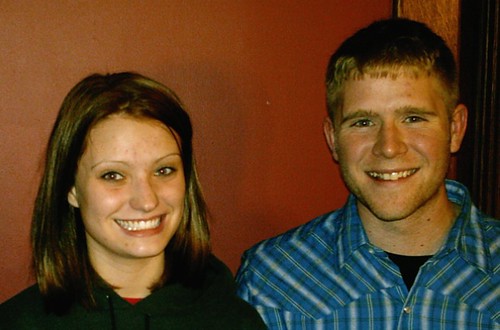
My top ten blessings are in no particular order, but the biggest news (#1) for our family is my daughter, Rachel, meeting and becoming engaged to Kyle Borg, a young man from Fairmont, Minn.
They are to be married December 30. Yes, this December 30. We’re very thankful the Lord has brought these two together, even using Facebook as the means for them to meet. Funny what happens when you search for people with a common interest in theology! You can read more about their story here.
With the bittersweet feelings of having my first daughter getting married, it’s (#2) nice that she, her two sisters my 8-year old son still call me “Daddy.” There’s no age better than 8, when little boys still think Daddy knows everything. Johnny turned 8 yesterday, and his next-oldest brother, Joe, turns 12 today. Come to think of it, age 12 is pretty nice too. So are 15, 16, 19 and 20.
Our six children (#3) are doing well in their education. Jacob and Rachel are in college at University of Wisconsin-La Crosse. Rebekah is having fun and getting all A’s at Austin High School (and excelling at Food Science!) Ruth, after having attended AHS last year as a freshman (and getting all A’s), decided she wanted to come home for another year of homeschooling. Next year she will follow in Rachel and Jake’s footsteps and attend Riverland Community College through Minnesota’s Post-Secondary Employment Options program, which will let her earn her two-year Associate of Arts degree at the same time she graduates from Aase Academy. We’re thankful she has the option to do that. Joe and John also are still homeschooled, and Lisa is enjoying being able to focus on them.
Rebekah getting to play varsity volleyball(#4) and basketball(#5) as a sophomore adds to our fun. As I’ve mentioned before, she’s my favorite volleyball player and we enjoy watching her play. What’s even better is what we found out at the awards banquet: she’s her teammates’ favorite, too.
My job with Mayo Clinic(#6) is next. Given my former career in politics, during which my employment depended on election results, having a job is always something for which I am thankful in November. But I can’t imagine a better and more fulfilling job in media relations than working to help draw attention to Mayo Clinic’s important research and programs, and helping to tell some amazing and heart-warming stories of patients and their families, and the staff members who care for them. The next item is a prime example.
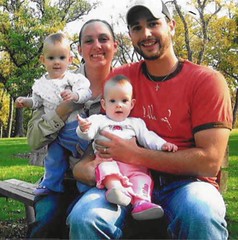
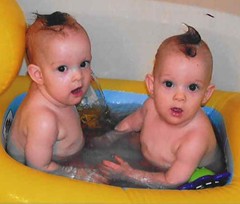
In February I had the pleasure of meeting Jesse and Amy Carlsen and their twin daughters, Abby and Belle. As it seems the whole world knows now, Abby and Belle were no ordinary set of twins, and their parents are special too. It was really rewarding to be part of telling the story of the twins’ separation on May 12 and their successful recovery(#7).
The girls have their first birthday party tomorrow (see the pictures below.) Their story got world-wide attention, with extensive or repeated features by the Star Tribune, NBC’s Dateline and Today, along with scores of stories by all of the TV stations in the Twin Cities. WCCO TV had an update story on the Carlsen family earlier this week, and has posted a still photo slideshow, too.
As much as I appreciate my job, one of the best parts is it lets me live in my home town (#8), with my brother and his family here and my parents still alive and well, with my in-laws also close (40 miles away) and able to visit. We had our big celebration here yesterday. At the end of the video below, you’ll see my sister-in-law, Sarah, playing hide-and-seek behind a pillar. She must have been thinking that if she couldn’t see me, I couldn’t see her.
Besides card-playing and gorging on a cornucopia of cholesterol-laden dishes, I also was challenged to a game of ping pong by Rebekah. The end of the video below from her follow-up game with Joe gives more insight into why she’s so fun to tease. Be sure to watch the slow-motion at the end.
Lisa (#9, but again we’re not going in order of importance!), is my bride of 21 years, 11 months and two days. In some ways, as Steve Martin would say, it seems like it has just been two years, five months and 17 days…but in others, it seems I’ve known her forever. We met 25 years ago last month, when we were freshmen at Waldorf College. She is God’s greatest gift to me, aside from His Son, and a daily reminder of His grace (#10).
Which brings me to the “Thanks” part of Thanksgiving. Thankfulness is a personal thing. By that I mean you thank someone or, better yet, Someone. Thanking “lucky stars” or good fortune is meaningless. You thank people who have done good to you, and you can offend them by being ungrateful, ignoring or denying the gift. It doesn’t make sense to say “thanks” if you think blind chance or impersonal luck has led to your favorable outcome.
Thanksgiving originated with Pilgrims sharing a meal with their native hosts and giving thanks to God for bringing them through safely. Lisa and I join them in thanking Him for all of these blessings recounted above, but most importantly for sending His Son to be the light of the world, and that He has shone in our lives. We pray that we and our children will reflect that Light, and that in this Christmas season many will see and delight in the glorious gospel of Jesus Christ. And may we be truly thankful.


 Technorati: Newspapers, Downsizing, Buyouts, cutbacks, news media, circulation, John Kotter, Ford, Our Iceberg is Melting, NBC