Fruitful Facebook YouTube Advertising

Fruitful Facebook YouTube Advertising

Susan Reynolds drew this Fruit of the Loom video with Vince Gill to my attention, and it illustrates several important points about marketing and advertising and how it is changed with the advent of social media and networking, in the era of TiVo, YouTube and Facebook.

[youtube=http://www.youtube.com/watch?v=OjGruchlKGw]

  • In the post-TiVo world, there is a great premium on great creative in advertising. You may have seen the :30 version of this ad on TV, in which Mr. Grape’s cell phone rings as the music is swelling to its peak. If ads are interesting to watch, people are less likely to skip them.
  • Great creative should draw attention to the brand being advertised, not just to the creative itself. How many clever ads have you seen that make you laugh, but you can’t remember what product or service was being advertised? Anybody over age 30 is likely to recall the Fruit Guys from previous Fruit of the Loom advertising. So even without an explicit underwear message in the TV :30, people get it.
  • Viral Distribution is Free. The full version of the ad is over two minutes long would be prohibitively expensive on TV, and yet it costs Fruit of the Loom nothing for distribution through YouTube.
  • Facebook multiplies the YouTube effect. YouTube placement makes it easy for people to recommend a video commercial to friends, and in Facebook it’s almost automatic. I had seen the :30 a few times on TV, but then saw in my Facebook News Feed that Susan had posted it on her profile. I commented on it and also posted it to my profile, which placed it in my mini-feed and in the News Feed for my friends. I also sent it directly to 9-10 of my friends. As my friends interact with the video in Facebook, the news will spread virally to their friends as well.

Everything about this video is done well, from the soulful playing of the Fruit Guys to the groupies mouthing the words as they gaze at the performers to the touching home videos. It isn’t slapstick viral and it probably won’t get millions of views, but this is about underwear, after all. You need to have reasonable expectations.

Note that every step after putting the video on YouTube was free for Fruit of the Loom. As of right now the two-minute version has been seen 5,300 times on YouTube. It will be interesting to track how this does over time.

Update: Here’s another good Fruit of the Loom music video from last year. Between the two versions I’ve seen on YouTube it’s had over 90,000 views so far.

[youtube=http://www.youtube.com/watch?v=JLj4YgDiRW4]

TechnoratiTechnorati: , , , , , , , , ,

Of COURSE Facebook is for Business

facebook is for business
A recent Techmeme has it that “Facebook’s closed platform and data lock-in” make it “NOT for Business.”

Please. Of COURSE Facebook is for business.

Any place that has 35 million people spending an average of 20 minutes a day absolutely has business uses.

If Facebook isn’t for business, then neither is eBay. Except of course now everyone knows people have made hugely profitable businesses solely on eBay. Many businesses found eBay valuable as a means of finding and selling to broadly dispersed customers. Even for business-to-business sales.

Now, doesn’t eBay have exactly the kind of “walled garden” characteristics that so many find it fashionable to revile in Facebook? How does it differ?

Facebook is, as Mark Zuckerberg says, a social utility. Utilities are like heating and electricity. They do things, or empower you to do things. Right off the bat there are lots of ways businesses can use Facebook to accomplish their goals. I’ve outlined a few Facebook business uses here. But beyond that, Facebook is infinitely extensible. If it doesn’t do what you want it to do, you can wait for someone to develop the application you need, or you can contract to develop the application yourself.

And unlike heat and lights — or eBay for that matter — you can use Facebook for free.

The problem isn’t with Facebook. It’s a lack of imagination in how to use it. Facebook, Twitter and all the other web 2.0 tools are just that: tools.

They aren’t the only tools for business; but web-wise MacGyvers will find creative ways to use them – not necessarily exactly according to the user manual (oh yeah, there is no user manual) – to accomplish their organizations’ goals.

For those concerned about mixing their personal and professional selves, I offer this: You can have lots of interaction with people with common interests in Facebook without becoming their Friend. You can just belong to the same groups. And for non-family members, you can use the limited profile to avoid divulging an information about yourself that you think others might find controversial. More on that in a future post.
TechnoratiTechnorati: , , , , , , , , ,

Facebook and The 4-Hour Workweek

Facebook 4-hour workweek
I reviewed Merlin Mann’s Inbox Zero talk at Google in this previous post, and suggested that Facebook could help create a new class of messaging, in keeping with the recommendations in The 4-Hour Workweek, that makes less-frequent checking of email a practical reality. I said I would elaborate in a future post. The future is now.

But first, let’s look at the past. Merlin was full of wist as he recalled his first email account in 1993, and how special each message felt because only a dozen or so of his friends had email. Email was a much more personal experience then. Now it threatens to overwhelm everything, with many people living most of their lives in their email inboxes. This should not be. There’s much more to life.
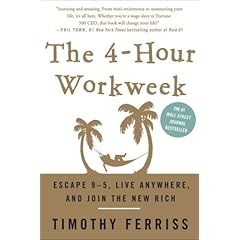
In his New York Times bestseller, The 4-Hour Workweek, Tim Ferriss suggests that a key to productivity and a fulfilling life is to go on a low-information diet and eliminate distractions so you can focus on priorities and actually accomplish important things.

One of his key recommendations is to check email no more than twice per day, and to facilitate this and reset expectations among those sending you messages he suggests creating an auto-responder for your email along these lines:

Greetings All,
Due to high workload and pending deadlines, I am currently responding to email twice daily at 12pm et and 4pm et.
If you require help with something that can’t wait until either 12pm or 4pm, please call me on my cell phone at 555-555-5555.
Thank you for understanding this move to greater effectiveness.
All the best,
Tim Ferriss

But what about people who need to be more available, whose success depends on timely response to key customers? What if responsiveness is one of your important priorities? For example, if you work in PR and a reporter with whom you are developing a relationship sends out an email to several potential interview sources, you don’t want to wait a few hours to find out about it. Someone else will have responded and will be in the story.
And sometimes you’re not at your computer. You’re in a meeting or otherwise having a life. News doesn’t happen in a predictable 8-5 schedule. So how do you stay in touch?

One “solution” to prevent missing an important email message when you’re out at a meeting is to have your Blackberry set to vibrate each time you get a new message. I used to do that. It was extremely disruptive. And it’s rude to have the Blackberry on silent mode, and then just pulling it out every so often to check messages. It tells people with whom you are meeting that they don’t have your full attention. Because they don’t.

With Facebook, you can recreate Merlin’s Edenic email world of 1993 all over again, and establish a priority level for your messages that goes beyond flagging in regular email.After all, if you’re only checking email twice a day, it doesn’t matter whether the message is flagged as highest priority or not: you’re not going to see it until you log in. That’s why you need an alternate way for people to get in touch when they really need you urgently.
If you use the Mobile application in Facebook, you can receive a text message delivered to your phone whenever someone sends you a message, or pokes you, or writes on your wall, or sends you a friend request.

So, I’m thinking I might adapt Tim’s autoresponder as follows:

Greetings All,
Due to high workload and pending deadlines, I am currently responding to email twice daily at 11 am CT and 4 pm CT.
If you require help with something that can’t wait until either 11 am or 4 pm, please call me on my office phone at 507-266-2442 during regular business hours, and ask to have me paged if I’m not at my desk.

Another way to reach me quickly any time is though Facebook (www.facebook.com). If you’re not in Facebook yet it’s easy to sign up, and 150,000 people a day are joining. Search for Lee Aase in Facebook (I’m the only Lee Aase there…one of the benefits of a unique name), and click Send Message. I will get an alert text message sent to my cell phone, so I’ll know you’ve sent me an urgent message. I’ll get back to you right away.

Thank you for understanding this move to greater effectiveness. I hope it will mean that I will be able to completely respond to the non-urgent messages on that regular schedule, and give everyone the service they need.

All the best,
Lee Aase

Michael Hyatt says his experience with the 4-Hour Workweek method has made him more productive, and he’s the CEO of a major publishing company. If you click the link above you’ll see how he’s tailored the Ferris formulation of the email autoresponse.

Even someone as promiscuous is accepting Facebook friend requests as Robert Scoble is would not likely be overwhelmed by text messages in this system. I’m one of Robert’s 4,701 friends, but I’m unlikely to send him a message unless I think it will be REALLY interesting.

If someone sends you a message in this way through Facebook that you don’t think was urgent, you can let her know that this was one that could have waited. And if she persists in not respecting the boundary you’ve set, you can block further Facebook contact.

In this way, Facebook can be not only the Spam Killer because it lets you segregate personally meaningful messages from everything else, thereby turning back the clock toward Merlin’s email Camelot; when combined with your cell phone and Facebook Mobile it also can serve as a 24-hour pager that alerts you when someone truly needs to get in touch urgently.

If you’re one of the self-employed “new rich” Tim Ferriss describes, giving your cell phone number may be the best and simplest way to let people reach you urgently. If you work for a company where someone answers your phone when you’re not able to take a call, maybe this work phone/Facebook message option will be a good option, instead of giving your personal cell phone number to anyone, including spammers, who sends you an email. We’ll see.

What do you think?

TechnoratiTechnorati: , , , , , , , , , ,

GTD: Inbox Zero email

GTD Inbox Zero email
If you have email (and the fact that you’re reading this means it’s highly likely you do), one of the best ways you could invest 59 minutes this weekend (or any time, for that matter) would be to watch the web video of Merlin Mann’s Inbox Zero talk, which he gave at Google late last month.

Merlin is the man(n) behind 43 Folders, a productivity blog that was among the influences that introduced me to David Allen’s Getting Things Done in 2005. After you watch this presentation, you’ll likely want to learn more about GTD, too. Merlin’s Inbox Zero section on his blog is a great resource, or you can go to David Allen’s site, or buy the book…or you can read more about my GTD experience here.

But this video is a great introduction to GTD concepts and their practical application, because it provides immediately useful tips for dealing with what is the single biggest time drain for “knowledge workers.”

Some of Merlin’s key points include:

  • Process your inbox to zero every time you check it. Don’t just check your email and leave messages in the inbox.
  • Think “verbs” with your email. You should do one of five things to every message in your inbox, and these are in order of desirability.
  1. Delete (or Archive for possible future reference in a single general reference folder)
  2. Delegate to someone else
  3. Respond quickly (five sentences or less, following David Allen’s Two-Minute Rule)
  4. Defer for later action
  5. Do it, or capture a placeholder for future action (put it on your calendar.)
  • Do not use your inbox as a to-do list. If you keep your inbox tidy, it won’t accumulate. If it starts to pile up, the pile continues to grow.
  • Develop The Processing Habit. Aristotle said “We are what we frequently do.” Getting at PDA doesn’t make you more organized. You need to actually apply the system on a routine, habitual basis. Make sure the system you implement is simple enough that you can regularly do it.
  • Do Email Less. Shut your email off for a while. Don’t have automatic minute-by-minute notifications. Check email once per hour at most, so you don’t have interruptions. Or, as Tim Ferris suggests, limit email to twice a day, at 11 and 4. I will have a post later about how Facebook can help make Tim’s tip more practical for people who need to be more immediately accessible, and for whom half a day delay in responding to messages is
  • Develop email templates for your responses. If you are answering the same things repeatedly, develop some core responses or boilerplate.

TechnoratiTechnorati: , , , , , , , , ,

Facebook: The Spam Killer

Facebook Spam killer

Some people love the canned meat produced in my hometown, but no one like its electronic namesake.

USA Today reports, well, today that the email spammers have developed a new trick in their mission to overwhelm and annoy us with their marketing messages, taking advantage of the formerly trustworthy PDF.

This is yet another reason why Facebook’s “astonishing” growth rate will continue. It enables people to create an alternate universe in which email spam ceases to exist.

If someone spams you in Facebook, you can “block” him, which is the opposite of poking. It says, “I never want to hear from you again. I don’t want you to search for me, or message me, or anything.”

This creates a powerful incentive for civility within Facebook. And it also enables Facebook users to get away from generic email and into a world in which nearly every message is a wanted message.

Like the federal “do not call” list that has made it possible for families to eat in peace without calls from telemarketers, Facebook’s system can enable you to get rid of much of the annoyance of junk email. And no anti-spam federal legislation was required.

This is one reason why college students don’t use email much. They mainly have it to sign up for Facebook, and to communicate electronically with old people. Jeremiah has a good discussion of Facebook supplanting email here.

This is another reason why Facebook will not only become acceptable for B2B communication, but will, I believe, become the preferred means for people to connect professionally without the clutter of generic Viagra ads.

TechnoratiTechnorati: , , , , , ,