Pew on Tagging

The Pew Internet Project has a good study on the increasing prevalence of tagging.

Just as the internet allows users to create and share their own media, it is also enabling them to organize digital material their own way, rather than relying on pre-existing formats of classifying information. A December 2006 survey by the Pew Internet & American Life Project has found that 28% of internet users have tagged or categorized content online such as photos, news stories or blog posts. On a typical day online, 7% of internet users say they tag or categorize online content.

These people said “yes” to the following question: “Please tell me if you ever use the internet to categorize or tag online content like a photo, news story, or a blog post.” The wording was designed to capture the growing use of tagging on sites such as http://del.icio.us/ (a site for sharing browser bookmarks), http://www.flickr.com/ (a photo sharing site), http://youtube.com/ (a video sharing site) and http://technorati.com/ (the blog search engine).

Tagging is gaining prominence as an activity some classify as a Web 2.0 hallmark in part because it advances and personalizes online searching. Traditionally, search on the web (or within websites) is done by using keywords. Tagging is a kind of next-stage search phenomenon – a way to mark, store, and then retrieve the web content that users already found valuable and of which they want to keep track. It is, of course, more tailored to individual needs and not designed to be the all-inclusive system that Melvil Dewey tried to create with his decimal-based
scheme for cataloguing library materials.

The great thing about tagging is it takes search to the next level. Instead of Google ranking sites by how many inbound links they have, these social bookmarking sites like del.icio.us let average users categorize content in ways that are useful to them. This is a report worth reading if you want to understand some of the trends in internet use.

TechnoratiTechnorati: , , , ,

Private Blogs

One of the neat functions of WordPress.com is the ability to have private, password-protected blogs for only those people you invite.

I have developed a couple of these private blogs, so this post on my public blog is intended to give a step-by-step guide to getting a WordPress.com account so I can add you as a user. If you want to create your own private blog, you can go to the WordPress.com documentation to learn about that.
One way to get access is to go to WordPress.com and sign up for a new blog, as described here. If you get a blog, all you need to do is send me an email telling me you now have a WordPress.com username, and I can add you to the private blog, too.

Another option is to click on the private blog URL I sent you via email, which will bring up a screen like this:


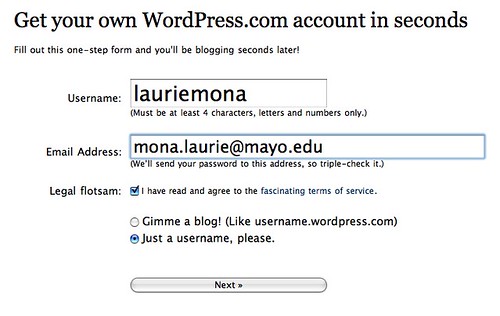
Click the link on the left that says “you can get one in seconds” and you will see a screen like this:


Use your own email address and pick a different username, of course…and if you don’t want a blog of your own, but only want a username, check the boxes as above and then hit the Next button.

Then you will get an email message with a link to click to validate your account (which makes sure you didn’t enter a fake address.) Once you have clicked that link, you will be presented a screen with your wordpress.com password. I would suggest you then log in to wordpress.com and proceed to immediately change the password to something you will remember.

Then you need to send a message to me (or the administrator of whatever other private WordPress.com blog you’re wanting to join), asking to be added.

If you’re one of the chosen blog members, you’ll get an email back saying you have been added and that you will now enjoy the bliss of blogging.

I hope this visual tour is helpful.

Time-Ly Trend Continues

Time, Inc. is continuing the downsizing trend among the major mainstream media.

In just the last few months:

Gawker media has a good take on this, as does Jeff Jarvis, from his experience having worked at People.

Gawker has an interesting bit of cover art, taking off on Time’s recent Person of the Year:

TechnoratiTechnorati: , , ,

I Dare You!

…to read this book by William Danforth (1870-1956), founder of the Ralston Purina Company, and grandfather of former U.S. Sen. John Danforth. I’ve just had the delight of finishing it after my assistant, Laurie Mona, passed it along to me last week. She had found it quite interesting and challenging, so have I, and I think you will, too.

Mr. Danforth attributed much of his direction and success in life to a challenge from one of his teachers, when he was a sickly young boy: “I dare you to be the healthiest boy in the class.” Through this experience he learned the power of a dare to create courage and single-minded focus, to get people out of their ruts. As he summarizes it:

My practical experience has convinced me that inner growth and broadening personality come from daring and sharing. You dare to use the talents you have. You find yourself growing stronger — physically, mentally, socially and spiritually. You multiply your daring a hundredfold by sharing its fruits. You give your life away and, behold! a richer life comes back to you. This principle works through all of life:

Our most valuable possessions are those which can be shared without lessening: those which, when shared, multiply. Our least valuable possessions are those which when divided are diminished.

So, in keeping with that philosophy, I’m sharing a bit with you, as Laurie did with me.
Danforth dares the reader to adventure and action, starting with his four-square checkerboard philosophy of a balanced life (which explains the checkerboard motif on all those Purina dog-food bags.) The four sides of his checker are the physical, mental, social and spiritual, and he says when they are out of proportion we cannot become our best. And so he dares us to grow in each of these dimensions.

Here’s just one example — from “I DARE YOU TO THINK CREATIVELY” — that highlights what is compelling about this book, which was written in 1931, in the early years of the Great Depression:

 The Edisons and the Marconis were the long range thinkers of yesterday. Wanted–some long range thinkers today. Where yesterday a hundred new inventions were made, a thousand new ones will be made tomorrow and some of you who read this message will dare to make them. I read an article not long ago where sombody prophesied conditions twenty years from now. Our homes would be artificially cooled in the summer just as they are artificially heated in the winter. Transportation will be just as different from today as today is from the gay ’90’s. People will dress differently, think differently, live differently. Are you leaders going to sit back and wait for yourselves to be adapted to these conditions? Or are you going to be one of those who help bring about these changes?

How amazed would Mr. Danforth be if he had lived to see today? As one who dreamed of air conditioning, how would he react to video cameras, DVDs, cell phones, PDAs and the internet? One thing I can confidently predict: he would issue the same challenge, but updated for our time. “Who will be the next Gates or Jobs? Who will develop the next Google?”

You’ll also find his language somewhat dated, hopefully in an amusing sort of way. In addition to his admonition to walk a mile a day in the fresh air, he advises daily calisthenics to “squeeze that liver.” But until you’ve had the success of a Danforth, it’s probably best not to laugh too quickly, but instead see what you can learn from him.

In I Dare You! you’ll also find some nuggets of practical wisdom I’ve noted in more contemporary books. Like David Allen in Getting Things Done, Danforth advises continually carrying a small notebook to capture creative ideas, even keeping one by his nightstand. Like Jim Collins in Good to Great, he extols the value of a “Magnificant Obsession” – or what Collins calls a Big Hairy Audacious Goal.

You can get the book on Amazon, or from the foundation established by Mr. Danforth.

I Dare You!

TechnoratiTechnorati: , , ,

A Septuagenarian Blogger

The Washington Post has an article about hotel CEO J.W. “Bill” Marriott and his new blog.

Right now, his is the only Marriott blog, and he dictates his posts into a tape recorder for transcribing. But it’s pretty clearly not just PR spin; you can also listen to the audio version, and these are his thoughts and reflections that are being converted to text.

So if a blog with video is called a vlog, what’s a blog with audio? An alog?

It will be interesting to see where they take this, and whether other employees such as hotel managers start blogging.

They seem to have thought through some of the implications of having a public blog, as indicated in their terms of use when you add a comment. Comments are moderated, and they say that just as they would ask someone to leave if they were shouting at the top of his lungs in their hotel lobby, they are going to expect decorum in the blog.

TechnoratiTechnorati: , ,