Rich Media Marketing

Notes on Rich Media Marketing from the Frost & Sullivan session moderated by Chris Young of Doubleclick, which was entitled “Brand Building: Engaging Your Target Audience with Rich Media and Video.” Kyoo Kim from MSNBC ad sales, Barbara Cerf from New York Life, and Craig Oldham of Allstate Insurance were the panelists.

Two different formats typically used include pre-roll ads and “in banner,” an ad within a page. Barbara is testing on-page ads because she finds pre-roll irritating. Kyoo mentioned heavy.com, which gave him his “aha!” moment, when he saw that it is possible to create rich media flash players instead of annoying users with the pre-roll. Craig uses :15 pre-rolls instead of :30s. He hasn’t seen video ads do better than the “dancing clown” so far, so it’s hard to prove that creating content specifically for online channel advertising is worthwhile. Most pre-roll is currently re-purposed TV :30s.

Kyoo says ads need to be proportional; a :30 in front of a brief YouTube video doesn’t make sense, but the same ad in front of a long-form documentary is a huge value for the customer.
Check out Spotrunner.

Scale (reach and frequency) is harder to get on the web than through TV advertising. On TV, for instance, you can reach several million people at once. There isn’t enough inventory for reach and frequency. Craig doesn’t think reach and frequency matters; what he cares about is how many people in his target audience see the ad, and whether they take action. Reach and frequency is putting an old media paradigm on new media.

For the B2B market, this tonnage really doesn’t matter. As Rick Short said (he’s in the semiconductor market), being on the Today show is irrelevant for his business: there might be three viewers who could possibly buy his product. But he can go to an industry-focused web site and reach 15,000 likely customers, for much less money.

I asked whether the panelists are doing anything to create ads that people actually want to see, instead of the interruptive, intrusive ads that annoy. Chris said DoubleClick is contracted with Digital Broadcasting Group, which produces original webisodes. For example, THQ has a video game called StuntMan coming out soon, and DBG is producing 3-minute episodes of a guy going around doing crazy stunts that THQ is sponsoring and is syndicating around the web.
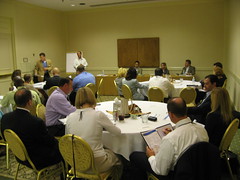
rich media marketing
Jeremiah Owyang asked about whether they have pursued consumers creating advertising (He’s blogging the conference here), and how the marketers are defining and measuring success. Doubleclick is pioneering something with webcams that lets users insert themselves into ads, and forward them to friends.

Craig says Allstate is exploring how to make car insurance something that people would even be interested enough in to want to create user-generated content.

Objectives for Rich Media Marketing could include brand awareness, direct response or, in the case of film marketing, having 8 weeks to create instant brand awareness before opening night.

Measures include click-through rates, percent of video viewed, brand awareness. For entertainment 19.2 seconds of a :30 is viewed; cars are about 21 seconds. Click-through alone isn’t enough, because people who see videos but don’t click through to the site have still seen the branding message.

Kyoo is interested in finding a way to measure “engagement” because he hears a lot about that from ad agencies. Jeremiah says he is developing a formula in the videoblogging space; hopefully he will post it.

Chris says he’s looking at who clicked on the ad, who sent it to a friend, interaction rate, time spent with the ad. For example, they had a Tiger Woods golf putting contest ad that had an 89-second time spent. The Odwalla Ken Jennings spelling contest, which I mentioned earlier here, is another one that likely has a long “time spent” factor.

I really like the panel format that Frost & Sullivan used for this, as compared with the overly interactive brainstorming groups like this one. Certainly there is value in both formats, but I would have liked to hear more from Craig from Facebook yesterday, and the format prevented it. We got to connect after the session, though, which was helpful. The panel format was still really interactive, with lots of good give and take, but we had one group conversation instead of six separate ones.

TechnoratiTechnorati: , , , , , , , , ,

7 Steps to Web Metrics Success

Kristine Kelley from Motorola facilitated this session, entitled “Metrics Framework for the Web and Interactive Marketing: How to Successfully Build/Deploy/Execute”

The goals for our session were to develop:

  1. An approach to determine key metrics and KPIs
  2. A process to define, capture and manage metrics taxonomy and reporting
  3. A governance model to support metrics framework

While others are B to B or B to C, we at Mayo Clinic are B to P (Patients), so that’s kind of a blend between the two. Kristine is concerned with measuring both B to C (buy that cell phone now) and B to B (with longer sales cycles, which make it harder to get the direct ROI from the web site.)

Here’s a synthesis of all of the breakout groups (and if I left important things out, please chime in:)

  1. Identify “Owner” of the project and what they want to accomplish.
  2. Begin with the end in mind. Define success and identify the steps involved in getting to the successful end.
  3. Identify Stakeholders within the company and an ambassador for each stakeholder group.
  4. Identify the universe of what could be measured (likely through a survey of each stakeholder group). Also define each measure so all stakeholders understand what each measure means and does not mean so they can judge relevance.
  5. Map the possible indications against the strategic goals and determine which ones are critical success factors. How meaningful is each particular measure in contributing to the overall goal.
  6. Measure against current sales and web data and benchmark against competitors.
  7. Establish a governance board for the measurement project that reports back up through the organization’s leadership to ensure that the data are collected and that the initiative has staying power.

John Kendig from VWR International also schooled me a bit on the high-level performance indicators for web marketing sites:

Clicks – how many people visit your site
Conversion – How many people buy something
Spend – How much do they spend

Typically, increasing any of those three factors leads to stronger sales, so you want to look for metrics related to these three categories if you are in the BtoC web marketing world.

As someone who spends most of my time in media relations and new media, this discussion was very helpful to me. Thanks to Kristine for facilitating!

TechnoratiTechnorati: , , , ,

Wikinomics Book Review

wikinomics book review
Wikinomics: How Mass Collaboration Changes Everything, by Don Tapscott and Anthony D. Williams, provides an excellent overview of the technologies and trends that are so disruptive in the Web 2.0 world. While traveling today to the Frost & Sullivan Sales & Marketing East Executive MindXChange, I had the opportunity to listen to the first couple of chapters of the Audible.com unabridged audiobook version of Wikinomics.

I had previously listened to the whole book on one weekend when I had lots of yard work to do. The upside of audiobooks is you can listen to them while you’re doing something else. The downside is it’s hard to take notes when you’re holding a power washer, so it takes a second listen to get maximum benefit. But at least you know where the highlights are.

Let me share a few.

The Wikinomics authors, who also maintain a companion blog and wiki, see four great trends shaping the 21st century landscape:

Openness – As exemplified by Rob McEwen, the CEO of the gold mining company Goldcorp, who made his company’s geologic data available to the world to get bright people from outside his company to help find more gold deposits on company property. By providing the data and $575,000 in prize money, he enlisted more than 1,000 virtual prospectors, who helped find targets that yielded 8 million ounces of gold, turning his company from a $100 million business to $9 billion concern.

Peer production, or Peering – Getting masses of individuals to collaborate openly, as exemplified by Wikipedia. The Apache server and the Linux operating system are among the other varied examples of peer production the authors cite.

Frankly, Tapscott and Williams are too deferential to laments from Bill Gates and others that peer production eliminates the profit-making opportunity for businesses and other purveyors of intellectual property. The answer to that (and the authors should have been stronger about this) is: SO WHAT? (Please forgive my shouting.) There may be economic disruptions and dislocations if open-source software like Linux or Apache displaces proprietary software like Windows, but people like Gates with entrenched interests forget that the ability to make money isn’t a divinely ordained right or the ultimate societal good. What matters to users of software or services is the cost of a product or service and its value.

Businesses exist for their customers, not vice versa. If someone (or an organized group of volunteers, as in Wikipedia) provides a service for free that was previously expensive, that’s a good thing. People can then spend their money to buy other services, so they get the formerly expensive product plus something else, as the societal bonus of Wikinomics.

When the Berlin Wall fell, political leaders and journalists talked about the “Peace Dividend“: if we as a society didn’t have to spend as much money on defense, we could spend it on other good things.

The same is true today. For example, craigslist is a great service for its users, enabling them to place free classified ads (in many communities) for everything from rentals to job postings to personals to items for sale, such as theatre tickets. It’s terribly disruptive for newspapers, which formerly milked the cash cow of classified advertising.

Does it hurt newspapers? Certainly. Is that a problem? If you own or work for a newspaper. Will western civilization crumble because of it? Hardly. Instead of paying several thousand dollars for a job posting classified ad in the newspaper, companies can post to Monster.com for a few hundred dollars, or craigslist for free. The companies can then invest the savings in other areas important to their growth.

That’s the “Wikinomics Dividend.”

The other two trends the authors examine are Sharing and Acting Globally. But instead of discussing them in a post that’s already too long, let me suggest that you get the book yourself.

The key value of Wikinomics is in providing broad trend overviews. The examples used, from Flickr to YouTube to MySpace aren’t the main point. Future competitors may one day render these irrelevant, too.

If you’re looking for the latest new thing, Wikinomics isn’t the place to find it; it is, after all, an old-media tree-killing production. But Wikinomics does give the theoretical framework upon which to build your understanding of changes in today’s economy.

Avoiding Irrelevance

Jeremiah’s Web Strategy blog has a great post about evolving your irrelevant corporate website.

Here’s a taste of his view of the future:

Websites are created with customers
This is disruptive, but I predict that the most relevant future websites will have customers building websites alongside employees. The most effective websites will contain a balanced point of view of both the product team and customers –even if they have qualms with the product.

Unfiltered customer testimonials will appear
You’ll no longer only be the only one publishing to your website, customers, prospects, and other members of the community will have direct access to publish on your website. Sure, there will be controls to make sure the content is somewhat factual or reviewed, but it will be obvious to many that the only voice won’t be the marketing one.

Content will have both negative and positive views about your products
This one is hard to swallow, but how do you build the most trust? By being open, authentic, and transparent to the marketplace. We know from research that the highest degree of trust comes from those ‘like me’, a savvy marketer will allow content to appear from peers, customers, and the market. These will not always be a product rave, in fact it may be downright criticism, the goal? To take that feedback, and demonstrate in public how you will improve your offerings in plain view. Case study: Dell has done this with IdeaStorm.

Check out the rest here. It’s certainly thought-provoking. Some organizations have high levels of trust. I think what Jeremiah is advocating will be keys to building and maintaining that good will with the public in the long term.

TechnoratiTechnorati: , ,

These columns must be mixed up

That’s what I thought at first when I logged on to my Wells Fargo on-line brokerage account today and saw $27.39 as the increase for the day for my aQuantive (AQNT) stock.

“That must be the stock price, not the increase,” I said to myself. “It’s been trading in the 30s. A $27 increase can’t be right.”

picture-1a.jpg
Then I read the daily news and found out Microsoft had agreed to purchase aQuantive for $66.50 a share, an 85 percent premium over the previous day’s close. It’s all over the blogs, too: here, and here, and here, and here.
Good for my IRA.

It just goes to show what a BIG deal on-line advertising will be. With Google having announced a deal for DoubleClick, Microsoft needed to buy a seat at the advertising table.

I first bought AQNT stock (but unfortunately only 100 shares) because of trends I had been following in media and advertising. Spending on TV ads is huge, but audiences are getting smaller and people are skipping the commercials. But so far there hasn’t been anywhere near enough on-line ad inventory for current TV advertisers to buy. So I figured companies like aQuantive would have a great long-term opportunity for growth as they figured out how to create advertising opportunities.
In this investment, I was partially taking advice from two money people I respect, and partially going against both. Phil Town in his Rule #1 Investing suggests purchasing single stocks in industries you follow and understand. That I did. This is an area I work in and blog about.
Town says, however, you should look for companies with long track records of earnings, but which are currently trading at a significant discount to projected future earnings. That wasn’t true for AQNT, but the long-term market upside looked too good to wait until this stock got cheap by his standards.
My real financial hero, Dave Ramsey, the get-out-of-debt guru, says you shouldn’t buy single stocks, but instead should invest in mutual funds with a long track record. He rightly points out the examples of Enron and others, in which employees who had all their retirement eggs in the company stock found themselves financially ruined.

So because I like the Town tactic and the Ramsey rule, I just try to, in essence, create my own mutual fund by limiting each individual stock to no more than 10 percent of my IRA. That meant I had to sell Apple because it had gone up enough that it was too big of a part of my portfolio.

Yes, I’ve had my share of losers, too. Nortel hasn’t been great (and that was one that did have accounting problems that whacked the stock.) And then there was the STUPID Tax I paid by falling for a “hot tip” on Pangea Petroleum (PAPO). But because they were small percentages of my account, they were just aggravating, not devastating.

aQuantive isn’t a Peter Lynch 10-bagger for me (although if you had bought it five years ago, it would have been), but having it go up 130 percent in six months, and 78 percent in a day, makes up for some mistakes.

TechnoratiTechnorati: , , , ,