Studying a Rare Disease with Dr. Tweet

In the last few months I have had an exciting opportunity to be part of a Mayo Clinic project using social networking tools to assist in the study of a rare disease, and last week we reached a milestone with publication of a study in Mayo Clinic Proceedings.

One of our key team members is Dr. Marysia Tweet, so it’s almost poetic that we’re working with Dr. Tweet to use social media in medical research. You can’t make that up!

At any rate, the paper on our pilot study of SCAD (spontaneous coronary artery dissection) is published this month in Mayo Clinic Proceedings, as reported in the Wall Street Journal and described in this Mayo Clinic news release.

The really exciting part of this story is how the research was initiated by patients, and this Mayo Clinic Medical Edge story tells how it happened:

We’re continuing to use our social media tools to help with the ongoing research into SCAD, as the Mayo Clinic research team led by Dr. Sharonne Hayes is creating a virtual registry to study SCAD. This SCAD research post on our News Blog provides the information physicians and patients need to take the first steps to be included in the study.

The pilot study showed that this kind of virtual registry is feasible; 18 women signed up for the pilot within a week, and the initial 12-person study included participants from New Zealand, the United Kingdom and Canada as well as the United States. Dr. Hayes discusses the rationale for and the implications of the study:

Finally, here are some additional sound bites about the pilot study and its implications, from Dr. Hayes, Dr. Tweet and yours truly:

Our Mayo Clinic Center for Social Media mission is to go beyond the public relations and marketing uses for social media and find ways to apply these revolutionary tools in education, research, clinical practice and in the administration of health care organizations. I was really excited to have the chance to be involved in this first publication, and that we are having an ongoing role in facilitating this patient-initiated research into a rare disease.
Should states ban student-teacher interactions on Facebook?

Yesterday’s Washington Post had an editorial about a misguided trend among state legislatures to ban communication between students and teachers through sites like Facebook and Twitter:

However, in some places, new laws and proposed measures are impeding teacher communication with students outside of school-sanctioned e-mail systems. The most recent practitioner of educational technophobia is Missouri, which last month adopted legislation intended to ban direct communication between teachers and students via Facebook.

The law is so broad it could effectively also bar student-teacher contact via Gmail or other non-school e-mail services. “No teacher shall establish, maintain, or use a nonwork-related Internet site which allows exclusive access with a current or former student,” the law reads.

The Post editorial board makes a good case against laws like this. I agree that these laws seem overly broad. I think are they well-intentioned as ways to prevent inappropriate relationships between students and teachers, but that banning Facebook messages is overkill. Facebook is just another means of communication, a platform more than 10 percent of the people in the world use.

Banning Facebook interactions seems analogous to prohibiting telephone contact between students and teachers. A private Facebook message can be sent even between users who don’t have a friend relationship, just as telephone conversations can happen between anyone via cell or land line. Should there be laws against phone calls too?

What do you think about these laws banning Facebook messaging in the schools?


7 Steps to Using Social Media in Business

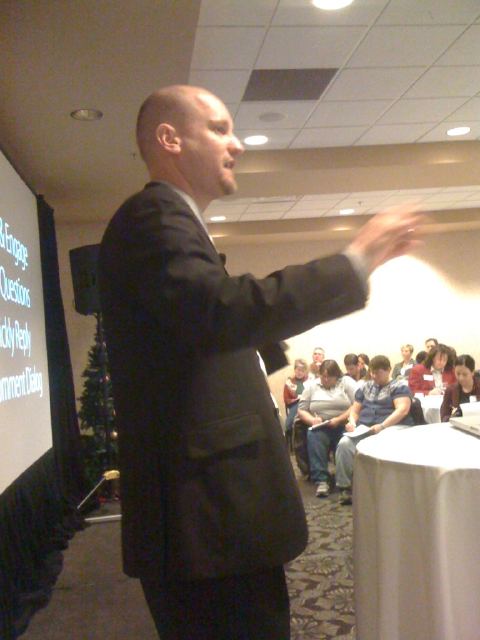
Today I am participating in a Rochester MN Chamber of Commerce event called Facebook for Business. I did a 15-minute intro/overview, and Alan De Keyrel of CWS, Inc. is delivering the keynote, called “7 Steps to Using Social Media in Business.”

Here are Alan’s 7 steps:

1. Develop a social media policy.

2. Educate your Employees.

3. Define your purpose. Alan says there are only 5 basic things businesses can do using social media

– Branding. YouTube is a great vehicle for this, as this Sienna music video demonstrates

– E-commerce

– Research

– Customer retention/service

– Lead generation

4. Understand timing. The “life” of a tweet is about 8 minutes, so you should post updates on Twitter or Facebook at 11 a.m., 3 p.m. and 8 p.m., which are the times when people are active and likely too see your message. The top of the hour also has the most interaction.

5. Create Facebook page.

– Understand the difference between a Page and a Profile. Profiles are for individuals. Pages are for businesses or organizations. Don’t try to make a business presence on a profile. It needs to be a page. Using a profile violates the Facebook terms of service.

– Get creative. Use a large picture. You are limited to width of your picture, but not the height. Design a long, tall graphic.

– Create a custom landing page using FBML. Get the FBML app in Facebook so you can customize, instead of having people just “dumped onto your wall.”

– Adjust permissions to have the default landing page be your custom landing page.

6. Set up processes. Decide who in your company does what, when, where and how. Somebody needs to be responsible.

7. Monitor & Engage. Ask questions. Respond.

How to get more fans?

– Give away something. Set up a contest saying you’ll give away an iPod to a fan once you get to 1000 fans.

– Tag fans in photos.

– Embed widgets or icons on your Website or e-newsletters. Ask people to “join the conversation.”

– Store displays.

– Add it to email signature line. Encourage employees to do likewise.

– Use the @tag. In your status updates, create a link to your page with the @ tag. Use it sparingly. More on this in a future post.

– Use “Apps.” Survey apps, poll apps, promotion apps get people involved in your page. Many have viral components.

– Use “Deals.” This is what users are most interested in getting from you. Individual, Loyalty, Friend or Charity deals, based on what works for you. When people “check in” at your business with their smart phones. When people check in at your business it goes on their wall that they just got a deal at your business. You need to start by claiming your place. Check in at your business using your smart phone. Go to your wall on your computer and execute the claim. You need to show proof, but then that lets you use Deals.

– Merge your Place with your Page. More on that later.

Dealing with four kinds of negative feedback:

Straight problems – Legitimate issues. Always respond.

Constructive Criticism – Suggestions for ways to improve. Thank the person for the ideas.

Merited Attack – Always respond. Don’t take them personally, but acknowledge.

Trolling/Spam – Do not respond. Delete.

Now we’re looking forward to a good discussion with the panel.

American Medical News highlights hospital social media

American Medical News has a nice profile this morning of Dana Lewis, who exemplifies the new role, in an article titled “Hospitals’ new specialist: Social media manager.” The article begins:

For otolaryngologist Douglas Backous, MD, Twitter and blogging were “like speaking a foreign language.” So he went to his hospital and got himself a translator: Dana Lewis, hired by Seattle’s Swedish Medical Center to handle all things social media.

Lewis is part of a trend in a new and growing type of hospital employment: the social media manager.

Technically, she’s called the interactive marketing specialist. But she, and others like her, are being charged by their hospitals to handle such duties as overseeing their social media presence, communicating with patients through social media — and, in many cases, teaching affiliated or employed physicians how to use social media. The idea is that by having a person dedicated to social media, the hospital can use the technology to strengthen its connections with all of what organizations like to call their stakeholders, which include the physicians who refer patients through their doors.

Check out the whole article: Ed Bennett’s Hospital Social Networking List also is featured, as are my 35 Theses here on SMUG. It also has a nice compilation of social media best practices for hospitals, which author Bob Cook apparently synthesized from several guidelines documents.

Here’s more information on what we’re doing at Mayo Clinic, with our new Center for Social Media. I’m excited that we’ve hired candidates for four of the eight new positions with the Center, and that we have interviews this week and next for two more. I’m also honored that both Ed and Dana are on our advisory board (with 12 more members still to be named). We’re going through about 120 applications from some really strong candidates to ensure broad-based and diverse membership.

When the official online publication of the American Medical Association devotes an extensive article to the topic of social media staffing for hospitals, that’s a good sign the activity is going mainstream. We’re glad to contributing to that through the Mayo Clinic Center for Social Media and the Social Media Health Network.

From the Good Morning America Archive: Octogenarian Idols

I was asked earlier this week for a link to the video segment for Marlow and Frances Cowan” live in-studio appearance on Good Morning America, so I thought I would just embed it here:

See this post from last year for the story about how this came to be.