Meet George Jetson!

The Jetsons was one of my favorite non-Looney Tunes cartoons from my youth. Flying cars and the 15-hour workweek were highlights for me of the Hanna-Barbera vision of the world of 2062.

Obviously those predictions haven’t come to fruition yet (at least for me), but one that has become reality in a big way is the video phone. Remember how George used to talk to Jane face-to-face from his office through a video screen? And how Mr. Spacely would always seem to appear on the video screen at inopportune times?

My wife Lisa and I played Jetsons a couple of nights ago with our daughter, Rachel, and granddaughter, Evelyn. They live about 500 miles away from us, in Grand Rapids, Michigan. Here was their first experience with Skype:


In the 1960s — when many long-distance phone calls were operator assisted and the per-minute charges for a simple voice call were exorbitant and only the big three television networks and their affiliates had video cameras — the idea of being able to talk by video across the miles was as outlandish as levitating cars seem to us today.

Which brings me back to the subject of my post about whether Facebook, YouTube and Twitter are free. If you had told anyone in 1962 (when The Jetsons ran in prime time), that they would be able to do what Lisa, Rachel, Evie and I did Tuesday night (along with our cat, Zeke), they would have shaken their heads in disbelief. 

Most probably would have doubted it even in 1992, or would have thought the cost of such a service would be exorbitant. Remember AOL, Prodigy and similar services that set time limits on Web access?

But like YouTube, Facebook and Twitter, Skype is FREE! Yes, you need a computer with a webcam to take advantage of it (and a MacBook with built-in iSight is a great choice), but for computer-to-computer voice calls or videoconferencing, there are no charges with Skype. 

If you’re reading this, you already have access to a computer. You may even have a webcam, but if not you can get one for about the cost of a cheap DVD player (another technology that’s becoming ridiculously inexpensive.)

Here is the key question to ask yourself (and doubters in your organization): If our competitors are paying nothing to communicate more effectively with their customers (and ours) by using this technology with the staff they already have, wouldn’t our failure to take advantage of these tools be a significant competitive disadvantage for us?

For some great reading on why all these tools are being made available for FREE, check out this article in Wired by Chris Anderson. It’s also the subject of his new book, to be released next month. I’ll be reviewing it here soon after it comes out.

Meanwhile, if you want to give Skype a try, download it and I would be happy to be your first videoconference conversation partner. Just tweet me (@LeeAase) and be sure you’re following me on Twitter, and we can connect via direct message to set a time for a face-to-face talk on Skype.
Are Facebook, YouTube and Twitter Really Free?

Some Tweeters have taken issue with a slide I typically include in most of my presentations. It says:

Total cost for Mayo Clinic YouTube, Facebook and Twitter:

$0.00

They protest that it’s inaccurate, maybe even misleading to say “total cost” and that it should instead say “Barrier to Entry” or “Cost to Start.” “What about the staff needed to run these sites?” they ask.

I will grant that these platforms don’t automatically maintain themselves, but I’m not changing the wording or conceding the point. I believe that in the way most people would have understood the phrase for at least the last century, these tools are FREE.

And this little video explains why:

  • YouTube is a FREE television station that lets you broadcast to the world.
  • A Facebook “fan” page is (at least) a FREE multimedia “white pages” listing for your business.
  • Twitter is a FREE incoming/outgoing communication channel, like the toll-free phone service discussed above.

But unlike the fictional AT&T and Pitney Bowes examples I described in the video, these are 100 percent real, bona fide offers. They are better ways for your existing staff to communicate, with each other or with your customers or other key constituents.

So ask not how you’re going to afford to hire staff to use these tools. Ask how these powerful tools can make your staff more productive!

For answers, look in the advanced courses in the Facebook, Twitter and Blogging curriculum listings.

Rochester Area Quality Council Presentation

Here is the presentation I’m delivering this morning to the Rochester Area Quality Council, a local affiliate of the Minnesota Council for Quality.

I look forward to a great discussion, as I understand the registration for the session (and therefore the interest in the topic) is strong. I will be tweeting about it using the #raqc hashtag. I invite you to follow the discussion there (although I’m not sure how much live-tweeting there will be), or share your comments and questions below.

My presentation is from 7:50 to 9 a.m. CDT, so your related tweets during that time would help to demonstrate the power of social media.

Viral Video Case Study: Mayo Clinic’s “Octogenarian Idols”

This is not a post about “How I created a viral video and you can, too.” It’s simply a story that I think you will find interesting, and from which you can learn. Your mileage will vary, but there are some worthwhile lessons for anyone interested in using social media from a business perspective.

At Mayo Clinic, we have been actively exploring and adoption social media tools. We did our first podcasts in September 2005. We set up a Facebook fan page in November 2007 and our Twitter account in April 2008. We’ve been actively uploading to our YouTube channel for a bit over a year, and have developed several blogs over the last 18 months or so.

We took a major step in January by establishing Sharing Mayo Clinic, our culture blog. This gave us a place to publish feature stories that don’t fit in our news blog or podcast blog.

With that as background, here’s our first viral video story:

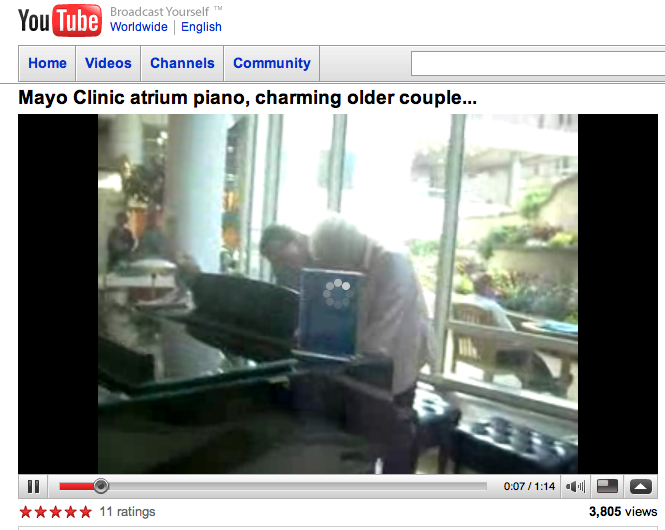
On April 7, 2009 I got an email (a few of them actually) alerting me to a charming video featuring Marlow and Frances Cowan, an elderly couple from Ankeny, Iowa. The Cowans had been recorded doing a piano routine in the atrium of our Gonda building in Rochester. I thought it was fantastic, so I decided to embed it in Sharing Mayo Clinic. As of that time, the video had been seen 1,005 times since being uploaded in September 2008. By the next day, it was up to 3,805 views (click to enlarge)…

April 8
April 8

…and a week later it was at 26,973.

Continue reading “Viral Video Case Study: Mayo Clinic’s “Octogenarian Idols””

Chancellor Commendation

I took a half day of vacation yesterday to do a presentation on use of social media tools in election administration for a conference sponsored by the University of Minnesota’s Humphrey Institute. Given my early career background in politics and government, it was a fun opportunity to stretch my basic presentation a bit beyond health care and general social media training.

I was really pleased with the response, and the Q&A period was great. I was introduced to one barrier to social media use that was new to me, though, in that some of the city and county officials present are concerned that using Facebook or YouTube in an official capacity will put them in violation of data practices regulations. State laws require government bodies to archive data for potential legal discovery, for example, and the concern is that a local jurisdiction can’t compel Facebook to maintain data practices in keeping with state law. I plan to devote a full post to this later.

But first, I wanted to share a testimonial from Pat, one of the conference participants. She came up to me after the presentation and was particularly enthusiastic about what she had learned. Kind of made me blush. But since I had my Flip along (as Karl Malden used to say about American Express: “Don’t leave home without it”), I asked if she would be willing to share her reactions on video.

I’m experimenting with the Flip HD camera (instead of standard definition) and how to best encode video to display on various platforms, so I’m going to upload this to the SMUG group in Facebook, too. If any other SMUGgles would want to upload a video to that group, or leave a comment here or on the SMUG wall, about your experiences in social media or your reactions to what you’ve learned through our University, it would be mose welcome.

My grandma would have called this fishing for compliments. Andy Sernovitz would call it word-of-mouth marketing.