Find Filling Favorites

Most of what Tim Ferriss recommended in his Slow-Carb diet aligns with what Lisa and I have found to be effective for weight loss and health.

I no longer eat beans daily as he suggests, and we don’t do the cheat days every week either. We have occasional pizza nights, perhaps twice a month, and we enjoy holiday meals to the fullest without guilt or regret.

One Ferris tip I’ve continued to follow to this day, however, was his suggestion to “Eat the same few meals over and over again.”

What that really means from my perspective is that I need to identify some go-to meals I can make at any time, and which I know will be satisfying.

Doing that has an extra benefit of making it a lot easier to skip meals and move toward intermittent fasting, #BodyBabyStep Four.

And because I don’t have to overthink my meal choices, I’m not spending time focused on thinking about food. That reduces temptation. I can just pick one of my standbys and know I will be satisfied.

Here are some of my favorites.

Top Choice: Scrambled Eggs
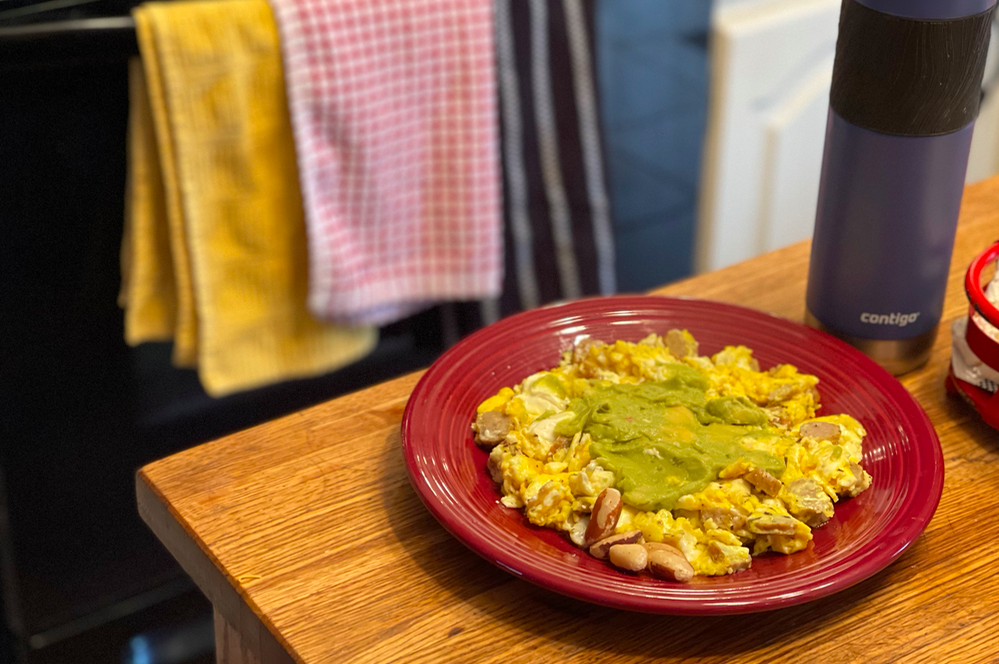
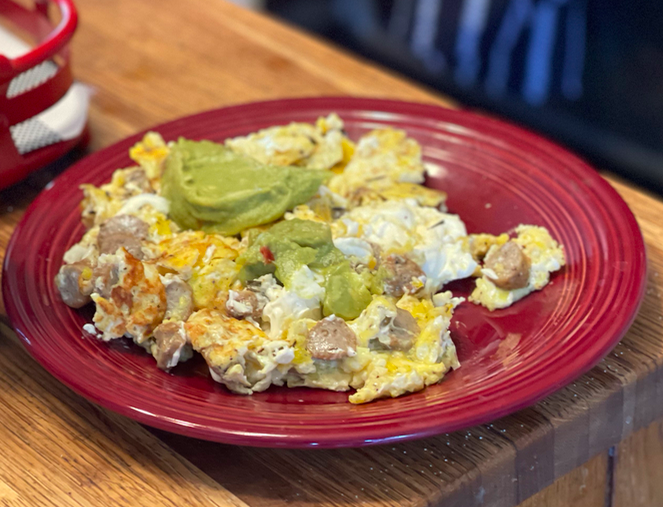
I probably have this at least five times a week. My concoction typically includes four eggs and some kind of meat (bacon, diced ham, sausage or steak) cooked in grass-fed butter or bacon grease. I usually add guacamole and a few Brazil nuts, and lately have been including cream cheese, too.

Last week for the first time I decided to count the macronutrients in this hearty meal. My estimate: 133g fat, 37g protein and 16g of carbs, but with 4g fiber that brings net carbs to 12. Total calories: 1,393, with 86% from fat, 11% protein and 3% carbs. Clearly ketogenic.

That may seem like a lot of calories in one meal, but because it is so filling it can often be my only meal of the day, and with almost no carbs I don’t get blood sugar spikes or crashes, and hence have no cravings.

Grilled Steaks or Bunless Burgers

Having a mini-Weber charcoal grill enables me to have delicious steaks year-round, even in December or January. Just add a few more coals to make up for the frigid outdoor air.
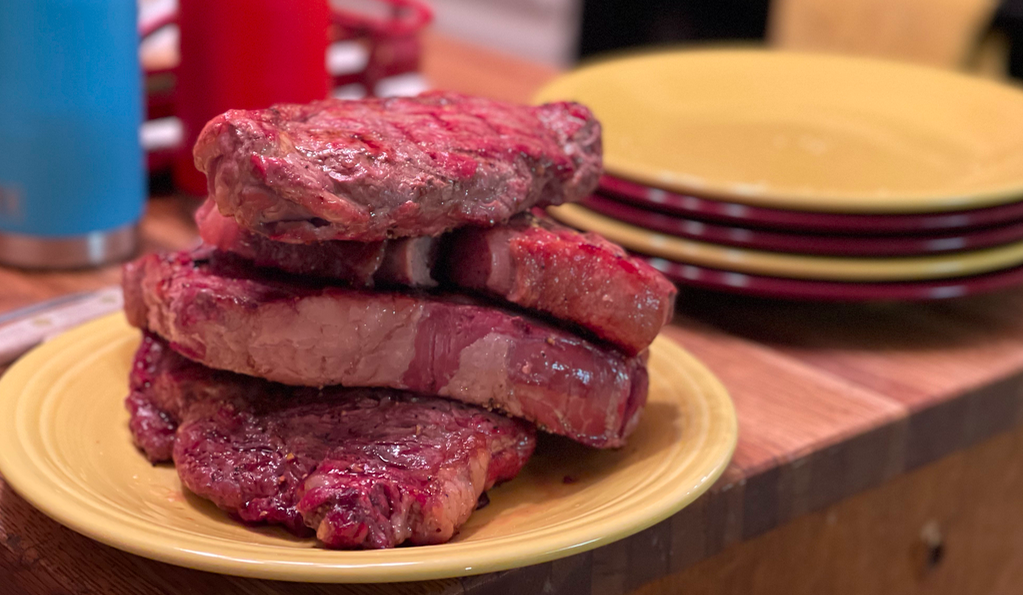
This whole stack wasn’t for me. We had company.

I have come to appreciate fattier cuts like ribeye, and whereas I previously would have trimmed off the fat thinking it was a healthy choice, now I do my best to eat the whole thing. Fat is our friend.

I typically grill an extra steak and then save it in the refrigerator, cutting it up to put in my eggs for the next two or three days.

For a lower-cost option, I grill four burgers with bacon and cheese, and eat two of them without a bun. I save the others to warm up for the next day’s meal, and that has the added benefit of reducing my thinking about food.

When I have steak or burgers I’ll often accompany with frozen broccoli warmed in the microwave, with grass-fed Kerrygold butter melted over it.

Beef Stroganoff
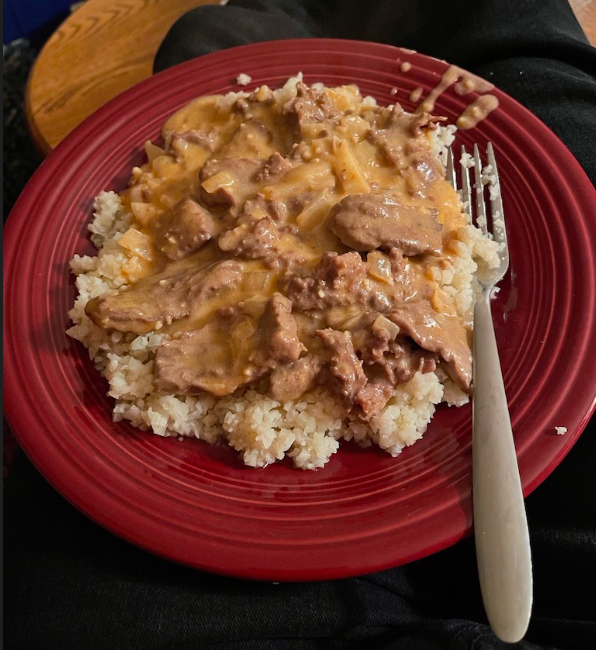
For this one I’m kind of at Lisa’s mercy, although I guess I could learn to make it. It’s my youngest son’s favorite, so she typically makes it when he’s home.

With regular rice it’s high in carbs, but riced cauliflower has a consistency I’ve come to find acceptable at least, and that keeps it ketogenic.

Other Favorites

Lisa has found these low-carb recipes and occasionally whips up a double batch that lasts us a few days. If she’s only cooking every two or three days that makes it easier for her as well, not having to be thinking about food constantly.

Being an empty-nester has its advantages!

  • Salmon Chowder
  • Chicken Curry Salad (leaving out the raisins)
  • Baked granola made from with pecans, almonds, unsweetened coconut and raw pumpkin seeds. It’s seriously addictive.
  • Meaty chili with cheese and sour cream
  • Baked cheese crisps

Every week Lisa typically tries one new recipe (often from The Everyday Ketogenic Kitchen) and if we like it she adds it to our rotation.

Filling and Tasty Dessert

As part of our last meal of the day, we’ll typically have our awesome more-than-full-fat yogurt and berries. I’m in charge of making that.

I usually have raspberries or blackberries, while Lisa prefers blueberries.

Along with the yogurt, I often have smoked string cheese and a small 85% cacao dark chocolate bar.

Lisa never has more than two meals in a day, and I rarely do.

Often we just have one, in the mid to late afternoon. My teleworking due to COVID-19 has given us more flexibility in mealtimes, enabling us to have a narrower eating window and more prolonged periods with low insulin levels.

Making it Work for You

You need to find what’s appealing to you, and that is relatively low in carbs and high in good fat. And by good fats I mean saturated and monounsaturated fats from animals, avocados, nuts and olive oil, not so-called vegetable oils, the polyunsaturated fats.

What hearty and healthy meals are your favorites? Tell us about them in the comments!

If you think your friends might find this post helpful, I hope you’ll share by email or on your social networks using the buttons below.

To get these updates on a regular basis you can subscribe by email, or follow me on FacebookTwitter and LinkedIn, where I’ll also be posting links.

Check out My Health Journey for our full story, and my #BodyBabySteps for tips on getting started on your own health-improvement journey.
Dr. David Unwin on Cutting Carbs

Most people readily agree, whatever their dietary predispositions or convictions, that reducing sugar intake is an important first step toward sustainable weight loss.

What many fail to appreciate is that carbohydrates — especially starches — are essentially long strings of sugars joined together. And when your body digests them, chopping them apart, that can raise your blood glucose level as much as a sugar-sweetened beverage.

That’s one of the points Dr. David Unwin, one of my Health Sherpas, makes in this tweet:

In the video below he is addressing the Royal College of General Practitioners in London at their 2018 Public Health Collaboration Conference.

He describes:

  • how he had seen the number of patients with diabetes in his practice increase by more than 1,000% since the 1980s,
  • how through a low-carb diet about 50% of his patients with diabetes were able to get it into remission without the use of drugs,
  • how Norwood Surgery went from the poorest quality ratings for diabetes management in his region of the NHS to the best in just five years,
  • how Norwood spends the least on diabetes medications of any practice in his region, and
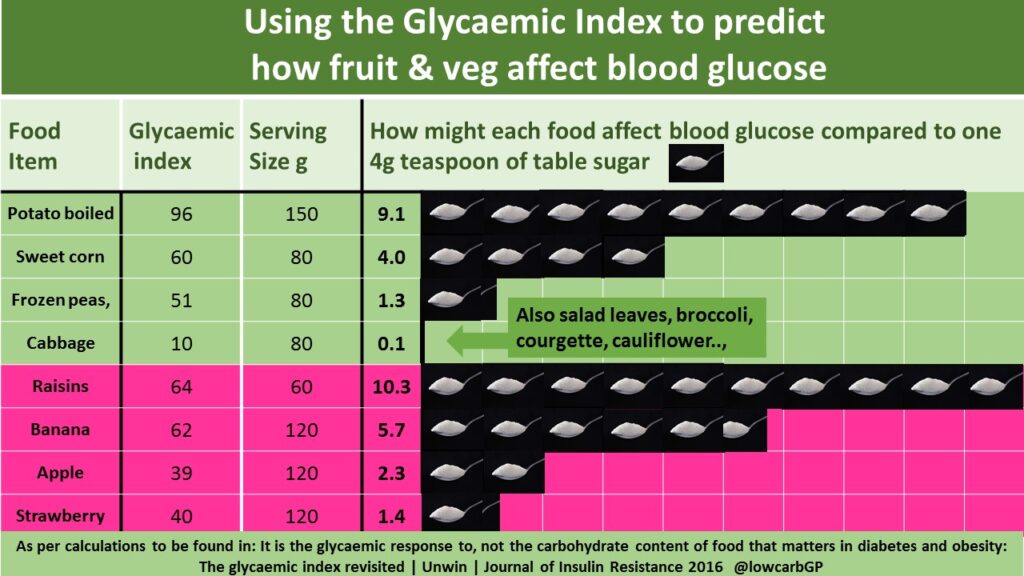
  • Why bananas are so terrible.

That last point comes from this innovative infographic Dr. Unwin has developed to represent various types of carbohydrates in terms of teaspoons of sugar equivalents.

See all of the carb categories converted to sugar teaspoon equivalents.

Dr. Unwin also describes how his patients’ diets, which because they are low-carb are necessarily higher in fat, also have led to

  • lower blood pressure and triglycerides,
  • higher HDL (good) cholesterol
  • improved liver function
  • average weight loss of 9.7 kg (21.3 lbs.) over an average of 26 months.

And according to a heart disease risk calculator from the Joint British Societies for the prevention of Cardiovascular Disease, they also saw a reduction of 12 years of “heart age.”

One of the main fears many have related to a low-carb, high-fat diet is that they will raise their “cardiovascular risk.” If that’s a concern for you, I hope you’ll make time to watch this video.

Dr. Unwin says that in 25 years of practice he had never seen a patient with type 2 diabetes go into remission.

Not even once.

In the last five years, using a low-carb diet, about half have achieved remission.

These are truly remarkable results, but Dr. Unwin is not alone in achieving them. In future posts I’ll introduce you to some of his low-carb co-belligerents.

If you think your friends might find this post helpful, I hope you’ll share by email or on your social networks using the buttons below.

To get these updates on a regular basis you can subscribe by email, or follow me on FacebookTwitter and LinkedIn, where I’ll also be posting links.

Check out My Health Journey and my #BodyBabySteps.

Blow up the U.S. dietary guidelines

Lest anyone get the wrong idea, I’m not advocating any kind of violence or destruction. I’m being metaphorical.

But news released yesterday by the National Center for Health Statistics raises serious questions about the devastation wrought by U.S. food and nutrition policy since the 1970s:

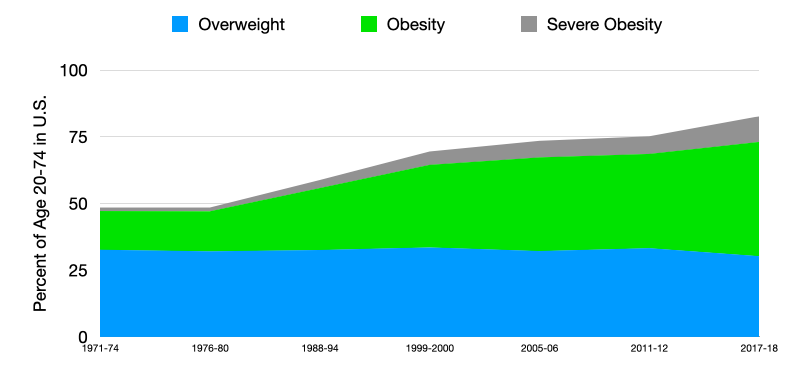
Results from the 2017–2018 National Health and Nutrition Examination Survey (NHANES), using measured heights and weights, indicate that an estimated 42.5% of U.S. adults aged 20 and over have obesity, including 9.0% with severe obesity, and another 31.1% are overweight. Body mass index (BMI), expressed as weight in kilograms divided by height in meters squared (kg/m2), is used commonly to classify overweight (BMI 25.0–29.9), obesity (BMI at or above 30.0), and severe obesity (BMI at or above 40.0).

I would encourage you to read the report for yourself on the CDC website, but to show just how completely the U.S. dietary guidelines have failed, I put the figures from Table 1 of the report into a graphic:

Since the early 1970s the proportion of the adult population that was overweight has held relatively flat, declining about 3% in five decades.

Meanwhile, the percentage who have BMI>30 has more than tripled!

As they say on Twitter, “Let that sink in.”

Four years ago I was among those with obesity, with a BMI of 30.1. And it’s only by doing the opposite of what the U.S. dietary guidelines recommend that I’ve lost 65 pounds and today have a BMI of 23.1, squarely in the healthy range.

When more than 80% of Americans are overweight and over half are some variety of obese, it’s pretty clear we have a systemic problem.

It’s not just a few people who lack willpower to drop the fork and start exercising.

As one of my Health Sherpas put it:

And yet the commission that sets U.S. dietary guidelines again refused earlier this year to even consider a truly low-carbohydrate option among its recommendations.

I believe the biggest reason behind the tripling of obesity in five decades is wrong-headed dietary advice from so-called “experts.”

It was well-intentioned, but still wrong.

They’ve told us we should eat lots of “healthy whole grains” and should avoid “artery-clogging” saturated fats, and that all we need to do to lose weight is to “eat less and move more.”

Do they really think that 80% of us have been completely disregarding their advice?

No way. Consumption of red meat and saturated fat has declined since the 1970s. A lot. The reality is all of our federal food and nutrition programs have been built on a high-carbohydrate, low-fat foundation.

Doctors have had their licenses to practice threatened for their advocacy of low-carb, high-fat diets.

And beyond that, they have good reason to fear that if they recommend a high-fat diet and one of their patients has a heart attack, they could be sued for malpractice.

Thankfully, there is a grassroots movement for a low-carb lifestyle which has helped many escape the obesity trap, and I’m grateful for the pioneering physicians, scientists and journalists who have taken the personal risks to research and advocate for it.

My series on the #BodyBabySteps is my way of contributing to this movement. It’s intended for people who are in a situation similar to what Lisa and I were in four years ago: seriously overweight and without a clear idea of what it would take to make a change.

Or whether it was even possible for us.

Through the #BodyBabySteps I’m trying to boil down what we’ve learned to its practical essence: What concrete things do you need to do to succeed in losing weight, reversing metabolic syndrome and reclaiming your health? How can you get there as easily as possible?

The NHANES report released yesterday suggests there’s an 80% chance you could benefit from following along on this journey. You can subscribe by email, or follow me on FacebookTwitter and LinkedIn, where I’ll also be posting links.

The chance you know someone struggling with overweight, obesity or extreme obesity is 100%, so please share this post on your social networking sites using the buttons below.

But isn’t saturated fat dangerous?

It’s understandable you might think dietary cholesterol is bad for you, or that eating too much saturated fat will increase your risk of heart disease or early death.

After all, for about five decades that’s what we’ve been told by governmental bodies and nutritional panels.

So when I suggest that one of the most important keys to a healthy diet, #BodyBabyStep Two, is “Seek Satiety in Filling Fats,” it’s understandable that you might have misgivings.

If eggs, fatty cuts of red meat and the like are filled with “artery-clogging saturated fats,” we should avoid them, right?

That sounds plausible, but the scientific evidence doesn’t support it, as my Health Sherpas would testify.

In this excellent video (embedded below) from the 2015 Low Carb Down Under conference, Professor Jeff Volek of The Ohio State University reviews what the peer-reviewed studies of low-fat vs. low-carb diets have suggested.

I have cued it to begin as he starts discussion of dietary saturated fat and the ketogenic diet, and would encourage you to watch it when you have time. For a quick summary, scroll down below the video player.

Professor Volek’s key points:

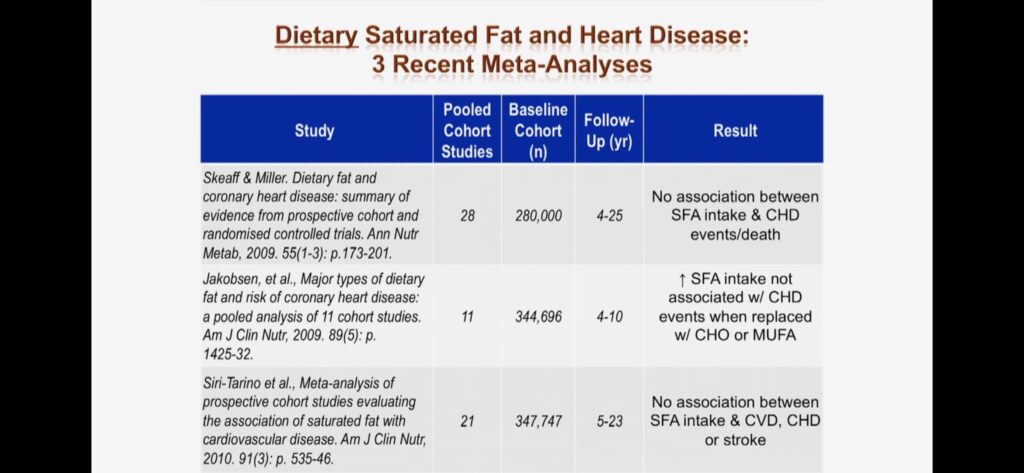
  • Dietary intake of saturated fat was not associated with heart attacks, stroke or death from cardiac causes, based on three pooled results of 60 cohort studies involving nearly a million total participants (see slide below).

  • Increased saturated fat in the bloodstream and stored in body tissues is associated with heart disease.
  • The Key: Those stored and circulating saturated fats do not come from the saturated fats you eat, but rather from the way your body processes excess carbohydrates, turning them into fat in your liver.
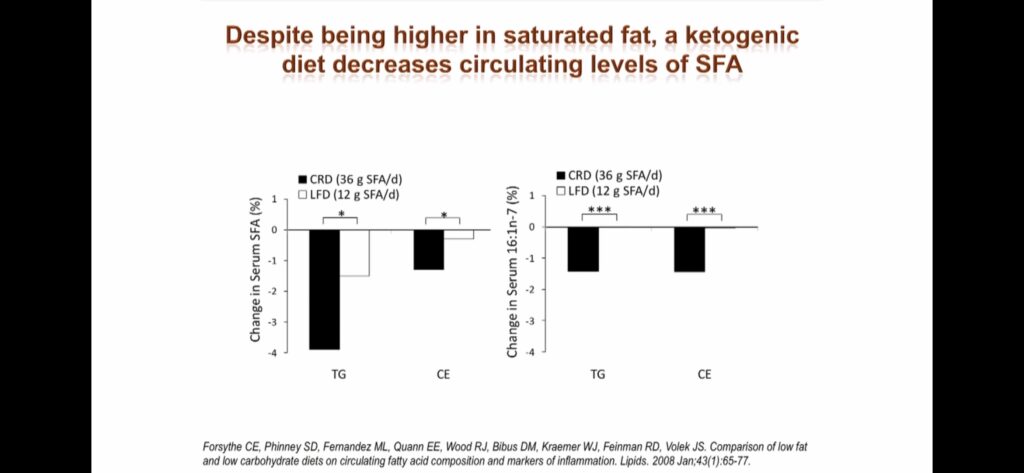
  • Eating more saturated fat as part of a ketogenic diet actually reduces saturated fat levels in your bloodstream.
  • Your body metabolizes the saturated fat you eat much differently in the presence of carbohydrates and insulin. With high carbs and saturated fat, you’re more likely to store the saturated fats in unhealthy forms.

There’s lots more detail in the video, and I’d encourage you to check it out in its entirety.

Feel free also to look up the scientific papers he cited, to check his work. I searched for the first one and found the PDF, which you can download if you’d like. Here’s the money quote as I see it:

There is probably no direct relation between total fat intake and risk of CHD. The strongest evidence in support of this judgement comes from the Women’s Health Initiative that showed that CHD risk was not reduced after 8 years of a low-fat diet. The observational evidence, summarised in the meta-analysis, showed no association between total fat intake and CHD risk, although there was heterogeneity between the study results.

Dietary studies are difficult with free-living subjects; you can’t know for sure that people were fulfilling the requirements of their “arm” of the study. Others rely on surveys asking people to estimate what they had eaten over the course of some period. Memories are faulty, and sometimes subjects understate their participation in what might be considered “unhealthy” choices.

The main point is that those who have been telling us saturated fat is dangerous do not have strong evidence to support that claim.

Still, their perspective has governed nutrition policy and what is offered in school lunches, hospital cafeterias and throughout the food ecosystem.

With prevalence of obesity, type 2 diabetes and metabolic syndrome tripling in the last few decades, we’ve clearly been going in the wrong direction .

As far as I’m concerned, the low-fat proponents do not have the evidence on their side, and as you explore for yourself I think you’ll agree.

That, along with the better results I’m seeing personally not only in weight loss and improved vitality but also lowered blood pressure and triglycerides and increased HDL (the “good” cholesterol), makes me confident low-carb is most effective for most people.

At least for the two-thirds of Americans who are currently overweight or obese.

We have to do something different, right?

If you think your friends might find this post helpful, I hope you’ll share by email or on your social networks using the buttons below.

To get these updates on a regular basis you can subscribe by email, or follow me on FacebookTwitter and LinkedIn, where I’ll also be posting links.

Check out My Health Journey and my #BodyBabySteps.

Seek Satiety in Filling Fats

Stopping Sugar and Cutting Carbs are important ingredients in the #BodyBabySteps, but the “meat” of the plan — literally and figuratively — is to Seek Satiety.

You will likely need cut back significantly on your carbohydrates, but that’s a negative focus. A positive focus is more helpful, emphasizing what you do eat instead of what you don’t.

My first meal of the day is typically four eggs, meat, cream cheese and guacamole. I’m usually not hungry for the rest of the day.

The key is to start with satiety as your goal, and to seek it in meats, full-fat dairy, cheese, eggs and other substantial foods.

Build your meals around these main courses. They’re your anchors. Don’t load up on carbohydrates first, and then top off with your filling foods. Start with rich, satisfying foods with a good amount of fat.

Eat at a leisurely pace, and stop when you’re full.

Fats are your friends, as long as they’re coming from natural, healthy sources like beef, fish, poultry, pork, nuts, olive oil and avocados. That’s not an exclusive list, but what you’ll notice about all of these is they are basic, whole foods.

They’re not highly processed.

What fats aren’t healthy? The so-called “vegetable” oils – corn, canola, soybean, safflower, sunflower. These are extracted from seeds under immense pressure and with the aid of industrial solvents. In their natural states no one would think of these seeds as “oily.” And instead of the healthy Omega-3 fatty acids, they are predominantly the less stable Omega-6s.

Dr. Ken Berry is one of my Health Sherpas, and one thing I appreciate about him is his down-to-earth, no-nonsense communication style, with short videos that get to the point.

He’s a great resource because as a physician, rigorously following the “eat less, move more” dogma he was prescribing to his patients, he found himself at about 300 pounds.

He suspected that if he was following the dietary guidelines and had become obese, that’s probably what was happening with his patients, too.

Here he discusses common misconceptions even physicians have about fats:

For related discussion, see also Dr. Berry’s video about “The Proper Human Diet.”

If you think your friends might find this post helpful, I hope you’ll share by email or on your social networks using the buttons below.

To get these updates on a regular basis you can subscribe by email, or follow me on FacebookTwitter and LinkedIn, where I’ll also be posting links.

Check out My Health Journey and my #BodyBabySteps.