When You Absolutely, Positively Need to Reach Someone Quickly

In the last week, I’ve needed to get in touch with a few people via email about a social media project. For a few of them, I was missing email addresses so needed to contact the participants first by some other means to ask them to send their email addresses.

For Contact #1, I knew we were connected on LinkedIn, so I decided to send him a message through that service on Friday, Dec. 30.

For the next three, I checked first to see whether they were following me on Twitter, and sent them direct tweets instead.

Finally, yesterday, after having not heard from #1, I sent a direct tweet.

Here is the table of my results:
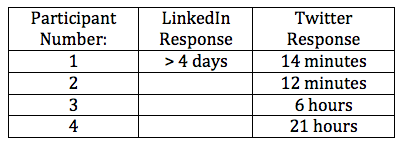
I realize this isn’t a large enough sample to be statistically meaningful. I also realize that my LinkedIn message was sent on a Friday before a holiday weekend, so it probably wasn’t the fairest test. But I wasn’t exactly fair to Twitter, either. For participants 2-4, I sent the tweets in the mid-to-late evening, possibly after some had gone to bed (they were all an hour ahead of me in the Eastern time zone). Number 3 responded at 4 a.m. I sent a follow-up to Number 4 the next afternoon, and this time the response was less than 2 hours.

Still, these results do fit with what I perceive as my experience in the relative responsiveness of Twitter vs. LinkedIn.

I think it relates to the way most people interact with the platforms. I don’t have statistics to support this (if you have some, please put them in the comments), but it seems people tend to use LinkedIn through its Web site. When you send someone a message in LinkedIn, therefore, people see it when they visit the site, or possibly through an email notification.

On Twitter, people can get notifications of new messages in those ways, but also tend to use smart phone clients or get text message alerts. This makes it much more likely they will get the notice quickly, wherever they are.

I’m not hacking on LinkedIn; it obviously has capabilities Twitter doesn’t, and you need to use different tools depending on what you want to accomplish. For soliciting and organizing professional recommendations, for instance, LinkedIn is clearly superior.

I have the LinkedIn iPhone app (although I haven’t used it much) and it probably offers push notifications as the Twitter app does (again, I welcome confirmation in the comments). My point isn’t that people couldn’t respond as quickly on LinkedIn as they do on Twitter, it’s just that in my experience they don’t.

How about you?

When you need to reach someone quickly, and if you don’t have the old-school contact information such as email or cell phone (and yes, having grown up with a single land line and snail mail, I realize the irony of calling email and cell phone “old school”), what do you find is the best social platform to use?

Holiday Greetings

Ever since I started this blog, I’ve used it as my Christmas Letter 2.0, instead of bothering with the cost and hassle of snail mail. Besides, with my celiac disease diagnosis, I can’t lick envelopes anymore, lest I get some gluten in the paste.

It’s great to take time in this season to reflect on God’s blessings from the previous year (and I’ve also enjoyed reviewing again the amazing changes in 2006, 2007, 2008, 2009 and 2010.)

Lots of things are different this year. When I wrote last year’s letter we were in the midst of the snowiest December on record in southern Minnesota. Here was the view out our porch window on Christmas morning a week ago today:

Part of the reason for my delay in writing this year’s edition is that for the last week we’ve had a full house, as our son Jacob and his wife Alexi and our daughter Rachel and her family have been here for Christmas. It would have been odd to spend the time writing instead of taking in the fun. But now that we’re down to our usual complement of the four youngest kids who are still at home (and since we got some updated pictures during Christmas, which you can enlarge by clicking), it’s time to recap 2011.

Continue reading “Holiday Greetings”

Meredith Gould Goes National

I’ve known Meredith Gould for about three years, and met her in real life a little over two years ago, at which time I discovered that she is a great humanitarian.

Meredith also has been a great advisor as we established the Mayo Clinic Center for Social Media, and in advance of her visit to Rochester for our Social Media Summit she did a post on our site, which she called: “This Bride Wants to Register at the Mayo Clinic.”

That post has gotten lots of traction, including being reposted on several other blogs. And earlier this week our Austin, Minn. ABC affiliate, KAAL, picked up on a tweet and decided to do a TV story featuring Meredith via Skype (and me in my office.). Here’s the link to that story.


Sometimes other stations pick up TV stories that have run on a network affiliate, and that happened with Meredith’s as well. Here’s the version that ran today on the ABC affiliate in Los Angeles, KABC:

Another case study showing how social media can lead to traditional media coverage. It will be interesting to see whether this goes any further.


How NOT to Handle Social Media Critics

The governor of Kansas has realized (although belatedly) that his staff mishandled the case of a teen constituent and her disrespectful tweet.

TOPEKA, Kan. (AP) — When a high school senior tweeted that Kansas Gov. Sam Brownback “sucked,” among other invectives, reaction at the state Capitol led her principal to demand an apology. Instead, it was the Republican governor offering a mea culpa Monday, forced to admit to a self-described overreaction by his staff that subjected him to ridicule for efforts to police a teenager’s Internet musings.

A few basic lessons and observations I take from this story:

As Stephen Covey says, “Begin with the end in mind.” In this case the gubernatorial (one of the great words in U.S. English) staffers saw the offending tweet and started the chain of events that led to this outcome without really thinking ahead to what they wanted to accomplish. They contacted the Youth in Government program director, who contacted the principal, and the confrontation ensued. What was the best possible outcome the staffers hoped to achieve? Even if everything turned out exactly “right,” what did they think they would get? I doubt they took time to consider this.

Most social media conversations are more social than media. When Emma Sullivan tweeted her comment, she was mainly talking with friends. It didn’t seem she meant it as a profound political statement. This is the kind of conversation that has happened about politicians since the days of the Roman Senate. When comments are posted online, they obviously can be found by anyone. But especially in Twitter, where the half-life of a tweet is about 30 minutes, most are lost to the ether, just as the spoken word was for previous millennia. That’s why…

Sometimes the best response is no response. The original tweet from Emma Sullivan went to her 65 (or so) followers. A lot of them probably missed it. As of this writing she has 12,700 followers, and there have been more than 800 online stories.

Stick to correcting factual errors. Ms. Sullivan had expressed an opinion about Gov. Brownback that is not subject to verification. If she had made a statement that was clearly factually inaccurate (as opposed to being her personal opinion), his staff may have had a basis for requesting a retraction. Again, they would need to decide if the end they were trying to achieve was worthwhile, but at least it would not have been a guaranteed loser.

Social media can create the political equivalent of fibromyalgia. To be successful in politics, candidates need to develop what is often called a “thick skin.” They can’t get too upset at criticism. Having just spent three days watching way more TV than I would have preferred, because of a nasty bout of intestinal flu, I’ve learned more about fibromyalgia through seemingly endless direct-to-consumer ads. According to my friends at MayoClinic.com, fibromyalgia seems to have something to do with increased sensitivity of the brain to pain signals. It seems the increased listening ability afforded by social media also can make politicians (or companies) hypersensitive to the “pain” of criticism.

It’s good to listen through social media, and these tools give unprecedented ability to hear what constituents or customers have to say. Listening is a great place to start in your involvement, but the power of the tools makes it all the more important to consider carefully when you should be informed by what you hear, and when and how it is advisable to respond.


My ABC National Radio Appearance

Instead of the American Broadcasting Company, it’s the Australian Broadcasting Company, and from an interview I did while in Sydney last week for the HARC Forum. The interview was for The Health Report, with Dr. Norman Swan.

We had a lively conversation, and I enjoyed getting to speak with Dr. Swan about our Mayo Clinic Center for Social Media.

The program aired Monday morning in Australia.

Listen to the program or download it. And follow Dr. Swan on Twitter.

Let me know what you think.