Weiner, Favre and the 38th Thesis

When I first heard about the racy photo tweeted from Rep. Anthony Weiner’s account, I thought the “I’ve been hacked” defense seemed dubious, especially since Rep. Weiner had not chosen to have law enforcement authorities investigate the alleged crime.

I thought it was much more likely that he had simply made a mistake, and replied to a tweet from the young lady in Washington state instead of sending a direct message with his photo. It’s a difference between typing “@” before her username instead of “d “ – which made the photo link visible to his 45,000 followers, and by extension, to the world.

Following his mistake, we now know Rep. Weiner broke just about every rule of PR and crisis management – making up a story about being hacked, denying that he had sent the picture and evading the question of whether the photo was of him. I thought the low point was when he berated ABC News’ Jonathan Karl for “not understand(ing) how social networks work.”

Monday we learned that the simple explanation was in fact the right one. As The Hill reported:

“Once I realized I had posted it to Twitter I panicked, I took it down, and said that I had been hacked,” Weiner said at a press conference in New York. “To be clear the picture was of me and I sent it.”

In actuality, Weiner had committed one of the classic errors of the micro-blogging platform: tweeting a message that was intended to be sent as a direct message. Direct messages are private messages that can only be sent to a user to one of their followers.

This outcome, especially when considered in light of a similar issue involving former Green Bay Packers quarterback Brett Favre (OK, he played for the Vikings, too) and the allegations of his “sexting” a female sideline reporter when he played a season with the New York Jets, provides a fitting illustration of a principle I’ve found myself regularly mentioning in presentations, and which I am now codifying as my 38th Thesis:

Social media raise the cost of bad behavior because they make it more likely misdeeds will be discovered.

By the account of Jenn Sterger, the photos Brett Favre allegedly sent her via text message were at least as explicit as Rep. Weiner’s. But we’re still saying “allegedly” in the Favre case, partly because the photos were sent via SMS instead of on a social network like Twitter. And her revelation came about two years after the alleged incident. The first news story about the Weiner tweet, by contrast, showed up within just a few hours.

Twitter is much more powerful as a communication vehicle than text messaging is because tweets can be discovered and spread by anyone, and because for regular tweets (as opposed to direct messages), there are no intended “recipients.”

But the same tools that can be so beneficial when used for good can have devastating effects when mishandled. The Favre sexting controversy took two months to be resolved,  with the NFL commissioner finally settling on a $50,000 fine. The Weiner case took 10 days from tweet to tearful confession.

Of course there were various differences between these two examples, and it isn’t my point to go through these fine distinctions. I just think it’s interesting to see how rapidly the Weiner case developed, and to consider how social media accelerated his decline. Two weeks ago tomorrow he was being mentioned as a leading candidate for mayor of New York. Today he has many of his party members in Congress urging him to resign.

In my presentations I have often suggested that users should apply the “front page” test to all of their online postings. As we’ve seen recently with Rep. Weiner, sometimes those postings really do make the front page.

What do you think? What are the social media lessons you take from this case study?
An Upgrade for SMUGgles?

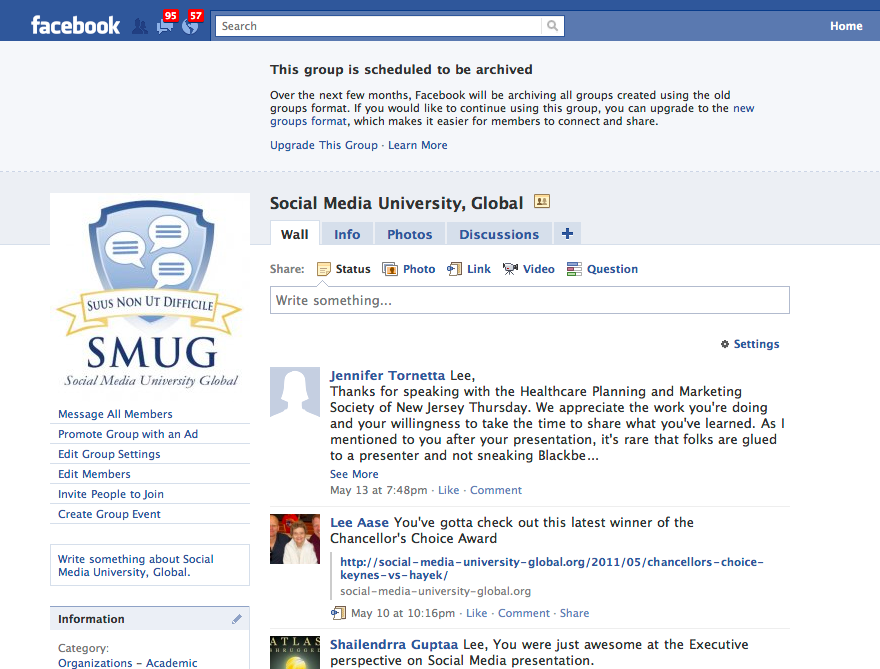
When I visited the SMUG Facebook group this evening, I saw a message that gave me pause (click to enlarge):

From the language of the alert (and what I found when I read more), it appeared that the archiving function would migrate the posts on the wall into the new group format, but that everyone would be kicked out of the group and would need to be added again.

In other words, ALL OF THE SMUGGLES WOULD BE EXPELLED!

I couldn’t let that happen, so I went for the upgrade. One thing I saw immediately was that there was a LOT more activity. Here’s a screenshot of what happened in the next 26 minutes:

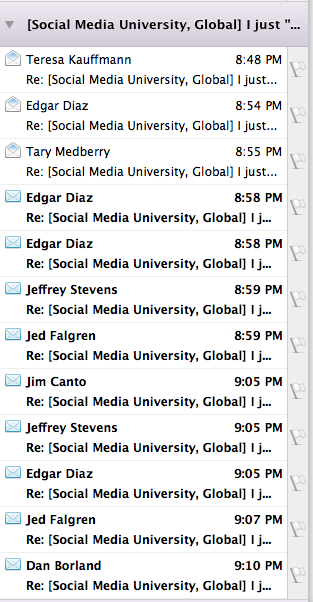
With, on average, one comment every two minutes, this certainly was an upgrade in terms of activity and engagement. Clearly that’s because of the change in email notifications, as evidenced by my Inbox:

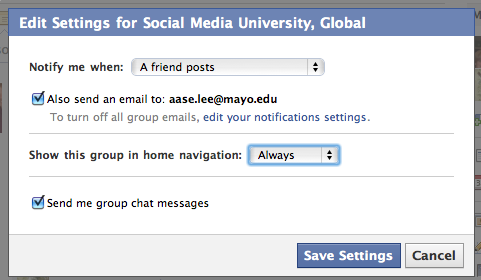
We all do have the ability to control our level of email notices, as you wee when you click the Settings button for the group:

So, this will be an interesting experiment to see how a group with more than 1,200 members works in the new format.

What do you think of the new SMUG group? Are you going to adjust your email notification settings? If so, how?

United Breaks Guitars. Delta Saves iPads. And Psyches.

Dave Carroll’s experience with the baggage handlers (and customer service staff) for United Airlines has become legendary thanks to his ballads about the matter, which have accumulated 12.9 million views together. Here’s the first and most famous of the videos:

And here’s the sequel:

And finally the third installment:

I had a somewhat different experience this week on Delta, as I flew into La Guardia for a couple of days in New York. It seems I had tucked my iPad behind me after using it during the flight, and I hurriedly got off the plane and left it behind. About a half hour after I left the airport, I got a call from the gate agent who said they would hold it at the Delta baggage office until I got back to the airport on Friday. Definitely nicer than Ms. Ihrlweg.

I hadn’t yet noticed my iPad was missing, and wouldn’t have until i got to my hotel room and wanted to use it. Then I would have freaked out and been frantically calling Delta, or possibly would have resigned myself to the loss, or at minimum would have been anxious and distracted for two days until I could back to the airport and check at the baggage office. So it was great that Delta saved my iPad. Also great that someone called to tell me they had it, to save me the anxiety.

Thanks, Delta!

Bringing the Revolution to Jersey

This morning I’m presenting to the Healthcare Planning and Marketing Society of New Jersey, as part of a program they are calling “Employing Social Media to Build Customer Satisfaction and Community Outreach.” I’m also moderating a panel that includes:

  • Margaret Fontana, Director of Social Media, Meridian Health Care and winner of the 2010 PeRCy Award for Best Use of Social Media
  • Chrisie Scott,Vice President, Marketing and Corporate Communications at Meridian Health
  • Loren Fisher, Web and Social Media Specialist, Somerset Medical Center
  • Victoria Allen, Vice President, Marketing and Public Relations, Somerset Medical Center

Here are my slides. It might be a new record for total slides in a single presentation.

Note: If it says the slides have been removed, just click through to view on Slideshare. Seems to be a Slideshare glitch with embedding.

Chancellor’s Choice: Keynes vs. Hayek

This has got to be the best thing to come out of George Mason University since 2006, when the Patriots made the NCAA basketball Final Four. It’s a fantastic example of how a creative video can make a dry topic (economics is called “the dismal science” after all) vibrant and interesting.

This one definitely gets a Chancellor’s Choice Award for Best Use of Video in an Educational Context:

As of this writing, Fight of the Century has racked up 621,000 views in just two weeks.

Here’s the first video in the series, which has had more than 2.2 million views:

And this video, also from the EconStories channel, includes an interview with the George Mason professor and his creative sidekick behind the series:

Together, these videos — which range from 7:33 to 10:10 — demolish the conventional wisdom that a video needs to be short to get traction, or that the “ideal” video is less than three minutes, or two minutes, or whatever a supposed “expert” says.

Length doesn’t matter. It’s more important that a video is interesting. And it isn’t necessary to be interesting to a mass audience. You just need to be interesting to your audience.

This video on myelofibrosis is about the same length as the Keynes/Hayek boxing match. Not funny at all, but extremely interesting to people who have myelofibrosis. As of today, it has more than 8,200 views, which has made it extremely successful. It has reached and interested the right people.

What’s your favorite video that’s more than four minutes long?