Sacred Social Media

Because of a storm that postponed another presentation I had scheduled for today, I am instead able to meet with a local church group at noon to introduce them to social media and to invite them to think about how to apply the tools in their mission. Here’s the slide deck:

This one should be fun; I always introduce my 35 Social Media Theses with reference to Martin Luther and his 95 Theses, so it will be nice being in a Lutheran church, where the analogy should be particularly meaningful.

Note: If the slideshow above doesn’t go all the way to the 72nd slide, you can view the rest here.

The 36th Thesis

Just as Martin Luther’s 95 Theses posted on October 31, 1517 on the church door at Wittenberg were not a comprehensive statement of his theology, the 35 Social Media Theses posted on the wall of SMUG 492 years later also were just a beginning of the discussion. So here for your reaction is the 36th thesis, which I’ve been trying out in some recent presentations:

If your organization can’t find a way to constructively use free tools that enable deep, two-way communication with anyone, anywhere, anytime, your real problem is lack of imagination.

If someone gave you free and unlimited long-distance calling, or the ability to send letters through the mail without paying postage, would you not find ways to take advantage of those opportunities?

Of course, with social media tools you don’t just get to send your messages for free: you also get to hear from key stakeholders, whether they be customers, prospects, employees or the community.

Maybe you’re doing fine without these tools, and you’re feeling really happy with how your organization is performing (although I doubt it, given the overall state of the economy.)

If you’re comfortable with the status quo, you can be confident of one thing: you’re too confident. If you don’t use these powerful communication tools, a competitor will. And it may not even be someone you consider a competitor today. After all, Blockbuster didn’t see Netflix coming.

So if you can’t think of a way to effectively use social media in your organization, or if the barriers to adoption seem too high, you need to think harder. Or, in the words of the famous Apple slogan:

Which is, after all, what the first 35 Social Media Theses were all about. You don’t need to be an Einstein. Just think like MacGyver.
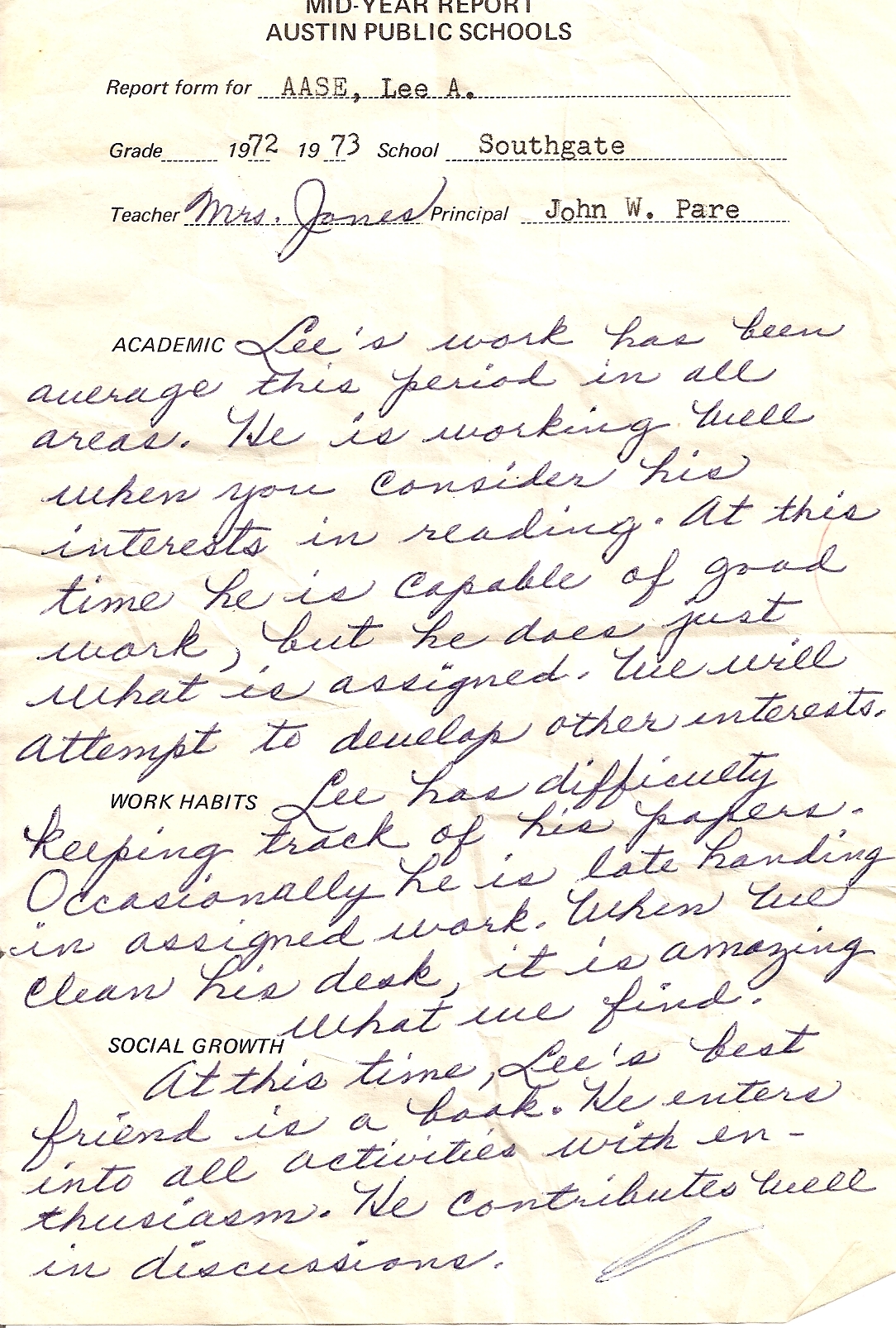
Hoping Mrs. Jones would be proud

At Christmas, as part of my parents’ gift to me, they included my mid-year report card from 4th grade. This obviously was from an era in which, unlike Garrison Keillor’s Lake Wobegon, not everyone was considered above average (click to view at full size).

4th Grade Report Card

A few observations:

  • I still like books, as you can see from our library picture in the SMUG Facebook group.
  • I’m still pretty enthusiastic and contribute well to discussions.
  • It’s still amazing what I find when I clean my desk.

So after I head to the Y for a run, I’ll be exploring for treasures in my home office desk.

Maybe that runs in the family, though: I think it’s pretty amazing that Mom would find a 37 year-old report card.

I’m hoping Mrs. Jones would be proud that one of her “average in all areas” students has grown up to become a university chancellor.

A SMUGgle Meetup

More of the power of social media: I’m in San Francisco today, and found out earlier this week that a SMUGgle from Norway was also going to be in town for a conference. Sturle Monstad (@SturleMo), who asked this good question in January. He came to meet me at the Ritz, and we had a nice talk. He even schooled me on the right way to say my last name in Norwegian, which helps me understand why my grandpa changed it to make it easier for the English-speakers.

I’m at the airport now, on the way back home, but it was nice to get another validation of the power of social media to make connection – even across oceans.

Why don’t teens tweet?

The Pew Internet & American Life Project came out with an updated survey today, which found that only 8 percent of Americans aged 12-17 use Twitter, and that blogging is much less popular than it was in 2006, when the survey was last conducted. Now only 14 percent said they maintained their own blogs, which is half of the 2006 figure.

I had an opportunity to discuss some of the reasons for this Wednesday, in advance of the public release, with Mary Brophy Marcus (@BrophyMarcUSAT) of USA Today, for her story related to the study.

“To quote my 15 year-old-son, ‘Twitter is lame,'” says Lee Aase, manager of social media at Mayo Clinic. He says Facebook and texting may be satisfying teen chat needs.

“They’re so into text-messaging that that niche is already sort of filled for them,” he says.

Aase also says some teenagers may grow back into blogging as they hit adulthood: “Blogging has become a way to communicate with the world, about more meaningful issues, not just about communicating to friends.”

Read the full story, and get more details on the Pew site.

As I see it, the big thing that has changed since 2006, causing blogging to decline, is the immense popularity of Facebook, which was still pretty new back then. And with Facebook’s chat feature, combined with text messaging, most young people already have ways to do the short message communication with people who matter to them…their friends. There really isn’t much incentive for them to go to Twitter, because most of their friends aren’t there anyway; they’re all on Facebook. Or they can be reached via SMS.

It’s different for adults; many of us actually use our cell phones primarily for voice calls instead of text. And we see Twitter as a way to make connections with people who have common interests.

What do you think? Are there other reasons why teens don’t tweet?