I was following the Massachusetts Senate special election last night on Twitter (while attending a high school basketball game), and one thing I noted was that the intense national interest was crashing several Web sites that were supposed to be providing updated vote totals. And from what I read this morning, the turnout for the election was much higher than had been expected – higher than most general elections in Massachusetts (which, as we all know, haven’t been very competitive lately.)
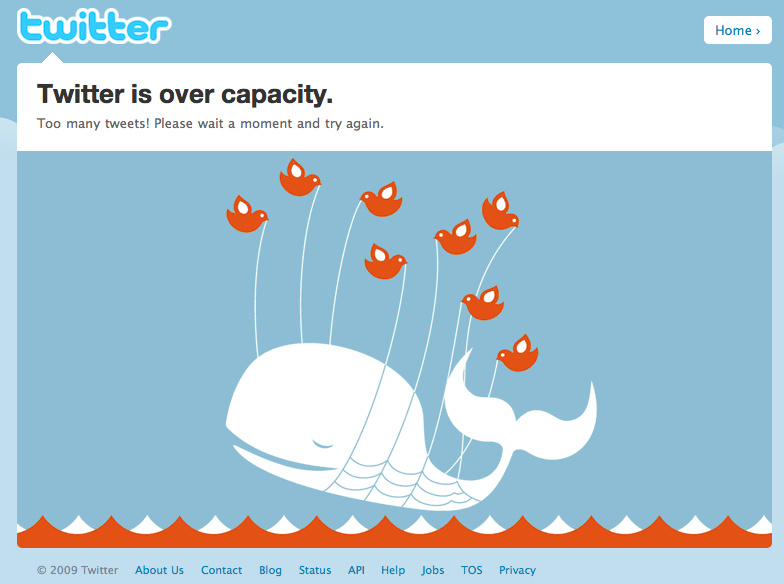
So I was interested this morning when I checked into Twitter and got this “blast from the past”:
I hadn’t seen this very often lately, and when I did see it the problem usually resolved with the next browser refresh. But this persisted for a while. I’m wondering whether the Massachusetts race had anything to do with it, with all the Wednesday-morning campaign managing (or celebrating).
It’s also interesting that #whentwitterwasdown is currently a trending topic.
While social media can be used to perpetrate the con jobs, their real power is to enable those who care to give meaningfully and with confidence.
You can give to charities endorsed by people you know, or by people the people you know, know.
I know that last sentence is really awkward, but take a minute to think about it. And while you’re thinking, here’s a story that will help drive it home.
I met Tom Vanderwell (@tvanderwell) last year via Twitter, as described here. Having met on Twitter on a Sunday night, we had coffee together in his home town, which is nearly 500 miles from mine, the following Wednesday. And when I returned to Grand Rapids, MI in August for my granddaughter Evelyn’s birthday, I went to Tom’s house to interview him via Flip video for this post on our Sharing Mayo Clinic blog.
While there, I met Tom’s youngest children, Abby and Isaac, whom he and his wife had adopted from Haiti. Cheryl and their older daughter were on a mission trip in Haiti at the time I visited him, which is why I needed to meet Tom at his home: he had to be there with his adopted kids. I also learned that Tom was involved as a member of the board of the Haitian orphanage, God’s Littlest Angels.
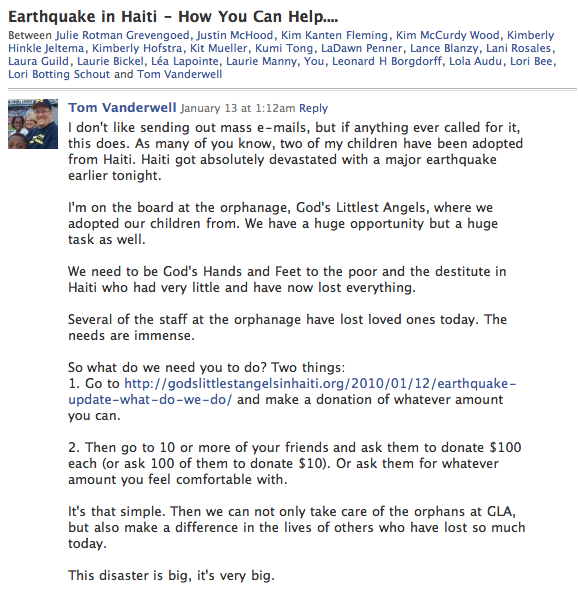
So when I got the message pasted at the top of this post from Tom yesterday via Facebook, I took notice. It brought the disaster one step closer to me, because I knew someone actively working to provide relief. And I knew that the projects he would be supporting would be well-run, economical and wouldn’t involve a lot of administrative overhead. In short, I knew that whatever I gave would be well spent.
I’m not going to suggest what you should give. You need to decide that on your own.
But I do want to assure you that whatever you send for God’s Littlest Angels will be used well, to meet real needs.
This shows something of the power of social media, in that through Twitter Tom and I created a personal relationship that led to meeting in real life, and also to maintaining that relationship through Facebook. And you should check out this post Tom did on another blog, about how he has been using social media in the aftermath of the earthquake, and how through Twitter he got the director of the orphanage in touch with @AnnCurry of NBC, which led to the Today story embedded above.
So now I’m inviting you to join me in a “Six Degrees of Trust” experiment.
I know and trust Tom
You know me (if you’ve been reading my blog regularly) and hopefully trust my judgment.
You have your own circle of friends on Facebook, and followers on Twitter, who know and trust you.
Your friends likewise have friends and followers.
…who have friends and followers…
…who have friends and followers…
So whereas Tom had some suggested steps for us who are his friends, here’s what I’m asking you:
Give what you can to help God’s Littlest Angels. I have embedded the contribution widget at the bottom of this post.
Post the link of this post to your Facebook wall, or send it directly to selected friends on Facebook.
Send a Tweet about this effort. Here’s some suggested text you could copy and paste: Six Degrees of Trust: People you know helping orphans in #haiti #godslittlestangels http://bit.ly/4Fmtq1
I talked with Tom briefly this evening via Skype. He said the orphanage is currently over capacity, with 160 kids. Given the deaths resulting from this earthquake, it’s likely there will be dozens more children needing housing and help. I hope you’ll take a few moments now to help provide that help.
An interview featuring one of my Mayo Clinic colleagues was posted recently on Ragan.com. Linda Donlin was interviewed as part of the health care social media summit we hosted with Ragan in Arizona. Here’s the video:
I thought you’d enjoy hearing from one of my colleagues at Mayo whose job is different from mine, but who is actively embracing social media tools for communication with our employees.
Here’s a post I did at the time about the “In the Loop” publication, including an example.
This emphasizes that social media tools are powerful, and can be adapted to your communication needs. They also help you go beyond “audiences” to “communities” by enabling those you’re reaching to provide feedback to you and share with others.
Here’s a recently asked question from Sturle Monstad (@sturlemo), from Bergen, Norway:
Lee,
Thanks for collecting such a wealth of info on your SMUG site. I am using the resources in my work with health promotion for older adults. I have a contract with Lions Club in Norway on a programme they are setting up a web site for them. I am now trying to include social media for marketing and community building.
They are a bit skeptical, but well see how things work out. We see that seniors are getting more active on Facebook, and I think the interaction may be positive for many. Have you written anything about social media/seniors?
Answer:
First, thanks for helping to put the “Global” in SMUG!
I also can tell you that on our Mayo Clinic YouTube channel, almost 30 percent of video views are from people age 55 or older.
As these tools are becoming ever easier to use, the growth of social media will continue. I believe women over 55, for example, are the fastest-growing demographic in Facebook.
It all comes down to whether the content or subject matter is worthwhile and interesting.
My dad turns 79 on Saturday. He’s on Facebook, too, because it’s a way to see video and photos of his great-granddaughter.
Social platforms, from blogs to Facebook to YouTube, make it easier for anyone to share information that others will find interesting.
What do you think? What other statistics or arguments about senior citizens and social media can you offer to Sturle? Do you have any personal examples or case studies to share?