Here are the slides for a presentation I’m delivering via videoconference this morning to a large gathering in Zurich, Switzerland. It’s entitled, “Why Social Media are Essential to the Future of Healthcare,” and it led me to develop a 36th thesis that may work its way into future presentations.
This evening as I traveled to Winona for the #WSUPRSSA presentation on social media, I got to meet my youngest daughters and swap vehicles with them, so they would have reliable college transportation. Here’s the video I shot when they saw it for the first time. Having video also enables Lisa to get in on the fun, even though she wasn’t able to be there.
This also gives me a chance to show the WSUPRSSA group how easy it is to write a blog post.
Here’s a recently asked question from Sturle Monstad (@sturlemo), from Bergen, Norway:
Lee,
Thanks for collecting such a wealth of info on your SMUG site. I am using the resources in my work with health promotion for older adults. I have a contract with Lions Club in Norway on a programme they are setting up a web site for them. I am now trying to include social media for marketing and community building.
They are a bit skeptical, but well see how things work out. We see that seniors are getting more active on Facebook, and I think the interaction may be positive for many. Have you written anything about social media/seniors?
Answer:
First, thanks for helping to put the “Global” in SMUG!
I also can tell you that on our Mayo Clinic YouTube channel, almost 30 percent of video views are from people age 55 or older.
As these tools are becoming ever easier to use, the growth of social media will continue. I believe women over 55, for example, are the fastest-growing demographic in Facebook.
It all comes down to whether the content or subject matter is worthwhile and interesting.
My dad turns 79 on Saturday. He’s on Facebook, too, because it’s a way to see video and photos of his great-granddaughter.
Social platforms, from blogs to Facebook to YouTube, make it easier for anyone to share information that others will find interesting.
What do you think? What other statistics or arguments about senior citizens and social media can you offer to Sturle? Do you have any personal examples or case studies to share?
This is an example of how treating customers right (or at least correcting errors) not only avoids a United Breaks Guitars fiasco: it can actually lead to positive social media buzz.
As I reported in October, Meredith Gould is a great humanitarian, having bailed me out by recovering the Flip video camera I left on the podium at a speaking engagement in Philadelphia. She sent it to me via UPS, and said she would let me know the cost when it showed up on her credit card statement.
I was more than a little surprised, however, when she sent me a direct message tweet in early December, with the bad news:
Although I was shocked at the bill, I told her I would of course reimburse her, but asked if she could send me a scan of the statement. As I tweeted:
I just want to use it as a graphic for a fun post: “What did Brown do to you?“
I figured that if it was going to cost me nearly $80, I should at least get a blog post out of it…especially since I had forgotten my iPod in Florida in mid-November and the FedEx bill for that shipping was $17.97. But then Meredith said:
In subsequent consecutive tweets, I told her:
“If you wouldn’t mind calling UPS about it (and telling them the FedEx charge in a similar situation was $18) it wld be cool”
“And depending how it works out, we’d either get a smaller bill or a better story to tell on my blog ;-)”
“Might as well have some fun with it…like I do when I run out of gas.”
“Between leaving a Flip and an iPod behind, and running out of gas, maybe I should stop and think a bit.”
(By the way, here’s the post I did about my out of gas experience.)
Meredith’s response:
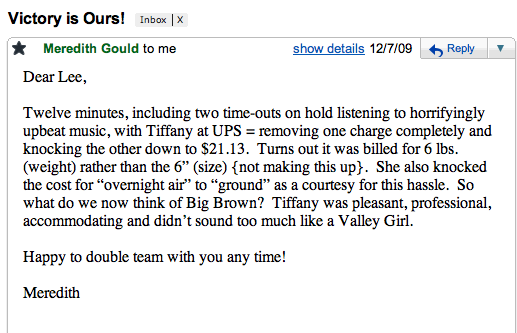
Two days later, I got this happy email:
Lessons:
If you think a bill is outrageous, don’t just pay it. Contest it. It may be a mistake.
If your business made a mistake, fix it, and you’ll not only avoid the bad word-of-mouth, but will instead get kudos. Fixing a mistake can be better for you marketing-wise than not having made the mistake in the first place. If the UPS bill had been correct originally, I wouldn’t have been the subject of my conversations, much less a blog post.
Don’t make mistakes on purpose so you can benefit from fixing them. If you’re systematically overcharging and hoping people won’t notice, it will catch up with you.
Hire more customer service people like Tiffany, and fewer like Ms. Irlweg.
I have been ever since the mid ’80s, when my brother-in-law, Lane, and I both had Apple IIe computers with 128K floppy disks, and he blew me away by getting a 5 megabyte hard drive to store data for his farm bookkeeping program.
The cost: $1,800. And it seemed unfathomable he would ever fill it.
Moore’s Law (from a paper Intel co-founder Gordon Moore published in 1965) suggests that computing power (or data storage) that can be purchased for a given price doubles every 18 months.
In this post, based on my recently acquired custom of Black Friday hard drive shopping, I want to prove Moore’s Law for you.
I usually get up early on the Friday after Thanksgiving to take advantage of the electronics sales, and one place I typically go is Staples. Two years ago, I bought a 500 gigabyte hard drive there for about $70 (after rebate.) That was 100,o00 times the storage Lane bought in 1986 for about $3,700 in inflation-adjusted dollars.
Last year, I bought a 600 gigabyte drive, again for about $70. Especially with my use of the Flip video camera, my “need” for storage has increased.
This year, I bought a terabyte drive (1,000 gigabytes) for $70. So in essence I got 200,000 times the storage Lane bought 23 years ago, for less than 2 percent of the price.
Granted, this was a door-buster sale. But even at full price for one of these drives, it’s mind-boggling.
And actually, I didn’t just get one drive; I bought two. In addition to the terabyte drive, I got another 500 GB drive that is powered by the USB connection. That makes it extremely lightweight, so I can carry it with me at all times in my laptop bag. As you can see in the photo below, it’s not much bigger than a classic iPod.
500 GB Hard Drive with iPod
And just to put it in further perspective, here are the two drives I bought on Black Friday, with a total of 1.5 terabytes for $140:
375 Hours of Flip HD Video Storage
But here’s the main takeaway/action point from this post, and how it applies to you:
Mark your calendar now for 11/26/2010 at 6 a.m. If Moore’s Law holds (as it has for 44 years), you should be able to get a 1.5 terabyte hard drive at Staples for about $70.
With HD video consuming about 4 GB per hour, you can never have too much hard drive space.