Social Media Pyramid “Servings” need to Serve

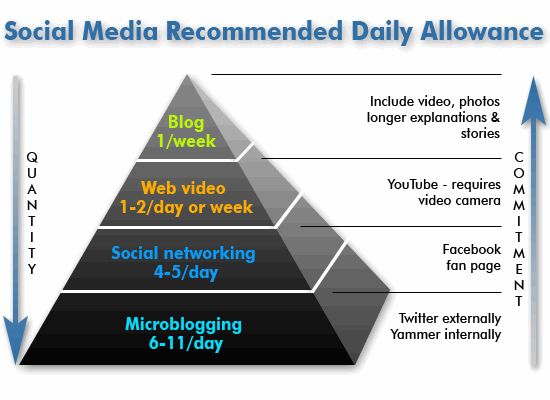
In my post on the SMUG Social Media Pyramid and the follow-up on servings and portion sizes, I recommended a basic level of each of the four basic social media “food groups” which are represented in this graphic submitted by Valeri Gungor (click to enlarge):

SMUGpyramid550x400

This led to some interesting discussion in the comments, which deserves fuller attention. Here were some of the themes:

  • Isn’t this just a “maintenance” plan? If you really want your social media influence to grow, shouldn’t you be beefing up with a lot more than what’s recommended here? Or on the other extreme…
  • Doesn’t 6-11 servings a day of Twitter encourage the kind of inane celebrity updates on personal minute-by-minute activities that give Twitter a bad name?
  • This seems like a tool-centric tactical approach, not a strategic tailoring of the tools to the particular objectives of the organization’s social media program.

So here’s some amplification of what a “serving” means.

To qualify as a serving your tweet, status update, video or blog post needs to…serve. Others, not just you. Any “servings” that don’t serve are actually subtracted from your total…they’re the social media equivalent of what Mom used to call “empty calories.” No nutritional value whatsoever.

In the food pyramid a serving is something you consume. In the Social Media Pyramid a serving is something you produce. It has to be of value to others to qualify. Otherwise it’s a negative. Five good tweets plus two pointless, self-promotional or “spammy” ones gives you a net of three servings, not seven. And some might even say a bad tweet is worth -2.

So in answer to the first two questions, I would say that the more real, valuable servings you provide, the more your influence will grow. And the more garbage you post, the more likely your Twitter followers leave, your Facebook friends and fans bail on you and you lose subscribers to your YouTube videos or your blog posts.

The third point, about strategy vs. tool-time tactics, I’ll tackle in the next post. And maybe I’ll expand on the serving scoring system.

Does this “net servings” guide make sense to you? How would you change it?

The Value of Twitter, Part III: Tom Vanderwell on Twitter

In my last post I told the story of how listening through Twitter enabled me to meet Tom Vanderwell, and some of the neat outgrowths that have come from that fateful tweet.

So as part of this “Value of Twitter” series in honor of the publication of Twitterville by Shel Israel, I thought it would be a good idea to let you hear directly from Tom about how he uses Twitter and the benefits he’s seen. (In the last minute or so he also talks about how Facebook has been surprisingly helpful.)

How about you? How have you seen Twitter help you in your business or professional life?

The Value of Twitter, Part I: Recommendation Engine

In honor of Shel Israel’s new book, Twitterville: How Businesses Can Thrive in the New Global Neighborhoods, which is coming out Thursday and in which I understand I am mentioned, I’m planning to do a few posts over the next several days on the practical value of Twitter for businesses.

I’m really looking forward to seeing the book. At the time I did my email interview with Shel we had not yet become officially active with our @mayoclinic Twitter account, and one of the points I made was that even without lots of interaction it’s smart for organizations to at least claim their “brand” name and automatically tweet with an RSS feed. From a purely defensive posture, it’s wise to have claimed your brand’s name on an increasingly popular social networking site like Twitter, to prevent someone else unrelated to your organization from “brandjacking” you. Our @mayoclinic Twitter activity has changed a lot in the last six months or so, and I hope at least some of that was captured in Twitterville. If not, that’s another reason for me to do a series outlining my thinking about Twitter today, and what I see as its main values for business in general and health care in particular.

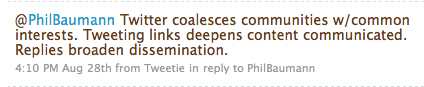
On a related note, @PhilBaumann challenged @EdBennett and me yesterday to “sell” the value of Twitter for health care in 140 characters or less. Here was my response:

Picture 2

That’s as good a summary as I can do within a Tweet, and in this series of posts I plan to expand on those themes. But for the fuller exploration, I’m confident Shel’s book will be excellent.

So here’s my first contribution:

Lots of people don’t “get” Twitter, and the question posed by its interface: “What are you doing?” is responsible for much of the mainstream misunderstanding. Just as Second Life skeptics routinely quip, “But I don’t even have time for my first life!” there is a similarly common (and unimaginative) phrase used dismissively of Twitter: “Who CARES what I’m having for breakfast?!”

I sure don’t. Care about your breakfast choices, that is. But if you’re reading an interesting article online as you slurp your coffee, it may be really helpful to me if you “tweet” the link so I can read the article as I savor my gluten-free Corn Chex.

That’s one of the significant values of Twitter: it enables you to find others with similar interests, and when they see (and tweet about) an online news story that interests them, there’s a good chance you’ll think it’s worthwhile, too.

So while Google’s search engine is great when you’re looking for particular information that you know must be out there somewhere, one of Twitter’s values is that it helps you get notified about things for which you wouldn’t think to search.

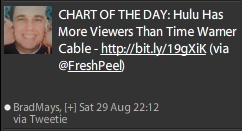
So tonight, for example, I saw this tweet from @BradMays:

Picture 1

I clicked the link and it took me to this story that shows the viewership of the online video site Hulu as compared with the number of viewers for various cable TV companies.

I would never have thought to search for this information, but it’s interesting to me as someone who follows media trends, particularly comparing more traditional delivery channels like cable vs. Web sites.

And because @BradMays is among those I’m following on Twitter, I came across this information and have marked it for future reference. It might well show up in a presentation in the coming months. In essence, he served as an unpaid scout/adviser, helping me find interesting material on the Web.

But I still have no idea what he had for breakfast.

Portions, Servings and the SMUG Social Media Pyramid

I appreciate all the positive feedback and re-tweets for yesterday’s post on the SMUG Social Media Pyramid. We even have our first graphical representation (click image to enlarge), submitted by Jason Melancon from the Louisiana Public Health Institute (LPHI).

SMUG-social-media-pyramid

One point that Jason mentioned in his email deserves further amplification. He said “I think the servings on social networks (in my own opinion) should be per week as opposed to per day.” And this leads me to the discussion of portion size and servings.

Have you ever noticed after drinking a 20 oz. bottle of Coke, when you turn it around and read the label, that you’ve just swallowed 2.5 servings? Or when you nuke a bag of microwave popcorn, do you always share it with two other people, as the label would indicate you should?

Welcome to the world of unrealistic portion sizes, at least in America. It likely helps to explain our obesity epidemic, but it also has application when we’re looking at our SMUG Social Media Pyramid and what a “serving” is.

On the SMUG Pyramid, essentially any activity qualifies as a “serving.” The tweet I will do about this post is a serving. A reply to those who re-tweet is a serving. And tweeting a link to another interesting article is, too. Relatively easy to get your 6-11 servings per day.

In the social networking sites, the reason I have 4-5 servings per day instead of per week is because posting a link is a serving. So is interacting with someone who writes on your wall, or uploading a photo, or creating an event, or uploading a video.

At the higher levels, Web Video and Blogs, the criterion for what constitutes a serving is a little higher. You can’t do half a video, and you either publish a new blog post or your don’t. But the interacting you do on YouTube, for instance, actually falls more within the social networking servings. So your 4-5 daily social networking “servings” may include comment activity both on Facebook and YouTube.

The other point to remember is that a pyramid like this is just a general guide, and your situation may call for different portions. I’m 6’6″ and weigh (…well, let’s not get into that!) My food portions are going to naturally be bigger than a 5’2″ female. At least it’s how I rationalize eating the whole bag of microwave popcorn. And despite that, I know I don’t always get the five servings per day of fruits and vegetables that USDA suggests.

The SMUG Social Media Pyramid is just a guide; a framework for thinking about social media involvement. Unlike the USDA, I can’t say it’s based on scientific research. I also have to confess that sometimes I get out of balance with it, both in my personal accounts and at work. Sometimes I overload on Twitter, for instance, and don’t get enough servings of the others.

But just as you’re not going to drop dead tomorrow for failing to eat enough fruits today, there’s flexibility with your social media diet too. You’re looking for balance over time for maximum health.

In a future post I’ll discuss the real key to portion estimation, which is serving with your servings.

The SMUG Social Media Pyramid

This post has been rolling around in my head for some time, but was triggered by a discussion Sunday night in the #hcsm chat on Twitter. One of the questions that arose related to what (and how many) social media platforms hospitals should use:

Is it better to do one or two channels well, or spread thinly across lots of platforms? Will results be different?

When I talk about a “Social Media Pyramid” I’m not talking about a Madoffian Ponzi scheme, but rather something that is a combination between the USDA’s food pyramid:
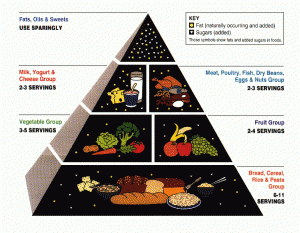
USDA_Food_Pyramid

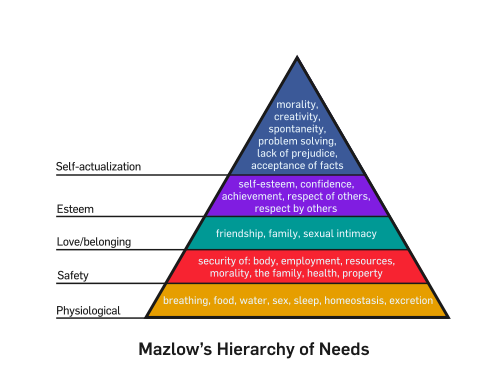
And Abraham Maslow’s famous “Hierarchy of Needs”:
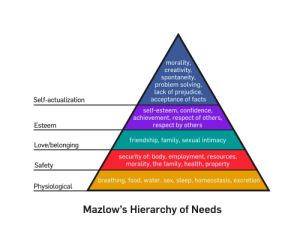
Maslow

Those who have spent any time at SMUG know I’m terrible at artistic representations that involve drawing, so I will just draw a word picture of the pyramid I’m envisioning, which represents both a balanced social media communications diet (analogous to the USDA pyramid) and steps toward increasing accomplishment, satisfaction and social media fulfillment (as per Maslow.)

Maybe someone would be kind enough to contribute an artistic rendering, as we saw in the SMUG seal development (which will soon come to fruition.) If so, I will update this post with that graphic.

Here are the levels of social media involvement (or four basic social media “food groups”) from an organizational perspective, as I see them:

Microblogging is the base, both because it’s easiest to start and because you should have more “servings per day” of this than any of the subsequent levels. Here I’m thinking Twitter as the main choice, but within your enterprise you may want to use something like Yammer for employee-only conversations. Like the USDA pyramid’s base, 6-11 “servings” of Twitter per day is probably a good target, particularly if you are interacting in conversations instead of just pushing out information. It’s a great tool for networking with those who may share your organization’s interests, but with whom you don’t yet have an online relationship.

Social Networking is the next level up, and here I’m using Facebook as the example. A Facebook “fan” page for your organization taps into a potential user base of more than 200 million and enables richer interactions that go beyond 140 characters. This might have a Recommended Daily Allowance (RDA) of 4-5 servings per day, as you could post links to news releases, or add upcoming events, or upload photos or video, for example. Balanced use even within the Facebook platform is advisable: if you send Updates several times a day, you’ll quickly turn off your “fans” unless what you have to share is extraordinarily compelling. Trust me: it’s not.

Web Video. The platform of choice here is a YouTube channel, because it’s free and it’s the world’s second-largest search engine. You need to have some source of video, which is what puts this a little higher on the pyramid, because you’ll need to spend at least $150-$200 for a video camera. But having the ability to upload video that can be found on its own on YouTube, emailed or tweeted to interested folks or embedded in Facebook or your blog greatly extends your reach. The RDA is 1-2 “servings” but with a camera like the Flip that has a built-in USB port for uploading, this is reasonable. And even if you don’t make that target, putting up even a couple per week is a good start, assuming you have something to say.

Blogs. These are at the SMUG Pyramid’s peak. They provide multimedia platforms for embedding video, slideshows and photos as well as a venue for longer, more reasoned arguments (like this post.) They’re at the peak because they require greater commitment, and because fewer organizations have taken this step. While Ed Bennett’s Hospital Social Networking List contains 253 hospitals with Twitter accounts and 174 with Facebook and YouTube, only 31 have blogs. Yet a blog is where you can have, in Paul Harvey’s phrase, “The rest of the story.” You can tweet a brief message and then include a shortened link that sends people to your blog for fuller explanation and discussion. Unlike Facebook, your blog is available to anyone with a Web browser, with no membership required for full access. You should have at least one post (or serving) per blog per week to keep it fresh, but more frequent is better.

Here is an example of a post I did on our Sharing Mayo Clinic blog, in which I embedded an interview with a patient, Tom Vanderwell, who I met via Twitter. We’re also friends on Facebook, which shows how the tools all work together.

The SMUG Social Media Pyramid answers the question that arose in the #hcsm chat by giving both a prescription for a well-balanced social media diet and a progression to get there. Don’t feel like you need to be involved in every platform, particularly at first. Start with Twitter (because it’s easy) and then probably with Facebook, if for no other reason than to keep someone else from claiming your organization’s name. The only investment is your time. As you grow in comfort and capability, and as others in your organization join you in the effort, you can then move to the higher levels of the pyramid.

In a future post, I will deal with the question, “How do I keep up with all the new platforms that are being launched?”

What do you think of the SMUG Social Media Pyramid? Does it make sense to you? Do you see other essential “food groups” for social media that I’ve omitted?