Are Facebook, YouTube and Twitter Really Free?

Some Tweeters have taken issue with a slide I typically include in most of my presentations. It says:

Total cost for Mayo Clinic YouTube, Facebook and Twitter:

$0.00

They protest that it’s inaccurate, maybe even misleading to say “total cost” and that it should instead say “Barrier to Entry” or “Cost to Start.” “What about the staff needed to run these sites?” they ask.

I will grant that these platforms don’t automatically maintain themselves, but I’m not changing the wording or conceding the point. I believe that in the way most people would have understood the phrase for at least the last century, these tools are FREE.

And this little video explains why:

  • YouTube is a FREE television station that lets you broadcast to the world.
  • A Facebook “fan” page is (at least) a FREE multimedia “white pages” listing for your business.
  • Twitter is a FREE incoming/outgoing communication channel, like the toll-free phone service discussed above.

But unlike the fictional AT&T and Pitney Bowes examples I described in the video, these are 100 percent real, bona fide offers. They are better ways for your existing staff to communicate, with each other or with your customers or other key constituents.

So ask not how you’re going to afford to hire staff to use these tools. Ask how these powerful tools can make your staff more productive!

For answers, look in the advanced courses in the Facebook, Twitter and Blogging curriculum listings.
Viral Video Case Study: Mayo Clinic’s “Octogenarian Idols”

This is not a post about “How I created a viral video and you can, too.” It’s simply a story that I think you will find interesting, and from which you can learn. Your mileage will vary, but there are some worthwhile lessons for anyone interested in using social media from a business perspective.

At Mayo Clinic, we have been actively exploring and adoption social media tools. We did our first podcasts in September 2005. We set up a Facebook fan page in November 2007 and our Twitter account in April 2008. We’ve been actively uploading to our YouTube channel for a bit over a year, and have developed several blogs over the last 18 months or so.

We took a major step in January by establishing Sharing Mayo Clinic, our culture blog. This gave us a place to publish feature stories that don’t fit in our news blog or podcast blog.

With that as background, here’s our first viral video story:

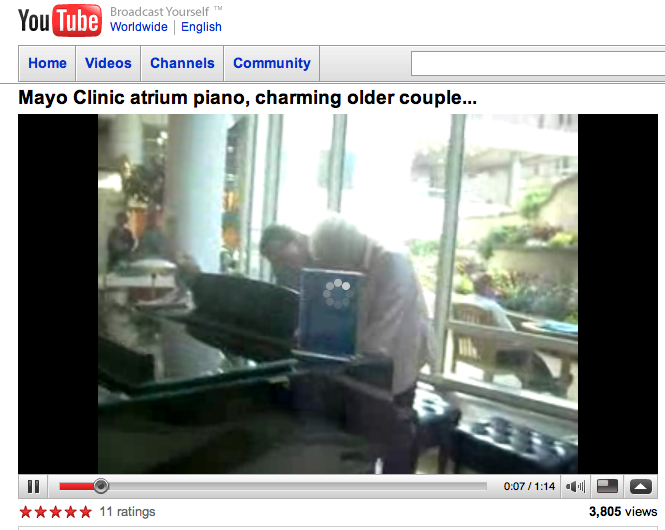
On April 7, 2009 I got an email (a few of them actually) alerting me to a charming video featuring Marlow and Frances Cowan, an elderly couple from Ankeny, Iowa. The Cowans had been recorded doing a piano routine in the atrium of our Gonda building in Rochester. I thought it was fantastic, so I decided to embed it in Sharing Mayo Clinic. As of that time, the video had been seen 1,005 times since being uploaded in September 2008. By the next day, it was up to 3,805 views (click to enlarge)…

April 8
April 8

…and a week later it was at 26,973.

Continue reading “Viral Video Case Study: Mayo Clinic’s “Octogenarian Idols””

SMUG Extension: Applying Social Media in Election Administration

Below is the presentation I’m scheduled to deliver on Friday, May 29, at the Hubert H. Humphrey Institute of Public Affairs, as part of the Innovations in Election Technology conference:

RAQ: Tips for Selling Hospital Leadership on Social Media?

This is another in the Recently Asked Questions series. I’m glad to answer these via email (and have answered directly in this case), but by de-identifying the person asking the question (to protect confidentiality) and also answering in public I hope to provide a resource for others who may have similar questions. More importantly, it opens the process so if other SMUGgles have tips to share, we all can learn from each other.

So here’s today’s question from “Pat” (not his or her real name):

Hi Lee — I am the Manager, E-Strategy, at ________. While admittedly late to the party, we are preparing to launch an official presence on Facebook, YouTube, Twitter and LinkedIn. But first, I have the pleasant task of selling our CEO and other senior leaders on the concept and benefits of social media. Do you have any resources/advice about how best to gain leadership buy-in? I’m not anticipating that it’s going to be a tough sell, but if there are any proven methods/pitfalls to avoid, I’d love to learn.

Dear Pat:

My presentations last week (embedded here and here) offer some basic guidance. I’d invite you to check them out. In essence, start by using social media tools to improve the efficiency of what you’re already doing (e.g. shooting Flip video for news releases and posting that to your Facebook site and YouTube channel…or just using the video to record your interviews and thereby do a better job of writing your old-fashioned text-based news releases). Use low-cost or no-cost tools so the out-of-pocket cost is negligible. Then when you get success at almost no cost you can build on that to extend into further applications.

If word-of-mouth plays any role at all in patients’ decisions to use your facilities (and it surely does), then social media will be a powerful means of spreading that word. You will be able to tell stories and describe treatments and services in much more detail than you could through mainstream media. And if you are spending anything on paid advertising, you can pay for your social media programs by channeling a tiny fraction of that budget. 

At Mayo Clinic we have been able to use social media tools to help tell stories, which has led to significant news coverage in the mainstream media, such as this story in yesterday’s Des Moines Register. And sometimes, as in this story in the Minneapolis Star Tribune, we’ve had news stories about our social media efforts.

I’d also recommend you refer to Ed Bennett’s listing of other hospitals using social media to show your leadership that many others have begun using social media tools.

Finally, I wouldn’t exactly say you’re “late to the party.” I think there are something like 5,000 hospitals in the U.S., and Ed’s list has 250 using social media. You will still be on the earlier side of the adoption curve, and should be able to move relatively quickly since there are some examples of others to emulate and build upon. 

How about the rest of you? What advice could you offer “Pat” in selling social media to hospital leadership?

A Nice Article about My Day Job

On Sunday the Minneapolis Star Tribune ran an article about our social media work at Mayo Clinic which began:

ROCHESTER – A few years ago, Lee Aase was just another flack for the Mayo Clinic, issuing press releases on cue and calling news conferences for doctors to present carefully scripted messages.

These days, Aase is a walking, talking, blogging, Twittering, Facebooking, YouTubing force who’s blasting Mayo into the social networking world faster than you can say “Mayo Brothers.”

I didn’t particularly like the lead because “flack” and “carefully scripted” carry some negative connotations, but given how positive the rest of the story was, I obviously have no basis for complaint. 

We have a great team involved in social media at Mayo Clinic, and it’s been exciting to see the enthusiasm grow.

The story became available online Wednesday after being print-only for three days. The irony of having a social media story be print only escaped no one’s notice, but it’s part of the Star Tribune’s effort to increase Sunday print circulation. I guess I’m honored that they would think this story might help.

I don’t know how long this will be available at no charge on StarTribune.com, but if you haven’t yet seen it, check it out here.