SMUG goes to Sweden

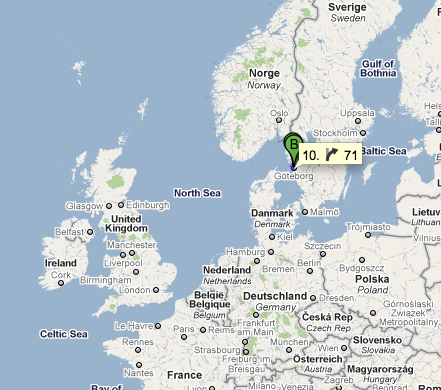
I’m at the airport in Rochester right now, getting ready to fly to Minneapolis, then to Amsterdam and finally to Gothenburg, Sweden. On Thursday I will be presenting at a symposium of the Swedish Society of Medicine, and also participating in a social media panel.

I’ll be heading back home Friday, in time for my middle son’s first varsity basketball game, which is Saturday afternoon. So it’s a short trip, but should be an interesting experience.

November 2010 has been my lightest-posting month in more than three years. I’ve got some good reasons for that, as will become apparent in the near future. Meanwhile, I’ll be making up for it by posting and tweeting about my Swedish experience, as I continue to put the “G” in SMUG.

More to come…

One of your next three page views will be on Facebook

If you’re reading this on the SMUG site (instead of in an RSS reader), it’s highly likely that one of the next three pages you load in your browser will be on Facebook. That’s according to this CBS News story:

According to Hitwise, Facebook has a 10 percent share of Internet visits in the U.S., and accounts for nearly 25 percent of page views. Trailing behind Facebook, Google has about a 7 percent share and YouTube (owned by Google) about 3 percent of Internet visits. On the page view front, YouTube and Google have a combined 11.7 percent share. It appears that Facebook is gobbling up a lot of what its CEO Mark Zuckerberg called the vast “uncharted” territory of the Internet.

So since this post counts as one, it’s likely that if you’re like most people (or at least “U.S. Americans“) one of your next three page views will be on Zuckerberg’s site.*

That got me to thinking about a post I did three years ago, when Facebook had “only” 35 million users, which I titled “Facebook: Covering the Planet in 5 years?” I made some projections based on Facebook’s “astonishing” growth rate of 3 percent per week, to see how long it would take Facebook to sign up everyone on the planet, a goal that had been attributed to one of its cofounders. Here was my take on it:

If that weekly growth trend continues, Facebook would have 6 billion users in January 2011, which would make that cofounder prediction of blanketing the planet in 5 years come true.

Of course lots of factors could intervene to diminish Facebook’s growth rate. As the old prospectus boilerplate says, “Past performance does not guarantee future results.” But even if Facebook’s “astonishing” growth rate were cut by a third, to 2 percent a week, it would have 400 million users by January 2010.

Clearly, Facebook’s growth rate slowed to something closer to that 2 percent a week mark. But even though it’s a few years behind schedule in covering the planet, the goal seems less fanciful than it did three years ago.

*Note to the humorless: I realize that the Hitwise figures are averages. More likely you’ll browse around on some other sites and then go on Facebook and log 50 page views there all at once. If you’re looking for some other historical (and hopefully interesting) posts about Facebook, mainly from 2007, check out the Facebook Business page. For a more structured approach to learning, see the Facebook curriculum section.
American Medical News highlights hospital social media

American Medical News has a nice profile this morning of Dana Lewis, who exemplifies the new role, in an article titled “Hospitals’ new specialist: Social media manager.” The article begins:

For otolaryngologist Douglas Backous, MD, Twitter and blogging were “like speaking a foreign language.” So he went to his hospital and got himself a translator: Dana Lewis, hired by Seattle’s Swedish Medical Center to handle all things social media.

Lewis is part of a trend in a new and growing type of hospital employment: the social media manager.

Technically, she’s called the interactive marketing specialist. But she, and others like her, are being charged by their hospitals to handle such duties as overseeing their social media presence, communicating with patients through social media — and, in many cases, teaching affiliated or employed physicians how to use social media. The idea is that by having a person dedicated to social media, the hospital can use the technology to strengthen its connections with all of what organizations like to call their stakeholders, which include the physicians who refer patients through their doors.

Check out the whole article: Ed Bennett’s Hospital Social Networking List also is featured, as are my 35 Theses here on SMUG. It also has a nice compilation of social media best practices for hospitals, which author Bob Cook apparently synthesized from several guidelines documents.

Here’s more information on what we’re doing at Mayo Clinic, with our new Center for Social Media. I’m excited that we’ve hired candidates for four of the eight new positions with the Center, and that we have interviews this week and next for two more. I’m also honored that both Ed and Dana are on our advisory board (with 12 more members still to be named). We’re going through about 120 applications from some really strong candidates to ensure broad-based and diverse membership.

When the official online publication of the American Medical Association devotes an extensive article to the topic of social media staffing for hospitals, that’s a good sign the activity is going mainstream. We’re glad to contributing to that through the Mayo Clinic Center for Social Media and the Social Media Health Network.