Beyond Hyphenation

As enrollment in rural schools declines, smaller communities have been left with no viable alternative but to consolidate their schools with neighboring towns.

Typically this leads to a lot of hyphenated names for the resulting school districts, such as (in our part of Minnesota) Zumbrota-Mazeppa, Elgin-Millville, Dover-Eyota and the like. Sometimes the district comes up with a whole new name for the school, as when Rose Creek, Adams and Elkton combined to become Southland.

I believe my wife Lisa’s home district set the hyphenation record when New Richland-Hartland combined with Ellendale-Geneva to become…you guessed it…New Richland-Hartland-Ellendale-Geneva, which the sportscasters abbreviate as NRHEG. Sometimes they’ll pronounce each letter, but if they’re in a hurry they just say NURR-heg.

A similar phenomenon has happened over the last half-century in the newspaper business, as competing newspapers in a community combined because neither could sustain themselves economically. So in Minnesota’s largest city the Minneapolis Star and the Minneapolis Tribune, which I remember as separate papers in the 1980s, became the Minneapolis Star Tribune. Likewise in Milwaukee the Journal and the Sentinel became the Journal Sentinel in 1995.

Hyphenated or not, you can probably think of several combo newspapers like this (e.g. Seattle Post-Intelligencer) – feel free to chime in with your examples in the comments.

But what happens when even the combined papers can’t make it? When even hyphenation can’t make the business model work?

We’re seeing that this week with the announcement that the Times-Picayune of New Orleans will be ceasing daily publication in the fall, moving to three days per week: Wednesday, Friday and Saturday.

If a metropolitan area of 1.2 million people can’t support a daily print newspaper, that’s a significant milestone in the decline of the traditional newspaper business model. Employee layoffs are coming there, too, which is the continuation of a trend being tracked at Paper Cuts.

As Seth Godin and others have said, newspapers aren’t primarily selling news to subscribers; they’re attracting subscribers and renting their attention to advertisers. The new publishing schedule of the Times-Picayune makes this explicit, as Wednesday is the traditional day for advertising inserts.

With so many choices for consumers in how they will get their news and entertainment, the mainstream media oligopoly is much less profitable than it was a generation ago. Those traditional media players have some built-in advantages. but the barriers to entry that formerly protected them (FCC licenses and the huge amounts of capital needed to buy transmitters or printing presses) are now practically non-existent.

That’s why I have often said:

Don’t just pitch the media. Be the media.

Do pitch the media. Work with the existing outlets as a resource and help them serve their audiences.

But be the media too. If you have a story to tell, you can do it through a blog. And you aren’t just limited to text: you can embed video, audio, slide presentations, photos and other resources. It costs you literally nothing to start.

Have you taken the blogging plunge? If not, why not?


Taking (Triple) Aim with ICSI

I’m delighted to be working with Dr. Gary Oftedahl of the Institute for Clinical Systems Improvement to present a pre-symposium workshop this afternoon. We’re going to be exploring how social media can support the Institute for Healthcare Improvement’s “Triple Aim” :

The Institute for Healthcare Improvement (IHI) believes that new designs can and must be developed to simultaneously accomplish three critical objectives, or what we call the “Triple Aim”:

  • Improve the health of the population;
  • Enhance the patient experience of care (including quality, access, and reliability); and
  • Reduce, or at least control, the per capita cost of care.

During the first part of the workshop we will be providing background and deepening understanding of social media tools along with examples of their applications in health care and in other industries.

After the break we will be brainstorming ways social media can be practically applied to solve problems and to meet one or more of the three aspects of the IHI aim.

Please join the discussion, even if you can’t be in the room. Share your ideas for how social media can help improve population health, enhance the patient experience and reduce (or at least control) per capita costs for health care. Here are two ways you can participate:

  1. Put your thoughts in the comments below, and we will share with the group.
  2. Otherwise, we will be tweeting from the using the #CoCreate2012 hashtag. Follow the discussion and chime in with your ideas.

What do you think? How can social media improve the patient experience, promote population health and reduce per capita costs?


A Chancellor Sabbatical

I know the new curriculum posts have been infrequent lately, but those following my Twitter stream know the main reason: it’s basketball season, and my son Joe and nephew Tom are two of the key players on our Austin High School basketball team.

They’re both juniors and both were named first-team all-conference, along with a sophomore teammate, Zach Wessels. I’ll have some posts in the coming days about how I’m applying the SMUG curriculum and the four basic food groups of social media in support of their team.

But first, I want to share some news coverage about a major achievement of their team, in winning their section championship and earning Austin’s first trip to the Minnesota State Boys Basketball Tournament in 30 years. And they did it in an extremely exciting way, as Joe, Tom and Zach all played a role in rallying to win in the last few minutes.

Here’s an interesting feature story from KTTC-TV in Rochester, featuring someone you all know:

So in a sense I have been taking a sabbatical in my Chancellor role, but as you will see in some upcoming posts, I’ve also been able to experiment with the application of social tools in an area outside of my regular work. I’m looking forward to sharing what I’ve learned in applying social media in high school sports.

A Revolutionary Opportunity

I received a call last November from a writer with Minnesota Monthly, the magazine Minnesota Public Radio sends to its donors, saying that its editors had been brainstorming an article idea for February’s issue and wanted to include me. The feature was to include a dozen Minnesotans they called “The Revolutionaries” and would involve a professional photo shoot, which they scheduled for December.
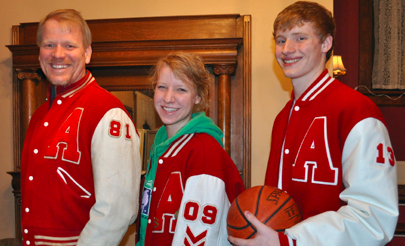
The February issue was sent to subscribers and available on newsstands in mid-January, but the articles weren’t online until last week. Here’s the lead-in to the “Revolutionary” profiles in the article, entitled “The Revolutionaries: 12 Minnesotans who are changing the way we think about the world—and its future.

It’s never been harder to think big. From an economy that keeps many of us clinging to crummy jobs to small-minded partisan bickering that puts innovative projects on hold, looking beyond ourselves and this moment can be mind-bendingly hard.

Nonetheless, there are still dreamers out there—and more important, dreamers who take action. We rounded up 12 Minnesotans who are tackling projects that have the potential not just to change their industry, but to change the state, the country, and the world.

Check out the whole article, and you’ll see the photo I’ve adapted for my Twitter avatar.

An Aase State of Mind

That’s the headline from this story in today’s Austin Daily Herald about basketball in my hometown, and about our family’s history (and hopefully future) of participating in Minnesota’s state high school basketball tournament. Here’s an excerpt:

Austin center Joe Aase knows all about his dad Lee’s history on the basketball court.

He knows he went to the state basketball tournament in 1981 with the Packers and he knows he played in the title game.

Joe also knows about his sister Rebekah. He knows she played in the state basketball tournament in 2008 because he was there.

Now Joe’s hoping he finally gets his chance to play in the state tournament as the Packers (12-4 overall, 9-2 Big Nine) are currently sitting atop the Section 1A standings and are just a half game behind Owatonna in the Big Nine.

Read the whole story here.

As a dad, it was a great blessing to be able to watch Rebekah and her team get to the state tournament in 2008 (I wrote about it here), and now Joe and my nephew Tom (who also is a junior starter on the boys’ team) are part of a team that is poised to make a tournament run. It’s particularly neat for my dad and mom, who also still live in Austin, to be able to watch both grandsons play, and also to get to go to Rebekah’s games as she is now playing at the local community college.

As a volunteer with the team’s booster club, I’m applying the SMUG philosophy, using social media tools to track (and promote) the team’s progress through a blog (the Packer Fast Break Club site), a YouTube channel and a Twitter account. I’m using a Flip camera (on a tripod) to capture game highlights to post to YouTube.

Since I already had the Flip, the total cost for all of it is about $20 a year for the PackerFastBreakClub.com domain and mapping it from WordPress.com.

How are you using your SMUG lessons to provide low-cost, high impact support for community or volunteer programs?