Husband of one, father of six, grandfather of 15. Chancellor Emeritus, SMUG. Emeritus staff of Mayo Clinic. Founder of HELPcare and Administrator for HELPcare Clinic.
I’ve had the pleasure recently of some discussions about social media, two of which were recorded as podcasts and one that was summarized nicely in a blog post.
Among the most important benefits of social media tools are their ease of use. While updating a static Web site can be onerous, and video shooting, editing and distribution also can be complicated, the beauty of blogs, Flip cameras (or Kodaks) and YouTube is the nimble authenticity they bring to communication.
Of course, it’s possible to develop bureaucratic processes that will completely erase the advantages of social media. By trying to fix perceived shortcomings of the standard social media tools by upgrading production values, you can lose their freshness and authenticity.
Don’t do that. Don’t complicate things.
To encourage you in this, I’m sharing a couple of examples from our Mayo Clinic experience, in which the nimbleness of social media tools enabled us to capture compelling stories that formerly would have been impossible, or at least impractical.
Exhibit A: Sharing Patient Stories
On Friday, September 18, 200, I received a late-afternoon call from one of our Mayo Clinic cardiologists, Dr. Michael Ackerman, telling me about an infant patient from the San Francisco area he had been evaluating. The call came about 3 p.m., and within an hour I was interviewing Trevor’s mom in the courtyard near their hotel. Here’s what she had to say:
The Kings were leaving for home the next morning, and if I had been unable to shoot the interview, we would not have been able to tell this story. Getting one of our professional videographers to break away on short notice would have added one more complicating factor to the equation, making it unlikely to work. But with the Flip, we captured the authentic moment.
Here’s another story from Sharing Mayo Clinic about Dr. Ackerman that will warm your heart. It doesn’t necessarily fit the theme of this post, but you should check it out anyway.
Exhibit B: Late-Breaking News
On Tuesday, June 3, 2008 at 8:45 a.m. I got some good news and some bad news. The good news was that one of our Mayo Clinic researchers, Dr. Victor Montori, had a paper being published in a major medical journal, Journal of the American Medical Association, or JAMA.
The bad news: the paper was being published that day, and was coming “off embargo” in just over six hours. This left us no time to prepare a formal news release or shoot and edit broadcast-quality video. In the era before our Mayo Clinic News Blog, we would have had no good options for calling attention to this research.
But since we had the blog and the Flip camera, called Dr. Montori and interviewed him at 10:20. By 11:55 we had uploaded the video to YouTube and had also prepared this blog post about the diabetes research. We sent “pitches” by email and Facebook to some journalists starting at noon, and the next day the Wall Street Journal Health Blog carried the story and embedded this video from our YouTube channel:
These are just two case studies of the practical advantages of using social media tools as more efficient and effective means of doing your work, if you don’t purposefully complicate things.
How have you used the Flip or similar tools for authentic storytelling?
Malcolm Gladwell is a great writer, which is why he has his own section among the SMUG textbooks. His latest book, What the Dog Saw: And Other Adventures, is unlike the others I’ve reviewed in that it’s not “about” a single topic. It’s rather a compilation of his previously published columns in The New Yorker.
I listened to What the Dog Saw over the Thanksgiving weekend, and here are a few snippets of his provocative thinking:
It’s almost impossible to predict which college quarterbacks will make it in the NFL because there is nothing “like” being an NFL quarterback. The defensive players are so much faster in the NFL, and therefore the offensive schemes must be so different, that success in college isn’t a good predictor of pro prowess. A college star can be a complete bust. This, Gladwell says, is “The Quarterback problem.”
There are certain jobs where almost nothing you can learn about candidates before they start predicts how they’ll do once they’re hired. So how do we know whom to choose in cases like that? In recent years, a number of fields have begun to wrestle with this problem, but none with such profound social consequences as the profession of teaching.
Thus, Gladwell observes, advanced teaching certificates (or Master’s degrees) don’t correlate at all with student outcomes. And yet, there is enormous variability in teacher performance: the best teachers can get through a year and a half of content in one year, while those at the bottom end of the curve only cover a half-year’s worth of material. Gladwell suggests that the reason why “book smarts” don’t guarantee good outcomes is that there’s nothing “like” being a teacher. And he has some interesting ideas for how teacher hiring and compensation could be changed if we were really serious about striving for excellence in our education system.
Among Gladwell’s strengths is that he questions commonly accepted truisms and brings research data to bear on the issues. In another of the essays, he looks at proponents of the so-called “War for Talent” and asks, “Are smart people overrated?”
The management of Enron, in other words, did exactly what the consultants at McKinsey said that companies ought to do in order to succeed in the modern economy. It hired and rewarded the very best and the very brightest—and it is now in bankruptcy. The reasons for its collapse are complex, needless to say. But what if Enron failed not in spite of its talent mind-set but because of it? What if smart people are overrated?
…
The broader failing of McKinsey and its acolytes at Enron is their assumption that an organization’s intelligence is simply a function of the intelligence of its employees. They believe in stars, because they don’t believe in systems. In a way, that’s understandable, because our lives are so obviously enriched by individual brilliance. Groups don’t write great novels, and a committee didn’t come up with the theory of relativity. But companies work by different rules. They don’t just create; they execute and compete and coördinate the efforts of many different people, and the organizations that are most successful at that task are the ones where the system is the star.
I would just add from personal experience that I work in just such an organization, at Mayo Clinic. Don’t get me wrong: we have a lot of really smart people working at Mayo. But it’s the way we work together in teams, and the systems that enable us to do so, that set Mayo apart. As Gladwell says, the system is the star.
In other essays, Gladwell examines FBI profiling, the Popeil family of pitchmen, why Grey Poupon mustard was able to make inroads into the French’s mustard market while Heinz continues to dominate ketchup, and several other interesting issues. You can read much of Gladwell’s New Yorker archive here (including the oneSeth Godin and I disagree with), but I strongly suggest you go ahead and buy the book. It will be one of the best investments you’ll make in improving your critical thinking skills.
Note: This post is part of the 35 Social Media Theses series, providing amplification and an opportunity for discussion of one of the theses originally posted on Reformation Day 2009.
In one sense, as I will argue in Thesis 4, the social media revolution is historic. But the fundamental issue to understand about social media is that, in their essence, they have been around from the beginning of human civilization. Or, as I put it in the first of my 35 Social Media Theses posted 492 years after Luther’s 95:
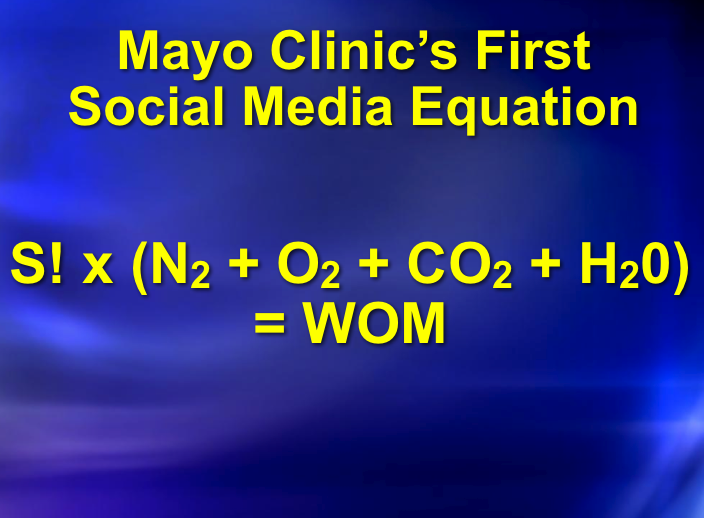
Social media are as old as human speech, with air being the medium through which sound waves propagated.
I have boiled that down further into the title of this post and in my presentation slides, in keeping with Seth Godin’s advice. I don’t completely agree with his arbitrary limit (never more than six words on a slide), but it’s good general guidance, so I try to comply when I can. And it’s nice to see that he relaxed the hard-and-fast limit with these helpful presentation tips.
For several millennia, “spreading the word” happened mainly by the propagation of sound waves through the mix of Nitrogen, Oxygen, Argon, water vapor, Carbon Dioxide (which is not a pollutant, by the way) and other chemicals that make up our atmosphere.
So whether it was news about a miraculous healer in the countryside of Judea or which merchant in the marketplace had the freshest produce, the way it was disseminated was almost entirely verbal, from one person to another (or a small group at a time), via the medium of air.
In other words, through a social medium.
I work at Mayo Clinic as manager of syndication and social media, but social media have been at work at Mayo long before I was even born. For more than a century, and even after the advent of mass media like TV and radio, word of mouth has been the most important source of information influencing preference for Mayo Clinic. It’s been all about people sharing their experiences as patients (or accompanying family members visiting Mayo) in a social context. In the equation above, S! stands for satisfaction, and as it is multiplied via sound waves through air, it leads to word-of-mouth. Putting it in a formula like that creates the illusion of scientific rigor, but it’s really pretty simple.
In considering the tools (as we will see in Thesis 2) social media are new, but in another sense they are just the way we as humans have always communicated.
Last week when I was in the Netherlands (See “Putting the ‘Global’ in SMUG”) I had the opportunity on Wednesday to help lead a couple of master classes on Web 2.0 for health care communicators from UMC Radboud, one of six academic medical centers in the Netherlands, in Nijmegen.
I often like to demonstrate Skype and its videoconferencing capabilities (and the fact that it’s FREE) in my presentations. It’s one thing to say, “Skype is like the video phone in The Jetsons.” That gets heads nodding. But it’s entirely different to show just how easy and cool it is. So I have sometimes Skyped with my daughter Rachel and granddaughter Evelyn, and also have done videoconferences with Darrin Nelson (a Mayo patient from Rochester, NY who shared his story about robotic heart surgery here, here, here and here on Sharing Mayo Clinic.) In those cases I had sent messages on Facebook (for Rachel) or Twitter (for Darrin) to arrange the times for our conversations and to ensure that they would be available.
Our Wednesday morning master class in Nijmegen went off flawlessly, as @JohnSharp and @CiscogIII and I tag-teamed as teachers, but in the afternoon they had to head back to Amsterdam, so I was on my own (along with my host, Lucien Engelen.)
I was doing fine until I got to the reference in my slides to Skype, and then I got what I thought was a great idea: I went to Skype and saw that my lovely wife, Lisa, was on-line.
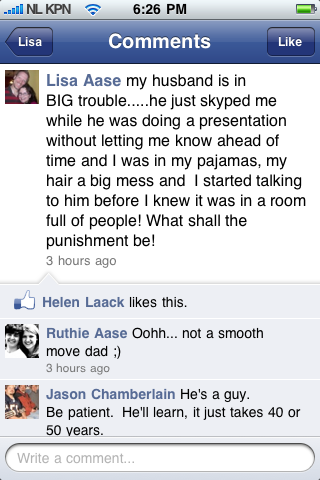
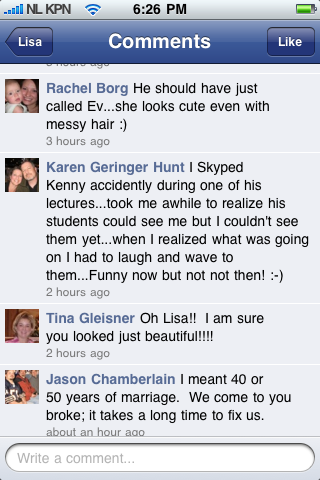
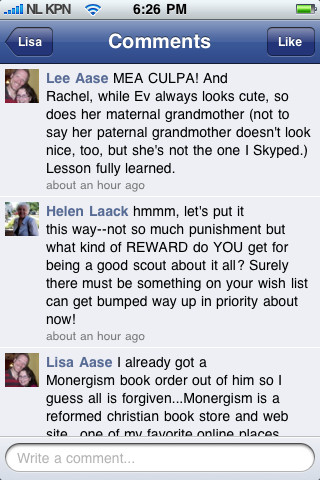
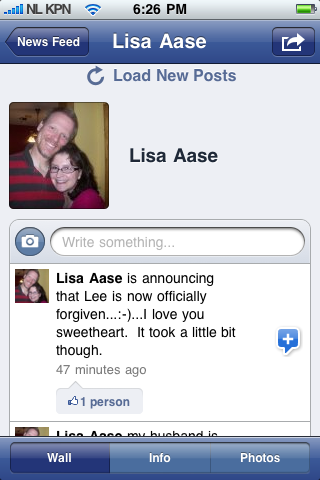
So (on the spur of the moment, not to mention a classic case of y-chromosome poisoning), I decided to just “surprise” Lisa with a Skype call without advance warning. I’ll let the Facebook conversation she started tell the rest (click to enlarge):
Lesson Learned: Privacy isn’t just something to be concerned about from a HIPAA perspective. It begins at home.
And a special note of thanks to Lucien for providing his own peace offering (although he personally had done nothing to offend), in the form of this beautiful bouquet of roses, pictured below next to my now fully showered bride of nearly 25 years.
 , is unlike the others I’ve reviewed in that it’s not “about” a single topic. It’s rather a compilation of his previously published columns in The New Yorker.