Will Blogs Make Vanity Publishers RIP?

blogs vanity publishers
Vanity publishers trade on, well, the vanity of people who feel they have a book within them that just needs to be published, no matter whether a regular publishing house thinks the book would be profitable or not.

I wonder whether vanity publishers are having a harder time these days, now that anyone can publish his or thoughts to the world for free through a blog.

After all, why would someone pay a publisher several thousand dollars to print a few cases of books (which then would need to be distributed and sold), when a blog provides instant worldwide access, with free distribution?

I think this might be another way in which the internet, and particularly Web 2.0, is disrupting the publishing industry. We know what it’s doing to traditional media, such as newspapers like the Minneapolis Star Tribune and Chicago Tribune, and broadcast networks like NBC. The Star Tribune lost 56 percent of its market value in barely 8 years, for instance.

Are those selling the dream of book publication to aspiring authors having a more difficult time these days, too? Are blogs enough of an outlet, so writers don’t feel the need to be published? Or does the experience of writing on a blog whet writers’ appetites to take the next step and paying to have their prose printed and bound? And how does this relate to the trend of authors giving away their books for free on the internet, either in PDF format or as audio files? Have you seen any information on what is happening to vanity press sales?
TechnoratiTechnorati: , , ,

Free Copywriting Seminar from a Crook

I have a debt to pay, so I need to tell you about a free copywriting seminar.

I wrote in an earlier post about some free book offers, (PDFs and audio files), and how that is a growing trend. I’ll have more reflections on that trend in a related post soon, but first I need to share another of those offers.

I saw another example yesterday on Lee Hopkins’ Better Communication Results blog, via his link from Walter Jennings’ blogroll. I had heard Lee (gotta like the name) previously on the For Immediate Release podcast, where he’s a regular contributor. Walter and I met (sort of) at the Page Society conference in California last week (we actually met via our blogs and Facebook afterwards.)

Free Seminar copywriting
The other Lee had an interesting post about a 10-hour copywriting seminar Trevor Crook formerly offered at $197, but which he is now giving away for free from his web site. I did it and started listening, and as Mr. Hopkins puts it, “Blimey, they’re good!”

All Trevor asks is that you pass the offer along to at least three friends (Oh, and you have to give him your email address, too.) Here’s the suggested text for an email to my friends that he sent with the download link:

What if I did you a favor, something big, something powerful and
proven to help you grow your business which you would usually have
to pay for and instead of paying for it, you simply pay it forward
to 3 more people as full ‘payment’.

You may think there’s a catch.

No, there isn’t. World class copywriter, Trevor Crook gave me his
10 hours of Copywriting Blueprint audios, his proven blueprint for
creating compelling sales copy and letters which he usually sells
for $197.

Trevor gave it to me as a favor because he has started a
revolution to help one million entrepreneurs in the next 30 days
and you and get a brilliant gift to help you get more sales plus
you can help change history at the same time.

You do not have to buy anything. There’s no gimmicks.

Too may people want to ‘take’ in today’s world instead of giving
and this is a recipe for a complete disaster.

When you understand the ‘Laws of Reciprocation’ like I do, you will
understand how much your life will change when you give freely
of yourself without any thoughts of getting anything back in return.

The sound quality on these isn’t great, but the content is really good. In the first session, for example, he focuses on the most important priority for successful sales copywriting, which is honing the offer: developing a compelling value proposition for your potential customers.

He’s putting that tip into practice, offering this seminar at an unbeatable price. Obviously, he’s betting that people who have heard his seminars will want to either engage him as a speaker, consultant or copywriter, or will want to buy some of his other products later.

So, instead of sending this in an email to a few targeted friends, I’m doing like Lee H and linking to it from my blog. I’m also posting it on my Facebook profile.

You may be asking, “Why would I want a teleseminar from a direct mail copywriter?” But that’s just like the problem I’ve been describing with how too many people see social media tools; they fail to think creatively about how Facebook or Twitter or MySpace can help them achieve business goals.

Even if you’re not in the direct marketing business, you’re probably selling your ideas in some way. Take the lessons you learn from Mr. Crook (admittedly not exactly the best name for someone in the mail order sales biz) and see how you can apply the concepts to your situation.

I’m going to continue listening, and hopefully Trevor’s tips will make my blog posts more compelling, too.

You’ll have to let me know whether it’s working, but remember: I’m only on the third lesson.

TechnoratiTechnorati: , , , , , ,

12-Step Social Media Program for PR Pros

NOTE: With the founding of Social Media University, Global (SMUG), this post has been incorporated into the curriculum as Social Media 101. Click the link above to learn more.

The Arthur W. Page Society annual conference this week was certainly eye-opening for me. I wrote here about how much I was anticipating this conference, and if anything it exceeded my expectations.

The feedback on our social media panel was positive, too, and it’s been great having several of the Page members “friend” me in Facebook and also join the Page Society group.

One thing I said during our panel was that

for communications professionals, being unfamiliar with social media tools borders on malpractice.

Think about it: Technorati tracks about 100 million non-spam blogs, and MySpace has more than 100 million active users. That’s also roughly the number of video streams served by YouTube each day. And Facebook, with 41 million members, has added a million a week, every week this year. This is mainstream activity in our society for ordinary people; we who communicate for a living on behalf of our organizations certainly need to understand the implications of these media. Far from “costing our employers dear” by involvement in Facebook, we actually cost them much more if we don’t know about all of the new means of communicating; not just “getting our message out” but actually engaging in conversations with customers, suppliers and employees.

Please note that you can take every one of these steps without spending a dime and without involving your IT department. Procrastination is your chief enemy. Take one step each day (starting by reading the rest of this post as step 1), and within two weeks you will have a good preliminary familiarity with social media. Then you’ll be able to start thinking creatively about how social media can be used on behalf of your company or clients. And you’ll be aware of how those with agendas contrary to your organization’s may be using social media.

So, with apologies to 12-step programs in which people have banded together to battle addictions, here is my 12-step social media program public relations professionals can join.

  1. Admit that you have a problem. See above. Unfamiliarity with social media is a serious gap for PR professionals.
  2. Browse some blogs, both to get a feel for the blog culture and to learn how blogs work. This backgrounder in Wikipedia will be helpful. As for blogs you should explore, any of those listed in my blogroll (at right) are good places to start.
  3. Check out TheNewPR/Wiki. This is a great resource for white papers, lists of CEO blogs, sample corporate blogging policies, blog directories, business podcast listings, and much more.
  4. Go watch three “Plain English” videos: RSS in Plain English, Wikis in Plain English and Social Networking in Plain English. These will be among the best few minutes you’ll invest in your social media education.
  5. Get an RSS reader/aggregator. If you use Safari for Macintosh or Internet Explorer 7 for Windows, you have an RSS reader built into your browser already. Google Reader is a great free online RSS aggregator. If you have a laptop and would like to be able to read your feeds when you’re not connected to the Net (like when you’re on the bus), you might want to get a standalone reader like NetNewswire (Mac) or NewsGator (Windows), or one of the Attensa products (they’re free).
  6. Subscribe to some blogs. You can subscribe to mine here, or as you are checking out others, look for the RSS or XML links, or for the universal feed logo.
  7. Get a free Gmail or Yahoo! email account. You’re about to start actively engaging in social media as you follow the next steps in the AAse program, and using a non-work email for blogging and commenting is a good practice.
  8. Over 90 percent of blog readers are “lurkers” and aren’t contributing to the conversation. That’s fine, but your next step is to comment in some blogs. If you find the information on a blog post helpful, say so in the comments. If you don’t understand something or have questions, ask them in the comments.
  9. Get a Facebook account and a MySpace profile. I’ve devoted a whole section of this blog to business-related uses for Facebook. I expect I will be writing a bunch more in the future. If you subscribe to my blog by RSS you’ll get these sent directly to your reader automatically. Or if you follow me on Twitter (see below) you’ll get more cryptic alerts. If you friend me, you’ll see some of the Facebook groups I’ve joined, or if you join my Professional Contacts group we can have conversations about social media within Facebook, and I can use that group to send special alerts to you through the Message All Members function. Once you’re in Facebook, spend some time exploring applications. Find high school and college classmates. Upload some photos and videos, and tag yourself and some friends in them. Then watch your News Feed and your mini-feed, and begin to see some of the networking power. I much prefer Facebook over MySpace, but I still need to spend some time with MySpace because so many other people do. It’s too big to ignore. And especially if you work for a company that needs to reach a younger demographic, it’s too big for you to ignore, too. Explore a variety of social networking sites like this so you understand their similarities and differences.
  10. As Sylvester’s prey would say, “Twy Twitter.” Twitter is a micro-blogging tool that lets you follow the actions of others and lets them follow you. Posts are limited to 140 characters. You can get alerts on your cell phone by text message, through your Twitter home page, or both. And you can send “Tweets” by cell phone, too. Here’s my Twitter account. As I’ve said previously, Twitter could be a great way to activate a crisis communications group.
  11. Share videos and photos with the broader world. YouTube and Flickr are the market leaders in these areas. In Facebook you can share photos and video with just your friends. YouTube and Flickr make it possible for anyone to access and share these digital resources.
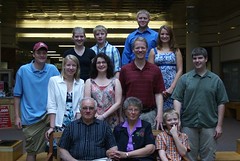
  12. Get your own blog. WordPress.com is free. So is Blogger. I prefer the former, and use it for this blog. One of the main benefits of WordPress is the Akismet spam protection; I’ve been protected from more than 18,000 spam comments in the last year. You can incorporate your YouTube videos (as well as others you find interesting) in your blog, and likewise can embed photos, like this one of my family at my in-laws’ 50th anniversary:

12-step social media program

And in WordPress.com you can make your blog private if you want, and not available for search engines or even visible without your permission. So you can experiment without worrying about other people seeing your blog, if you just want to explore.

But if you follow step 12 and create a public blog you will be doing the social media equivalent of the 12th step of Alcoholics Anonymous:

Having had a spiritual awakening as the result of these steps, we tried to carry this message to alcoholics, and to practice these principles in all our affairs.

I’m not promising spiritual awakening as a result of getting involved in social media, although here’s a blog with spiritual awakening potential. But as you learn about social media and its implications for PR and corporate communications, engagement in the discussion through your blog, or by inviting your co-workers to join social networking sites like Facebook, is a way to”carry this message” about social media to other professional communicators. As the cutesy cliché puts it, this is how you can “pay it forward.”
Members of addiction-fighting 12-step programs find it necessary to meet regularly to support, encourage and challenge each other to stay sober. By following the 12 steps of the AAse Social Media Program for PR Pros you will have this built-in support network for continued learning and growth.

But you may find you need a new kind of 12-step group to help with your Facebook addiction.

Add to FacebookAdd to DiggAdd to Del.icio.usAdd to StumbleuponAdd to RedditAdd to BlinklistAdd to Ma.gnoliaAdd to TechnoratiAdd to FurlAdd to Newsvine

TechnoratiTechnorati: , , , , , , , , , , , , , , , , ,

Face(book)less Corporations

peninsula employment law firm

The Peninsula employment law firm study of UK time-wasting in Facebook and other social networking sites, and its call for companies to ban employees from Facebook access during the work day, highlights the “all cost/no benefit” mindset behind many studies of social media. Not all law firms are so myopic, though.

To repeat what I said earlier, if companies have employees spending two hours a day on Facebook activities that are unrelated to their work, they have bigger problems than any social networking ban could solve.

But in this post I want to focus on the potential benefits for companies of having their employees engaged in social media, and particularly in networking sites.

The “Faceless Corporation” is a cliche, but there is a reason why cliches achieve their status: the first few times, at least, they communicated a truth in a compelling way.

By engaging in blogging, Robert Scoble helped pull back the curtain at Microsoft to reveal hard-working engineers trying to make the best products they could for their customers. At the time, Microsoft was seen as an anti-competitive monolith, personified only by Bill Gates and Steve Ballmer.Channel 9 helped humanize Microsoft.

Creating Facebook groups and encouraging participation by individual employees, and having them engage customers in conversation, could for some companies help create customer loyalty that can survive a low-price competitor underselling you. If you’re engaged with them, maybe your customers would also give you ideas for improving your services to gain even more business.

There are lots of other ways businesses can use Facebook positively. I have a whole section of this blog devoted to the topic.

But Ethan Kaplan says it well: if you can’t find a way to take positive business advantage of a social networking site with 40 million active members that is growing by more than a million users a week, your company has a serious lack of marketing vision.

TechnoratiTechnorati: , , , , , , , , , ,

Jott: Phone Blogging

Jott Phone Blogging

Jott is, as I described earlier, a great free service you can use to send yourself (or others) email and text messages. You’re out and about. You hit your Jott speed-dial number on your cell phone. You speak your message, and Jott transcribes your speech reasonably reliably. You get a handy message in your inbox that you can put into your GTD workflow.

Now Jott has announced a bunch of new features, including letting you speak your Twitter tweets (see the example from my test in the graphic above) or your blog posts. You can link your WordPress or Blogger blog to your Jott account, and then when you dial the number and it asks you, “Who do you want to Jott?” you answer “WordPress” instead of “me” and whatever you record is transcribed and posted to your blog.

Here’s what happened when I tried it earlier today. It isn’t perfect, but it does also include a link to the audio file on the Jott site. Maybe it would transcribe better if I wasn’t a Minneso-o-o-o-o-tan.

This has limitations: if you want to include Technorati tags, you need to add those later. There’s also a limit on how long a message can be (it’s longer than Twitter’s 140 characters, but it does cut you off after a few sentences.) I think the post’s title is always the same, too: Jott Blog Post.
But this does further illustrate some of the wonderfulness of Web 2.0. Applications talk to each other. They work together. And they just work. There are WordPress and Twitter applications in Facebook, now there are in Jott, too. Shel Holtz also has a nice Jott review focusing on the Twitter experience.

I think this is a great move for Jott, for search engine rankings if nothing else. When people use Jott to blog, the post includes two links to the Jott.com domain: one to the main page, and one to the audio file of the post. But obviously the main benefit for Jott is the visibility on blogs; as lots more people will run across it and will give it a try.

Jott phone blog

Why don’t you? It’s free, like everything else you see on this blog.

TechnoratiTechnorati: , , , , , , ,