5 steps to getting the most out of #mayoragan09

I’m excited that we are on the verge of beginning the health care social media summit, which we are hosting at our Scottsdale, Arizona Mayo Clinic campus in collaboration with Ragan Communications. The pre-conference sessions start tomorrow, with the full conference kicking off on Monday.

I will be delivering the opening Keynote on Monday, and part of my role (and my goal) is to set the tone and provide pointers on how participants can have the best possible experience. I will be posting my slides for reference here on SMUG, but I wanted to start by offering some links and tips that I hope will be especially helpful for those who are newer to social media.

  1. Join Facebook. If you need some background, see the Facebook curriculum and particularly Facebook 101.
  2. Join the #MayoRagan09 group in Facebook.
  3. Write on the Facebook group’s wall, upload photos or videos, and start or participate in discussions.
  4. Join Twitter. You may find Twitter 101: Intro to Twitter and Twitter 102: Creating an Account helpful in getting started.
  5. Follow the #MayoRagan09 hashtag in Twitter in whatever way seems most convenient to you, whether it’s through a desktop application like Tweetdeck or a Web-based service such as Tweetchat, Hootsuite or CoTweet.

If you haven’t yet made plans to attend the summit, you can still sign up for the Webcast. Video recordings will likely be available for purchase following the summit. Meanwhile, please do join in the conversation via the means listed above.

Clayton Christensen on The Innovator’s Prescription

I had a tremendous opportunity this morning to hear Clayton Christensen at #txfm09, the Transform symposium sponsored by Mayo Clinic’s Center for Innovation.

I can’t recommend Christensen’s work highly enough. His thinking on innovation is excellent, and based on what I’ve read of his writing, and the presentation I just heard from him, watching this similar talk embedded above will be well worth your while.

SMUGgle Interview: Aaron Hughling

I had a chance to meet Tuesday with Aaron Hughling (@aaronhughling), all-around Web guy for Scott & White Healthcare, and his colleague Rhona Williams London, who is the head of PR for Scott & White. After about a year of investigation and preparation, their system (based in Temple, TX) is getting ready to launch into Facebook, YouTube, Twitter and a couple of blogs.

Aaron and I have been interacting through Twitter and email for several months, and I met Rhona at a conference in Phoenix in June. It was great that they were in Minnesota so we could sit down for a chat among SMUGgles.

Aaron also said he’s excited to be attending, along with one or two others from Scott & White, the social media summit for healthcare Mayo Clinic is hosting with Ragan Communications in October in Scottsdale, Arizona. I’m looking forward to it, too; if you attend I believe you’ll come away both inspired to bring social media to your organization and encouraged by the examples you’ll see and hear. There’s still time to register, so I hope you’ll join us.

After our conversation, I asked Aaron if he would be willing to share some of the things he’s learned through his social media journey. Here’s what he had to say. It’s some good advice:

What lessons from your journey into social media do you think would be most helpful to others looking to get started? If you had one thing you could go back and do differently, what would it be? Or if you haven’t taken the plunge, what questions do you have?

Is all health care local?

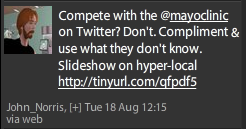
This presentation from John Norris caught my eye on Twitter because of how he promoted it through a tweet:
Picture 6

Give his presentation a review and then I’ll share some thoughts that he stirred in me (since I work for @mayoclinic, and particularly with our Twitter account.)

I think this slideshow has a ton of useful ideas for a hospital interested in using Twitter or similar tools effectively. Phil Baumann’s 140 Healthcare Uses for Twitter is another good read.

When John says “All healthcare is local” that’s true…except when it’s not, just as Tip O’Neill’s “All politics is local” was occasionally trumped by national issues.

I would instead say “All healthcare is personal.”

And social media platforms are, above all, personal.

Most of the healthcare people get is local. But sometimes they look outside of their local for specialized expertise. And part of the power of social media is that it makes that expertise available to a community that can be globally dispersed.

But as John points out, the social tools (including Twitter) can be extremely helpful for a local community, too. Just because a Twitter community can be global doesn’t mean it has to be, or that the only worthwhile Twitter efforts are those with thousands of followers.

Ed Bennett’s list of the hospitals with most Twitter followers was interesting and fun, but as he says, you shouldn’t read too much into it. A hospital with a few hundred followers could be providing a great service and interacting with that local community.

The point is to be of service to the community, whether it’s geographical or interest-based. If the information you provide is useful, and if you can interact with that community, the activity can be valuable both to you and to the people you serve.

For example, people might want to follow and interact with @mayoclinic AND their local hospital (e.g. @InnovisHealth in Fargo, ND), and maybe a service like John is providing in Corvallis, Oregon called @CorvallisHealth. They would be likely looking for different information from each source, and to have different conversations with each.

Twitter lets users (including each hospital/corporate user) decide on suitable goals that meet their objectives. As John suggests, don’t let someone else’s Twitter strategy have too much influence on you. Look at what Twitter can do, and what you can do with Twitter, and decide what makes sense for you.

Then go for it, without worrying about “competition.”

I’m looking forward to learning about lots of other innovative uses of Twitter at the Health Care Social Media Summit Mayo is hosting in October in Scottsdale, Ariz,, co-sponsored by Ragan Communications.

If you’re using Twitter in an interesting or different way, I’d love to hear about it and help spread the word about it. By sharing what you’re doing, you may spark ideas in others. Not that they would necessarily do the same thing exactly, but it may help them see connections they could make in their communities.

And since most health care is local, you can just feel good if someone in another community can gain from what you’ve learned.

Getting Twitter “Traction” in Health Care

I have enjoyed working with Chris Seper at MedCity News (on this story, for example) but I think he misses the point of @EdBennett‘s list of hospitals ranked by number of Twitter followers.

And therefore I think his recommendation also is off.

Certainly some hospitals (and other organizations) have just had their Twitter accounts on autopilot, sending Tweets based on an RSS feed. If they’ve done that, though, they aren’t putting a lot of effort (or any time) into Twitter. So even if they don’t have a lot of followers, you can’t really say the project has been a failure, because the cost has been essentially zero. We did this for several months with our @mayoclinic account at the start, and while it isn’t the best approach it can be a good defensive move (see my bottom-line recommendation below.)

But comparing hospitals to celebrities like Ashton Kutcher makes no sense. In fact, as I wrote in a comment (currently awaiting moderation) on the post Chris did about Ed’s list:

Look at the TV stations in the Cleveland market: @wkyc – 3883 followers; @fox8news 2,686; @19ActionNews 1,520; @WEWS 2,098. Only one of those would crack the top 5 hospitals, and one wouldn’t match the hospital numbers at all.

I think Chris is presenting not just a false choice, but a wrong-headed recommendation, when he says:

Hospitals may be better served setting up accounts for high-profile doctors and managing those accounts, rather than trying to gain followers for an institution.

I think this is wrong on two counts:

First, it isn’t an either/or situation, i.e. to  develop an institutional Twitter presence OR encourage individual physicians to engage. There is a place for both.

Second, if the alternative would be “setting up accounts for high-profile doctors and managing those accounts” then that’s really missing the point of social media. Public affairs staff can provide guidance and training for MDs who want to use Twitter, but as Ed says, “docs will do SM on their own if so inclined. Hospitals can’t make them do it.” And hospital PR staff shouldn’t pose as MDs and “manage” accounts for them.

I’m pleased with the progress we’ve made on our @mayoclinic account: our number of followers has quadrupled in the last six months as we have become more interactive. And we also have individual physicians like @vmontori and @davidrosenman getting active in Twitter. They’re both doing some really interesting innovation projects in health care, and are interested in the application of social media.

But we’re not managing the accounts for Dr. Rosenman or Dr. Montori. And the reason DrVes, Dr Val and KevinMD have gained lots of followers is because of their personal involvement, not because someone has “managed” their accounts for them.

The Bottom Line:

  1. Hospitals, or other organizations for that matter, should have a Twitter account, if for no other reason than to keep someone from brandjacking them. But the more they engage, the more valuable they will find even this corporate account.
  2. They should encourage and train individuals who are interested to get involved personally. You can’t manufacture passion, though. If doctors and other leaders are excited about engaging, they will likely be successful. But ghost-tweeting by PR staff would be the wrong approach.