Twitter 202: Selectively adding Tweets to LinkedIn

At our Mayo Clinic Social Media Residency, fellow faculty member Meredith Gould (who is a great humanitarian, by the way), shamed several of us for linking our Twitter profiles to LinkedIn, and for having Twitter updates automatically posted to our LinkedIn profiles.

I think that for many of us for whom Twitter is our “mother tongue” among social platforms, having Twitter updates posted to LinkedIn is a way to keep our profiles updated without visiting the site.

Meredith said it is more important that you keep your LinkedIn profile professional than it is to update it frequently, and that many tweets about personal matters will be detrimental to that goal. (And since she has more than 47,000 lifetime tweets, I can definitely see that in her case.)

Having resolved to comply with the Meredith Mandate, I went to LinkedIn this morning. As I reviewed my settings, though, I noted that there is another option, as I have captured in this screen shot:
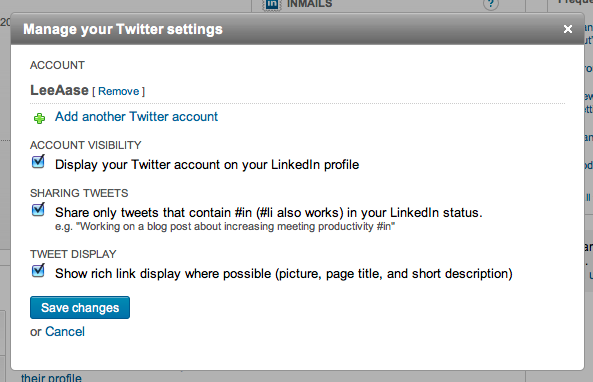
By checking the middle box, I could limit the Twitter updates going to LinkedIn to those in which I included the #in or #li hashtags.

This seems like a good solution to me. If I think of LinkedIn while I am doing an update, I can just add one of those hashtags and the post would go to LinkedIn.

If I forget about LinkedIn and don’t include those hashtags, I am essentially following the Meredith Mandate.

What do you think? Is that a good solution?

WWMD?

New Mayo Clinic Heart Health Campaign

Today at our Mayo Clinic Social Media Summit, which we have produced in collaboration with Ragan Communications, we launched a new awareness campaign about heart health. Here is the story behind the project (including the back story behind the video.) This video is the cornerstone of the campaign:

We also have a Facebook app on our Mayo Clinic page, and a contest site for friendly competition in helping to raise awareness of heart disease through this video. Here’s my profile on the site.

Note: I can’t win the contest, and neither can any other Mayo Clinic employees. But others can win Mayo Clinic books, pedometers or other prizes, including a trip to next year’s Social Media Summit. And teams can win a one-year Social Media Health Network membership for their organization.

Please help spread the word!


Studying a Rare Disease with Dr. Tweet

In the last few months I have had an exciting opportunity to be part of a Mayo Clinic project using social networking tools to assist in the study of a rare disease, and last week we reached a milestone with publication of a study in Mayo Clinic Proceedings.

One of our key team members is Dr. Marysia Tweet, so it’s almost poetic that we’re working with Dr. Tweet to use social media in medical research. You can’t make that up!

At any rate, the paper on our pilot study of SCAD (spontaneous coronary artery dissection) is published this month in Mayo Clinic Proceedings, as reported in the Wall Street Journal and described in this Mayo Clinic news release.

The really exciting part of this story is how the research was initiated by patients, and this Mayo Clinic Medical Edge story tells how it happened:

We’re continuing to use our social media tools to help with the ongoing research into SCAD, as the Mayo Clinic research team led by Dr. Sharonne Hayes is creating a virtual registry to study SCAD. This SCAD research post on our News Blog provides the information physicians and patients need to take the first steps to be included in the study.

The pilot study showed that this kind of virtual registry is feasible; 18 women signed up for the pilot within a week, and the initial 12-person study included participants from New Zealand, the United Kingdom and Canada as well as the United States. Dr. Hayes discusses the rationale for and the implications of the study:

Finally, here are some additional sound bites about the pilot study and its implications, from Dr. Hayes, Dr. Tweet and yours truly:

Our Mayo Clinic Center for Social Media mission is to go beyond the public relations and marketing uses for social media and find ways to apply these revolutionary tools in education, research, clinical practice and in the administration of health care organizations. I was really excited to have the chance to be involved in this first publication, and that we are having an ongoing role in facilitating this patient-initiated research into a rare disease.

On Italy and Aletta

I’m in Baveno, Italy today and will be coming back to the U.S. tomorrow after my 8:30 a.m. presentation. As this video shows (and tells), this has been quite an eventful trip since I left Rochester, Minn. on Saturday morning:

I’m about to go for dinner, and this time I’m fairly confident I won’t be locking myself on the outside patio. Last night I had to call my host Hans and have him get someone from the front desk to rescue me. I’m not sure what I would have done if I hadn’t brought my phone out there with me, and if I hadn’t previously talked by cell with Hans. It’s about 30 feet to the ground, and I’m sure I would have freaked some of the other guests if they had seen a big blond guy crawling on the roof.

The hotel staffer graciously assured me that this had happened many times before. I’m blaming this incident on jet lag.

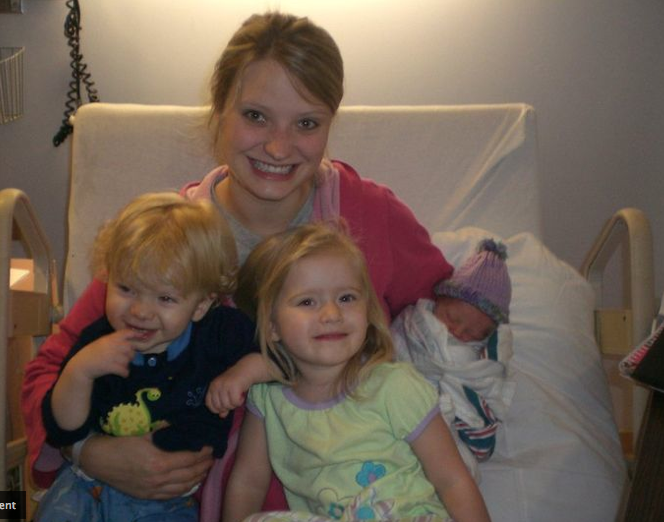
And while I’m not blaming my need to run to the Mall of America for dress pants during my MSP layover on my wife Lisa’s absence, it sure will be good to have her back home when I get there Thursday. She’s been in Grand Rapids, Mich. for the last 11 days to help my daughter Rachel, who just gave birth to our third grandchild, Aletta Louise Borg, last Wednesday. Lisa flies home Wednesday.

Here’s a picture of Rachel with her little brood, including the newest arrival:

I’m glad Lisa has been able to help Rachel, but with her home I will hopefully be less out of sorts.

Should states ban student-teacher interactions on Facebook?

Yesterday’s Washington Post had an editorial about a misguided trend among state legislatures to ban communication between students and teachers through sites like Facebook and Twitter:

However, in some places, new laws and proposed measures are impeding teacher communication with students outside of school-sanctioned e-mail systems. The most recent practitioner of educational technophobia is Missouri, which last month adopted legislation intended to ban direct communication between teachers and students via Facebook.

The law is so broad it could effectively also bar student-teacher contact via Gmail or other non-school e-mail services. “No teacher shall establish, maintain, or use a nonwork-related Internet site which allows exclusive access with a current or former student,” the law reads.

The Post editorial board makes a good case against laws like this. I agree that these laws seem overly broad. I think are they well-intentioned as ways to prevent inappropriate relationships between students and teachers, but that banning Facebook messages is overkill. Facebook is just another means of communication, a platform more than 10 percent of the people in the world use.

Banning Facebook interactions seems analogous to prohibiting telephone contact between students and teachers. A private Facebook message can be sent even between users who don’t have a friend relationship, just as telephone conversations can happen between anyone via cell or land line. Should there be laws against phone calls too?

What do you think about these laws banning Facebook messaging in the schools?