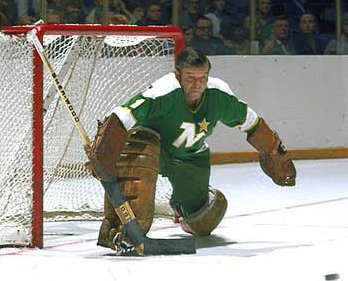
What’s wrong with this picture?

Meet Gump Worsely, who played goalie in the National Hockey League.

Gump was famous for playing without a mask and helmet long after almost everyone else in pro hockey had adopted this protection. Slap shots would fly at his face at speeds often exceeding 100 miles per hour, but as Wikipedia says (so we know it must be true!), he told reporters he went without a mask because, “My face is my mask.”

I guess it was his choice, as he was grandfathered in and didn’t have to follow the new rule.

I think of Gump when I hear people complain or express anxiety about their privacy in Facebook. One of the things I want to ask them is…

Did you remember to put on your mask and helmet?

Facebook has extensive built-in privacy protections that you can control. And next week I’m going to have a course to show you how to configure your settings according to your preferences. You can go to your Facebook privacy settings to start exploring right now, if you’d like.

On an interesting side note, I discovered this other side of Gump in my extensive Wikipedia-based research for this post:

Worsley was also well known for his fear of flying. He suffered a nervous breakdown in the 1968–69 season after a rough flight from Montreal’s Dorval Airport to Chicago on November 25 en route to Los Angeles, and received psychiatric treatment and missed action as a result. It is said that when he came out of retirement to play for the North Stars he was assured that, as Minnesota was in the central part of the continent, the team traveled less than any other in the league.

Air travel was significantly less risky than having high-speed projectiles shot at his unprotected face. Yet Gump’s fears didn’t match the comparative risks of the two activities.

Next week we’ll work at easing any fears you might have about your privacy in Facebook.

Web Video 105: Why you should always use a tripod with a Flip

SMUG doesn’t have a formal curriculum in Web video (come to think of it, none of our curriculum is really formal in the accreditation sense.) I guess what I should say is SMUG doesn’t have a curriculum series in Web video.

That may change, but for now here is the first post in what might become a series.

I didn’t start with 101 for the course number, because I can think of some lessons that would be more introductory or basic than this one. But this is something you should learn early and take to heart:

Always use a tripod when shooting video with a consumer-grade video camera.

The videos below show the difference a tripod makes. The first is a compilation of highlights from my son Joe and nephew Tom, in their first few games of the high school basketball season. I’m using a WordPress.com blog as the team booster site. I used a Facebook group a couple of years ago to do the same for my daughter’s team. All of the video from these first games was shot using a tripod:

Last night, however, when the Austin boys played John Marshall High School in Rochester, I realized upon arriving at the game that I had left the camera base that connects to my tripod attached to my other camera. So I had to shoot the whole game holding the camera in my hand.

And while I haven’t yet edited the highlight video for the whole game (which Austin won by the palindromic score of 74-47), here’s one snippet that was particularly fun for me as a dad:

I really wish you could tell that was my son, Joe, but because I had a hand-held camera, it’s considerably more blurry than the earlier games. So please just take my word for it.

I think the other factor is that I was a little closer to the court than usual, and therefore had to move the camera more quickly to keep up with the action, which increased blurriness.

So, to summarize the lesson:

  1. Always bring a tripod.
  2. If you goof up and forget to bring a tripod and are shooting action footage, get some distance away to avoid introducing extra movement.
  3. If you are shooting an interview or something at close range, find some other surface (a box, a stack of books, etc.) upon which you can set the camera.
  4. Don’t mess with the Austin Packers. 😉

Seriously, it was pretty cool to get to see and capture my son’s first dunk in a high school basketball game. And I always try to turn these moments into teaching opportunities.

It’s the life of a Chancellor.

Twitter 310: Custom URL Shortening Case Study

So you want to get a custom-shortened URL for your Tweets.

How do you do it?

This post builds upon Twitter 210, and provides the answer. By watching the video below and following along with the slide presentation, you will see step-by-step how I created the leeaase.me custom short domain, and how you can do something similar.

It’s not expensive (at least it doesn’t have to be), and you can do it in an hour or so.

So, grab a Slurpee or your other favorite beverage, hit play on the embedded video, and follow along.

Was this helpful? If you use this to guide you in creating your own custom URL shortener, please leave a comment and let me know what short domain you used.

Or if you still have questions, let me know about that, too.

Please also check out my Christmas letter, which I tweeted with this link http://leeaase.me/fRxcCt

Twitter 210: Vanity URL Shortening

In Social Media 110, I highlighted 7 services for shrinking URLs as a way to pack more information into the 140 characters Twitter allows.

After all, if you can compress a 90-character URL into 20 characters or fewer when sharing a link, that leaves you more space to provide information on what people will see when they click the link. That serves you and your users in two ways:

  1. You can be more colorful in your description, to encourage people to click, and
  2. You can give enough info that they may not need to click right away, but can perhaps “favorite” the link for later viewing or for reference.

Any of those seven link-shortening options work well, and there are no doubt dozens more available.

I’m returning to the subject today with an option some of you might find helpful, particularly if you work for a large organization. But it isn’t necessary that you be with a big company. In fact, even a small (but global) university can do this, and it doesn’t have to cost a lot.

You may have noticed some different shortened URLs in your Twitter stream from time-to-time, following a format like:

These are, as you might have guessed, custom-shortened links for a YouTube video, a story in the New York Times and a program note on CSPAN.

Why would they do that?

I see two main reasons for this strategy:

Branding: With youtu.be, nyti.ms and cs.pn, these organizations are “getting their names out” with every tweet that uses a link from their domain. Instead of the link being http://bit.ly/giXAam and just looking like hundreds of millions of others, CSPAN’s version carries its network name. Likewise for YouTube and the Times.

User confidence: With a bit.ly or ow.ly or TinyURL.com link, you never really know what’s on the other end before you click it. Creating a custom-shortened link system with a domain that you control enables users to click your link without worrying whether a site that is NSFW is on the other end.

How did they do that?

That’s the topic of my next post, in which I will take you step-by-step through how I created this shortened link to my annual Christmas Letter:

http://leeaase.me/fRxcCt

Meanwhile, I have a closing question: Besides the two I mentioned…

What are some other reasons you would want to have a short custom URL for your organization?

Still think Facebook is a Fad?

If you are dealing with skeptics questioning whether social networking is worthwhile for your organization, maybe this post (and the Washington Post article that inspired it) will help you make your case.

From yesterday’s Washington Post:

In 2010, Facebook pushed past Google to become the most popular site on the Internet for the first time, according to two Web tracking firms. The title caps a year of rapid ascent for Facebook in which the social network hit 500 million users and founder Mark Zuckerberg was named Time magazine’s Person of the Year. It also marks another milestone in the ongoing shift in the way Americans spend their time online, a social change that profoundly alters how people get news and interact with one another – and even the definition of the word “friend.”

“This is the most transformational shift in the history of the Internet,” said Lou Kerner, a social-media analyst with Wedbush Securities and former chief executive of Bolt.com, an early networking site. “We’re moving from a Google-centric Web to a people-centric Web.”

According to Experian Hitwise, Facebook jumped to the top spot after spending last year in third place and the year before ranked ninth. The company found that 8.9 percent of unique online visits were to Facebook this year, compared with Google’s 7.2 percent. Meanwhile, ComScore, another firm that calculates Web traffic, said Facebook is on track in 2010 to surpass Google for the first time in number of pages viewed. Each unique visit to a site can result in multiple page views….

Another interesting element from the story is the comparison of market valuations, which pegs Facebook at $45 billion, roughly a quarter of Google, despite the search giant having more than 20 times Facebook’s revenue.

This reminds me of a post I did three years ago, in which I said Facebook was worth more than the Wall Street Journal, the Chicago Tribune, the Chicago Cubs, the Los Angeles Times and YouTube…combined.

Bill Gates, Steve Ballmer and their Microsoft (MSFT) colleagues had given Facebook this $15 billion valuation, buying 1.6 percent of Facebook stock for $240 million.

This seemed like an outlandish valuation at the time, even before the 2008 economic meltdown sent the prices of everything crashing.

Facebook still isn’t publicly traded, but the latest figures suggest it has tripled in value in just over three years.

And now it’s the most-trafficked site on the Web, adding nearly a million users a day.

It has about 8 percent of the world’s population among its regular users.

If your organization’s work involves interacting with humans, Facebook is definitely worth your time and attention.