Flip Video Camera vs. Kodak Video Camera

In many of my presentations this year I have used the video embedded immediately below to illustrate the quality available through consumer-grade video cameras, such as the Flip video camera. With my daughter Rachel’s permission, here’s an example of what you get from the Flip UltraHD, from my granddaughter Evelyn’s first birthday party in August:

Here is an example of a video I shot earlier in April with the standard definition version of the Flip video camera (before we got HD), with Philadelphia Phillies outfielder Jayson Werth, in a room behind the dugout at Citizens Bank Park in Philadelphia:

You will note that in this video there is background noise from the indoor pitching machine and batting cage, but I think in both cases the quality of the video is perfectly acceptable for use on the Web. And since the HD only costs $50 more, I think it’s well worth the extra cost. (Of course, I’m kind of partial to the subject of that HD video .)

Kodak has some similar consumer-grade video cameras, such as the Kodak Zi8 HD, and their key advantage is that they have an external microphone jack, which could improve the audio quality in some cases. If I had used that camera for the interview with Jayson Werth, for instance, the batting cage noise probably would have been less pronounced. The good news: you can put in a huge memory card to get really long recording times without having to download the files to your computer. The bad news: extra cost.

Here’s an example of a video we shot with the external microphone, and uploaded to YouTube:

One additional advantage of the Kodak is it can record in 1080p, but can also downshift to 720p or even standard definition. Here’s a brief sound bite to that effect from my colleague Joel Streed, shot and edited as 1080p.

The downside of 1080p is that for a video of any length, the processing power required is pretty immense, without much of a perceptible difference in image quality, at least for Web video.

If you don’t see yourself complicating the recording process by attaching a remote microphone to the interview subject, the Flip video camera is fine.

So, to sum up, here are the advantages I see for each of these cameras (as compared with each other):

Flip UltraHD Camcorder, 120 Minutes (Black)(Amazon Affiliate link – currently $149.99)

  1. Simplicity and cost. One-button operation and a ready-to-go camera. With the Kodak, by contrast, you really can’t shoot video unless you have purchased an SD memory card. And if you’re going to take advantage of the external microphone, that means you need to buy an external microphone. So the Flip video camera price is pretty much “all inclusive” while you will have some additional costs for the Kodak. Given the $70 difference on Amazon you see here currently between the Flip and the Kodak, you’ll likely spend at least $100 more for the Kodak.
  2. Solid, durable design (the Kodak’s USB connector seems a bit more flimsy)
  3. Can use AA batteries. (With the Kodak, you could possibly be stuck with a temporarily unusable camera if the built-in rechargeable batteries run down. On the Flip Ultra HD, if you’re in that situation you can swap out the rechargeable pack and replace it temporarily with AAs.)

Kodak Zi8 HD Pocket Video Camera (Amazon affiliate link – Currently $219.99)

  1. External microphone jack. If you’re shooting in a noisy environment, this gives you the possibility of using a remote microphone to get better sound. With the Flip you need to choose where you shoot if the sound quality is important.
  2. Flexibility in storage. The Flip UltraHD holds two hours of video in its 8 GB memory. With the Kodak you can use a bigger card and record longer, although a larger card adds to the camera’s cost.
  3. Multiple resolution choices. You can record 1080p, 720p or standard definition. The Flip UltraHD is just straight 720p.

The really good news to take away from this is that there are at least a couple of good options for capturing video using consumer grade cameras for use in your professional efforts in social media, whether it’s posting videos to YouTube, Facebook or some other sharing site. Both of these cameras are light, small and therefore easy to carry in a coat pocket or purse, so you’ll never need to worry about missing an opportunity to capture video.

The first rule of video is that you can’t edit what you don’t shoot, so these cameras both make it more likely you’ll get some good material for editing.
6 Reasons Your Organization Should Get a Twitter Account

Nancy asks:

I’m trying to convince my boss we need to start a twitter account and she’s not convinced. My main argument has been that it would increase our exposure on the web through our links on twitter. Can you help me make a better case?

I saw your slide presentation on slide share on Making the Case for Social Media but it didn’t get to exactly what I need (or I missed it).

And on the slight chance that we do get to start twitter, what can I do to build a following?

Here are my top six reasons why organizations should have a branded Twitter account:

Brand Protection. If you claim your organization’s name on Twitter, others can’t. One headache you don’t want is having someone impersonating your organization on Twitter. Claiming your Twitter handle is a good step, even from a purely defensive perspective.

Scalability. You can have a Twitter account without putting a lot of human resources into it. It’s reasonable at first to use a service that converts the RSS feed of your news releases into tweets, without any additional human involvement. You do have RSS feeds, right? If not, see the Social Media 102 course, and also my third reason.

Serving stakeholders. A non-human Twitter account connected to an RSS feed isn’t ideal, but like RSS it does at least provide a way for people interested in your news to get it in a way that’s convenient for them. And as you become more familiar with Twitter, it can lead to a much better use, Listening and Engagement, which I list as my last reason.

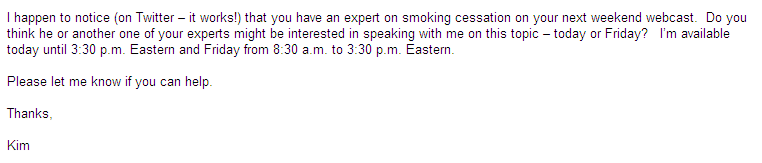
Increased News Coverage. Journalists are increasingly involved in Twitter, and looking to it as a quick way to identify sources and story ideas. Here’s a portion of an email one of my colleagues got in late October from @KimPainter, a columnist with USA Today (click to enlarge):

KimonTwittersource

Kim had seen one of our @MayoClinic tweets connected to our #mayoradio program called Mayo Clinic Medical Edge Weekend. We got her in touch with Dr. Richard Hurt, who was the guest on that program, and here is Kim’s column in USA Today in which he was featured.

It’s Free. Nothing I have mentioned above involves any cash. Your Twitter account is free. Twitterfeed to convert your RSS feed to tweets also is free. But even if you have to manually send tweets about your news, and including a link to your news releases, the time investment can be minimal. It doesn’t involve incremental cash outlays. If you’re like most organizations, you probably pay EurekAlert or PR Newswire or BusinessWire to distribute your news releases. If you are paying for those services, why wouldn’t you take advantage of a free tool like Twitter?

Listening and Engagement. The preceding reasons provide more than enough justification for getting a corporate Twitter account, but engaging stakeholders and listening to them is the best use for Twitter. For that reason, whether your boss approves a corporately branded Twitter account or not, I strongly suggest that you get your own personal Twitter account. Just dive in and start making connections. As you are using Twitter personally, you will see applications that are relevant to your work.

If you have questions about how to get started with Twitter, we have a whole Twitter curriculum here on SMUG to take you through the process. To answer your last question about building a following, see Twitter 103: Following and Being Followed, and Twitter 104: Four Steps to Building Your Personal Twitter Network.

Air Medical Transport Social Media

A friend and colleague at Mayo Clinic who works with Mayo Medical Transport is part of a national organization involved in air medical transport. He asked me to do a Webinar today for some of his national peers, as this industry is looking at how social media could possibly be used to improve communication.

These are the slides I’m using for the presentation. Much of the material is similar to what I’ve used elsewhere, but there are some EMS and air medical transport examples sprinkled in.

I will be inviting participants to tweet, if they are involved in Twitter yet, using the #airmed hashtag.

Social Media 401: Vince Muzik Case Study

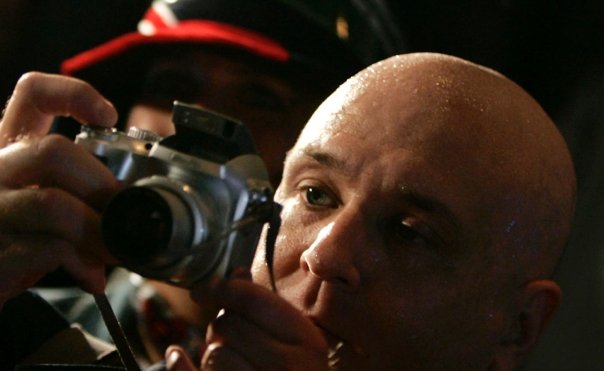
Vince Muzik
Vince Muzik

I’ve known Vince Muzik for nearly four decades, ever since I took piano lessons from his mother, Jan. (Yes, my piano teacher was Mrs. Muzik.) But it gets even better: Vince’s father, Conrad, was the Austin High School band instructor, so when I played trombone (until 9th grade) my instructor was… Mr. Muzik.

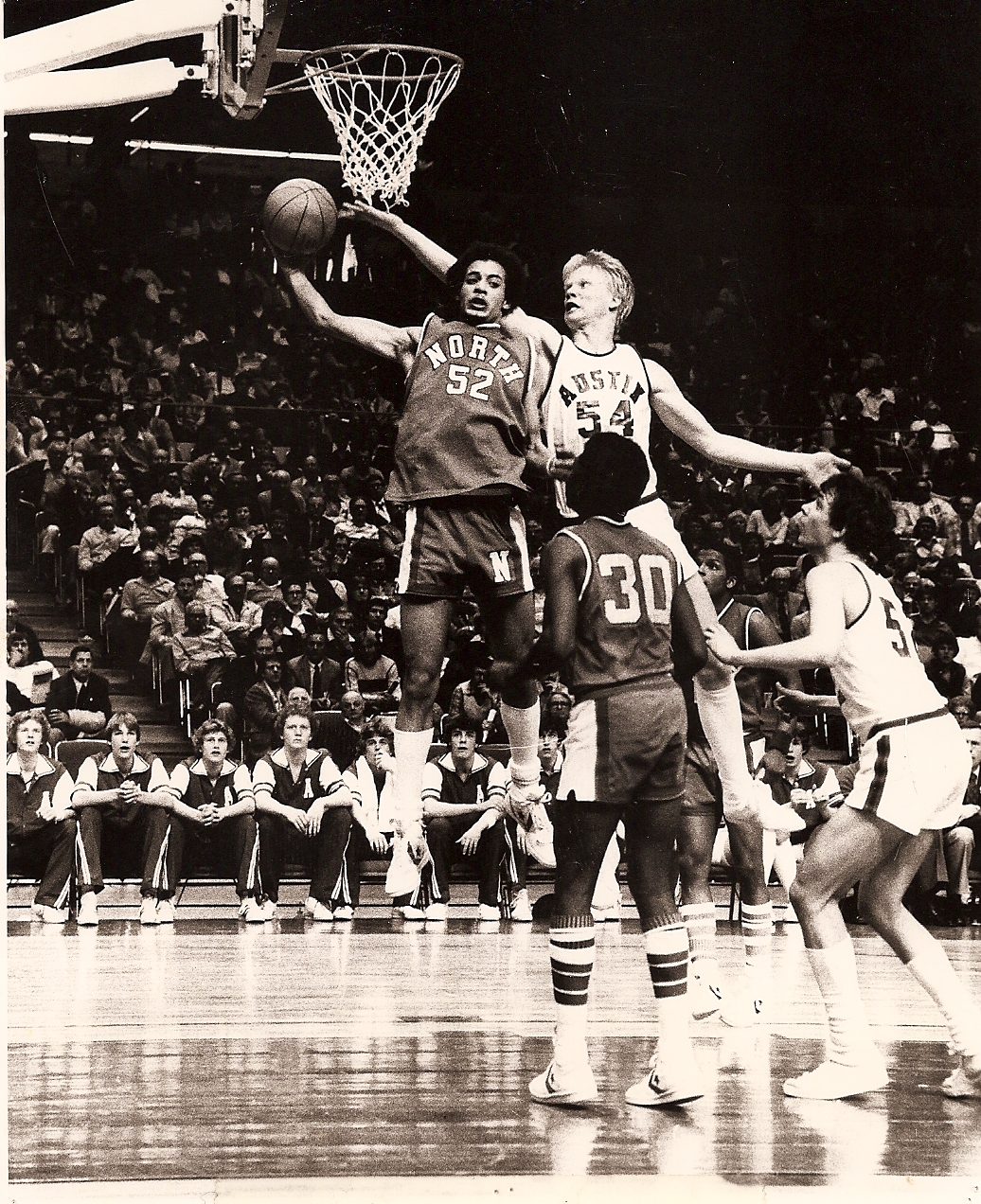
Vince’s love was photography, though, and particularly relating to sports. He got his first chance to shoot a big statewide event when he was a teenager, and the Austin Daily Herald got him press credentials for our basketball team’s trip to the state high basketball tournament in 1981. We were 22-0 going into the tournament, but faced the also-unbeaten (and defending champion) Minneapolis North in the first round. Here’s a photo Vince took at that game (can you tell which one is me?)

One of Vince's first published photos

Although I didn’t get that rebound, we did come back to win the game after being down 31-24 at halftime. We beat another undefeated team, Chaska, in the semifinals, before losing to Anoka in the championship game. Here’s my admittedly self-serving highlight video from that experience, which is only available thanks to another friend whose brother was one of the few consumers who had a VCR at the time:

Vince has stayed interested in sports, and has gotten opportunities to shoot some much bigger events with much better athletes. We reconnected this year when he heard about what I was doing in social media at Mayo Clinic and about SMUG, and he asked me for advice about a really exciting project he had in mind. Now that he’s getting it off the ground, I want to highlight it as a great example of using social media tools to tell a story.

Vince lives in the Twin Cities now, and has made some good connections with Cretin-Derham Hall, where American League MVP Joe Mauer of the Minnesota Twins went to high school. Other notable alums include hall-of-famer Paul Molitor, 2000 Heisman Trophy winner Chris Weinke, Baltimore Ravens All-Pro Center Matt Birk and current Notre Dame star receiver Michael Floyd.

This year, CDH has the consensus number one football recruit in the nation, Seantrel Henderson, and Vince’s great idea was to tell the story of what it’s like to be that guy, giving a behind-the-scenes look at the recruiting process.

Vince is a great storyteller, but his niche has been photography. And sometimes a niche can become a pigeonhole. But with social media, he can break out of that niche. He’s getting video of Seantrel talking about his experiences, and sending a Flip video camera with his parents as they go along on official visits. Here’s the video Vince posted of Seantrel’s Ohio State visit and his conversation with former Buckeye Chris Carter and with coach Jim Tressel:

This video has already been picked up by the Cleveland Plain Dealer, and SportsIllustrated.com also asked Vince to send it to be embedded there.

I don’t know where this will end up, and neither does Vince, but one thing it shows is how the low cost and easy availability of social media tools make it possible for someone with a good idea to just make it happen instead of needing to pitch it in advance to a mainstream media outlet. As he says:

I suppose you could say this is part of a social media documentary project I’m doing on Seantrel about recruiting and his life as the No. 1 recruit in the country. If it works out, someday you’ll be able to download it and watch it on your computer or iPhone or Blackberry. Or I may just keep following him until he gets to the NFL. We’ll see.

When he was a teenager back in Austin, Vince had to get the local newspaper to bless his photography project before he could do it. Now he is using YouTube, Twitter (@VMuzikman) and a WordPress.com blog as his publishing platform, with a Flip camera as his main video source. His first video is up to about 12,000 views as of this writing.

Vince is a star SMUGgle who is putting the MacGyver mindset into action.

I hope you will follow what he’s doing and help spread the word about his #Seantrel project, and if you have suggestions for how he can improve, give him feedback.

More than that, I hope you will follow his example and just dive in and start using social media tools creatively in your projects.