SMUG Textbook: Here Comes Everybody

Here Comes Everybody: The Power of Organizing Without Organizations, by Clay Shirky.

I read this book more than a year ago, and it has significantly affected my thinking. Shirky’s main point is that complex projects formerly required the overhead of an organization, which meant that there had to be some way of funding that overhead, either through business profits or government taxation. The advent of digital tools has made complex projects possible without the organizational overhead. Some of these, such as Linux or Wikipedia or Craigslist, have seriously challenged or even “beaten” the products of formerly profitable organizations. But these tools have also made it possible to undertake projects that previously weren’t worth doing. In a section he calls “The Tectonic Shift,” Shirky explains:

For most of modern life, our strong talents and desires for group effort have been filtered through relatively rigid institutional structures because of the complexity of managing groups. We haven’t had all the groups we’ve wanted, we’ve simply had all the groups we could afford. The old limits of what unmanaged and unpaid groups can do are no longer in operation; the difficulties that kep self-assembled groups from working together are shrinking, meaning that the number and kinds of things groups can get done without financial motivation or managerial oversight are growing.

You will find traces of Here Comes Everybody in many of the 35 Social Media Theses. I highly recommend it to all SMUGgles.
Thesis 1: Air was the original social medium

[ratings]

Note: This post is part of the 35 Social Media Theses series, providing amplification and an opportunity for discussion of one of the theses originally posted on Reformation Day 2009.

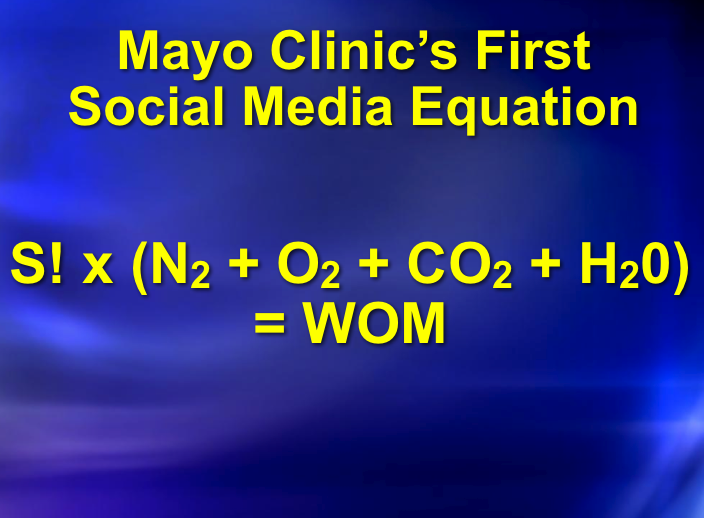
SocialMediaEquation

In one sense, as I will argue in Thesis 4, the social media revolution is historic. But the fundamental issue to understand about social media is that, in their essence, they have been around from the beginning of human civilization. Or, as I put it in the first of my 35 Social Media Theses posted 492 years after Luther’s 95:

Social media are as old as human speech, with air being the medium through which sound waves propagated.

I have boiled that down further into the title of this post and in my presentation slides, in keeping with Seth Godin’s advice. I don’t completely agree with his arbitrary limit (never more than six words on a slide), but it’s good general guidance, so I try to comply when I can. And it’s nice to see that he relaxed the hard-and-fast limit with these helpful presentation tips.

For several millennia, “spreading the word” happened mainly by the propagation of sound waves through the mix of Nitrogen, Oxygen, Argon, water vapor, Carbon Dioxide (which is not a pollutant, by the way) and other chemicals that make up our atmosphere.

So whether it was news about a miraculous healer in the countryside of Judea or which merchant in the marketplace had the freshest produce, the way it was disseminated was almost entirely verbal, from one person to another (or a small group at a time), via the medium of air.

In other words, through a social medium.

I work at Mayo Clinic as manager of syndication and social media, but social media have been at work at Mayo long before I was even born. For more than a century, and even after the advent of mass media like TV and radio, word of mouth has been the most important source of information influencing preference for Mayo Clinic. It’s been all about people sharing their experiences as patients (or accompanying family members visiting Mayo) in a social context. In the equation above, S! stands for satisfaction, and as it is multiplied via sound waves through air, it leads to word-of-mouth. Putting it in a formula like that creates the illusion of scientific rigor, but it’s really pretty simple.

In considering the tools (as we will see in Thesis 2) social media are new, but in another sense they are just the way we as humans have always communicated.

YouTube, Facebook, Twitter and blogs are new.

Social media aren’t.

Twitter 116: 3 Steps to Joining or Leading a Twitter Chat

[ratings]

Note: This post is specifically intended to help USA Today readers who are new to Twitter so they can participate in our #MayoUSAToday Twitter chats. For more introductory information on Twitter, see the Twitter curriculum.

Update: This week’s #MayoUSAToday Twitter chat is on concerns about memory loss. Join us from 1-2 p.m. ET on Thursday, Sept. 16.

In Twitter 115: 5 Benefits of Twitter Chats, I discussed why you would want to create (or join) a Twitter chat. Twitter 116 takes you through the how.

Prerequisite: It seems obvious, but to join a Twitter chat, you need to have a Twitter account. If you don’t have one yet, go to Twitter 102 for step-by-step guidance.

3 Steps to Twitter Chats

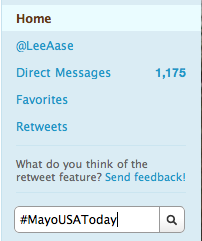
searchinTwitter

1. Go to Twitter.com and search for your desired hashtag. This applies whether you are joining an existing chat (like #MayoUSAToday) or creating one of your own. If you’re starting your own chat, your goal for this step is to find a tag that hasn’t previously been used.

2. Save your search for easy reference. When you see your search results for a chat you’re joining (like our Mayo Clinic/USA Today chat) you will see a “Save this search” link:

savesearchcloseup

…right next to the “Real-time results for #(name of hashtag)

savethissearch

When you click the “Save this search” link, you will add that search query to your list of saved searches, like this:

savedsearcheslist

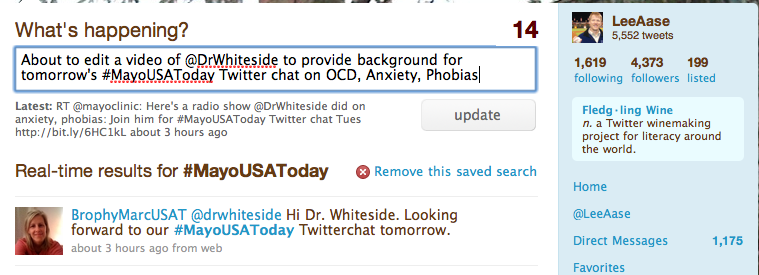
3. Use the hashtag in a Tweet to start or join the conversation. Here is an example of a tweet I did as part of the #MayoUSAToday chat (click to enlarge):

addingatweettochat

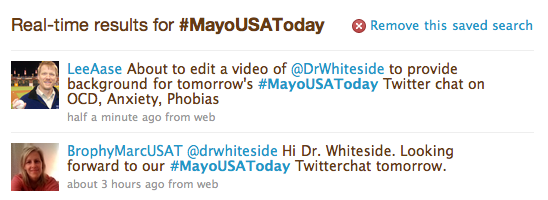
…and then after refreshing the page, you’ll see that the tweet shows up in the thread:

chatsearchresults

That’s really all there is to it. When the chat starts, just click on your saved search link and wait to see what tweets show up. You should occasionally see a yellow bar at the top of your search results that looks something like this:

Picture 11

Just click that yellow bar and the new tweets will show up. To reply to any of them, just hit the reply arrow next to the tweet…

Picture 12

…and be sure to add the #MayoUSAToday hashtag to your tweet so it will be included in the conversational stream.

There are other ways to participate in a Twitter chat, such as through desktop clients like Tweetdeck or smartphone clients like Tweetie or Twitterberry, but for Twitter beginners this is the simplest way, just using the main Twitter Web site.

Is this clear? Do you have other questions about how Twitter chats work?

Assignment:

  1. Add the #MayoUSAToday chat to your saved searches, using the first two steps listed above.
  2. For extra credit, join the conversation if you find this week’s topic interesting.

Twitter 115: 5 Benefits of Twitter Chats

[ratings]

Twitter chats are an amazing way to bring together people for a focused conversation on a particular topic or surrounding an event, such as a conference or Webinar.

There’s no need for the people involved to know each other before the chat, and in many cases the chats can be great ways to connect with people who have common interests. For example, I frequently join the #hcsm chat for people interested in using social media in healthcare, and occasionally join the #hcmktg chat related to healthcare marketing.

For Mayo Clinic, we use a #mayoradio Twitter chat to gather questions from outside our local area for our Medical Edge Weekend radio program, and have done several joint chats with Mary Brophy Marcus (@BrophyMarcUSAT) from USA Today, inviting readers to discuss the topics of her stories with a Mayo Clinic specialist. We’re now using #MayoUSAToday as the hashtag for these discussions.

In 3 Steps to Joining or Leading a Twitter Chat, I take you step by step through the process of joining a Twitter chat. But first, here are some of the reasons you might want to participate. I’ll use the #MayoUSAToday chat as an example:

  1. Public discussion that spreads as it continues. When a new person joins the discussion by including #MayoUSAToday in a tweet, it spreads the word about the chat to her Twitter followers. Any of her followers who retweet or reply to her tweet extend the reach still further.
  2. Broad geographic reach. Speaking of extending the reach, the beauty of a Twitter chat is it can be worldwide. Some diseases or conditions just aren’t common enough to build a critical mass for discussion locally, no matter how metropolitan the location. Getting people together physically is tough, but with Twitter you can gather people with common interests virtually without them having to leave the comfort of wherever they use their computer. And of course with iPhones, Blackberries or Androids people can join the chat from wherever they are: I did a recent chat from O”Hare airport in Chicago.
  3. No need to raise your hand. Unlike an in-person meeting, you don’t need to be recognized by the moderator to ask you question or make your comment. Just include the #MayoUSAToday tag in your tweet, and you’re part of the conversation. If you use the tag to interject your marketing messages into a discussion, you won’t last long in the chat (or in Twitter). Users will report you as a “hashtag spammer” (a term that is part of a Twitter lexicon I plan to publish) and your account will be suspended. But if you’re a real person who just wants to join the conversation without hijacking it for pecuniary reasons, you’ll find people in Twitter quite friendly and open.
  4. Wallflowers welcome. It’s fine to just lurk and listen. You can just click the #MayoUSAToday link, for instance, and watch what others are saying. But more importantly, a Twitter chat can be a great tool to get discussion from the whole audience at a conference, instead of just those who are most verbose and comfortable speaking in public. So when I do a presentation, I generally create a hashtag that enables everyone to comment or ask questions. This can help make sure we hear from the introverts, whose ideas may not otherwise get as much consideration as they deserve, which leads to the final point…
  5. No time limits. Many if not most Twitter chats have a set time during which people have agreed to gather. The #MayoUSAToday chats are scheduled to run for one hour, during which time our Mayo Clinic subject experts are online to answer questions tweeted by USA Today readers and others drawn into the conversation (see Benefit #1 above.) But the time expiring doesn’t mean you can’t continue to tweet using the hashtag, and the conversation can continue on at a slower pace.  So if someone tweets with a #MayoUSAToday tag three hours after the scheduled chat ends, it just means the question probably won’t be answered right away, as it would during the one-hour window. This also obviously applies to conferences and other in-person meetings; just because people have gone home doesn’t mean the conversation has to end.

In 3 Steps to Joining or Leading a Twitter chat, I will take you step-by-step into joining the #MayoUSAToday chat, and you can use the same pattern to join other chats (or set up one of your own.)

Colonoscopy Social Media Case Study

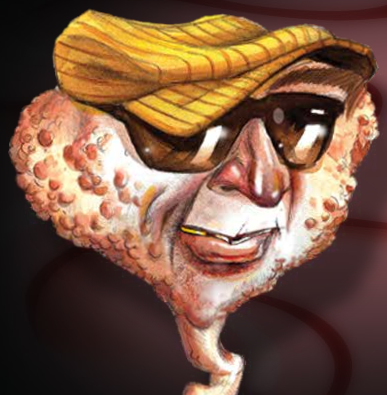
Pauly Trimmed

Here’s another case study from the recent Healthcare Internet Conference in Las Vegas. I got a chance to interview Jason Voelker from ThedaCare about Pauly Polyp (pictured above) and the idontwantacolonoscopy.com Web site that invites users to share their excuses for not complying with colon cancer screening guidelines.

Pauly is on Twitter, too.

What’s your excuse (for not getting a colonoscopy, or not getting on Twitter)? Really, neither of them are that painful.