SMUG Textbook: Trust Agents

Trust Agents: Using the Web to Build Influence, Improve Reputation, and Earn Trust, by Chris Brogan and Julien Smith.

I got to have dinner with Chris Brogan at a conference in May in San Francisco, and from our conversation (and his blog) I was pretty sure this book would be good, but this is one of those books that had me nodding in agreement almost from the start.

I particularly liked the chapter called “Make Your Own Game,” which is about seeing your life and career as a game, and progressing from playing to “hacking” to programming, and is similar to what I call “The MacGyver Mindset.” It’s about understanding the rules of social media so you can help develop the rules for your own game, tinkering with tools and seeing how they can let you do your work in a new way, and maybe even create a whole new business.

Here’s how Brogan and Smith define what a trust agent is:

Trust agents have established themselves as being non-sales-oriented, non-high-pressure marketers. Instead, they are digital natives using the Web to be genuine and to humanize their business. They’re interested in people (prospective customers, employees, colleagues, and more), and they have realized that these tools that enable more unique, robust communication also allow more business opportunities for everyone.

Who, exactly, are trust agents? They are the power users of the new tools of the Web, educated more by way of their own experiences and experiments than from the core of their professional experiences. They speak online technology fluently. They learn by trying, so they are bold in their efforts to try new applications and devices…. Trust agents use today’s Web tools to spread their influence faster, wider and deeper than a typical company’s PR or marketing department might be capable of achieving, and with more genuine interest in people, too.

I added some emphasis on elements in the above that embody the SMUG philosophy, but would just take issue with the “digital native” descriptor. I don’t think you need to have grown up with digital tools to become a trust agent. It’s perfectly fine to be a naturalized digital citizen. But that’s a minor quibble with an otherwise excellent book that has the SMUG textbook seal of approval.
Thesis 1: Air was the original social medium

[ratings]

Note: This post is part of the 35 Social Media Theses series, providing amplification and an opportunity for discussion of one of the theses originally posted on Reformation Day 2009.

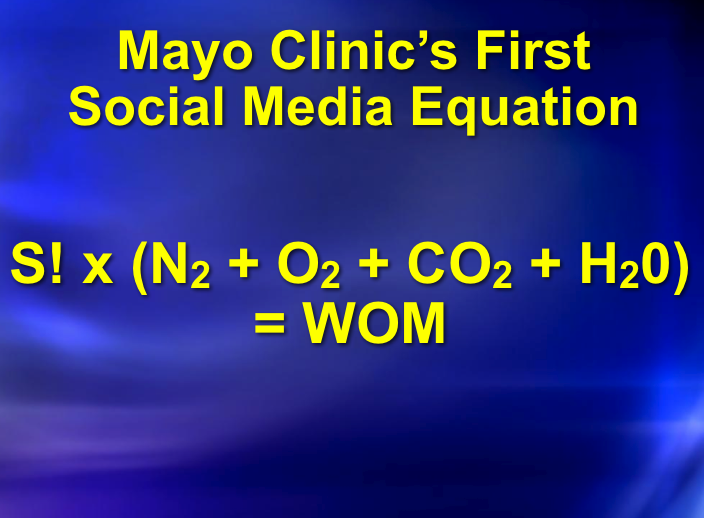
SocialMediaEquation

In one sense, as I will argue in Thesis 4, the social media revolution is historic. But the fundamental issue to understand about social media is that, in their essence, they have been around from the beginning of human civilization. Or, as I put it in the first of my 35 Social Media Theses posted 492 years after Luther’s 95:

Social media are as old as human speech, with air being the medium through which sound waves propagated.

I have boiled that down further into the title of this post and in my presentation slides, in keeping with Seth Godin’s advice. I don’t completely agree with his arbitrary limit (never more than six words on a slide), but it’s good general guidance, so I try to comply when I can. And it’s nice to see that he relaxed the hard-and-fast limit with these helpful presentation tips.

For several millennia, “spreading the word” happened mainly by the propagation of sound waves through the mix of Nitrogen, Oxygen, Argon, water vapor, Carbon Dioxide (which is not a pollutant, by the way) and other chemicals that make up our atmosphere.

So whether it was news about a miraculous healer in the countryside of Judea or which merchant in the marketplace had the freshest produce, the way it was disseminated was almost entirely verbal, from one person to another (or a small group at a time), via the medium of air.

In other words, through a social medium.

I work at Mayo Clinic as manager of syndication and social media, but social media have been at work at Mayo long before I was even born. For more than a century, and even after the advent of mass media like TV and radio, word of mouth has been the most important source of information influencing preference for Mayo Clinic. It’s been all about people sharing their experiences as patients (or accompanying family members visiting Mayo) in a social context. In the equation above, S! stands for satisfaction, and as it is multiplied via sound waves through air, it leads to word-of-mouth. Putting it in a formula like that creates the illusion of scientific rigor, but it’s really pretty simple.

In considering the tools (as we will see in Thesis 2) social media are new, but in another sense they are just the way we as humans have always communicated.

YouTube, Facebook, Twitter and blogs are new.

Social media aren’t.

Putting Social Media to Good Use

Today I’m honored to be presenting to a group of folks working (mainly) in local government communications, and I’m doing it in St. Paul, Minnesota, for the Minnesota Association of Government Communicators‘ fall conference. It’s a bit of a “back to the future” day for me, because I worked in government in St. Paul for about six years: partly at the Minnesota capitol, and partly as an assistant to a Ramsey County Commissioner. This gives me a lot in common with these folks, because I’ve been in their shoes (although it was in the pre-Web days.) So I’m looking forward to a great discussion.

If you want to join the discussion, we will be using the #magc hashtag.

Making the Business Case

Today I’m presenting at the 2009 Communications Conference for AHIP, the association of America’s Health Insurance Plans. I’m looking forward to hearing Dr. Atul Gawande at the opening session, especially since he wrote an article in The New Yorker that highlighted the cost-effective care provided by my employer, Mayo Clinic.

Here’s my presentation deck:

Twitter 132: Creating a Twitter Search Widget

[ratings]

In Thesis 33, I invited those interested in helping to spread the word about the #wristpain Twitter chat to

  1. retweet this: @mayoclinic: Know anyone with mystery #wristpain? Discuss a common cause Thurs on Twitter w/@RABergerMD http://bit.ly/dBlMH
  2. post to their Facebook and/or (if you’re really motivated)
  3. embed a Twitter search widget in your blog in a post on in the blog’s sidebar.

So I thought it would be good to give a step-by-step course on how to set up a Twitter search widget.

Note: This is one of the things you can’t do in WordPress.com, because the javascript is not allowed on WordPress.com blogs. You need to be using a self-hosted (WordPress.org) version, or a platform like Blogger or Typepad. One of the few downsides of the free WordPress.com platform.

So, here’s the step-by-step:

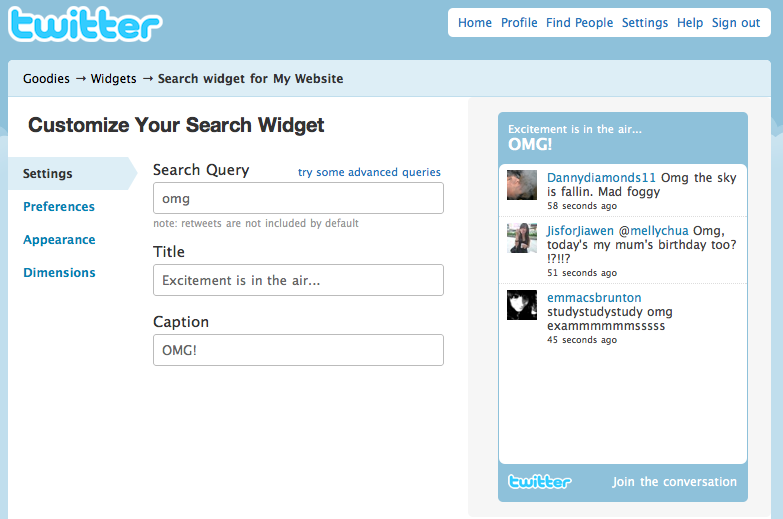
1. Go to the Twitter Search Widget page. You will see a screen like this (click any of the images to enlarge):

OMGsearch

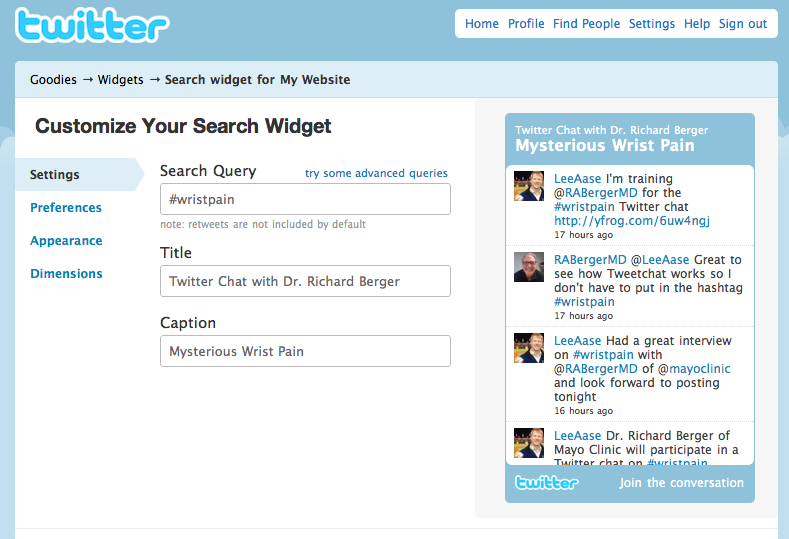
2. Since you don’t really want to display all of the Tweets using “OMG” in their body, you need to change the title and search criteria. Here’s what I did for my widget about the #wristpain Twitter chat:

Berger chat

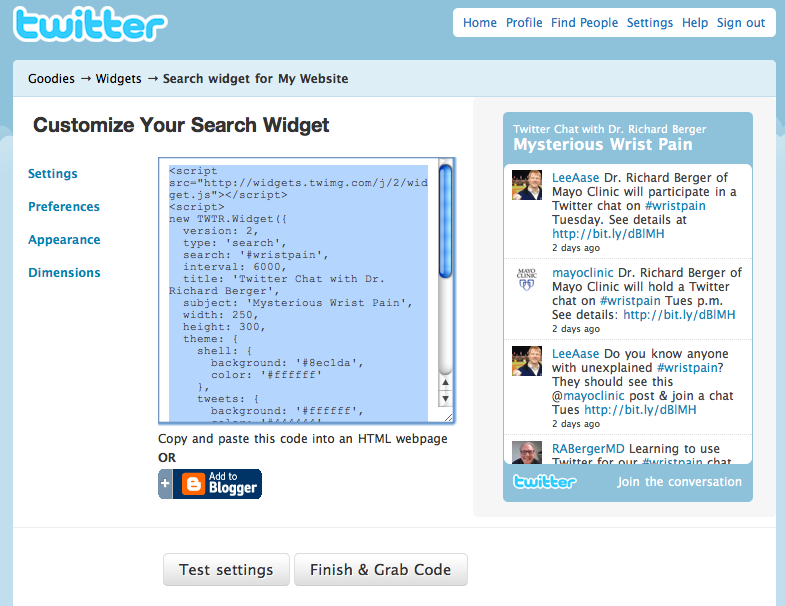
3. You can adjust appearance and other settings if you want, but all you really need to do at this point is click the “Finish & Grab Code” button, highlight the code by clicking on it, and copy it to your clipboard.

Finish grab code

4. Go to your self-hosted WordPress blog (the process is similar for Blogger or Typepad) and either create a text widget for the sidebar, or a new post into which you want to insert your widget.

If you are doing a new post, be sure to switch from Visual to HTML view before you paste in your code:

HTML not Visual