On World Peace, Labor Day and Blocking Facebook

I’m as big an advocate of social media as you’re likely to meet. Still, I think Washington Post columnist Kathleen Parker went a bit overboard in yesterday’s offering, Facebook and social media offer the potential of peace:

Not to be a Pollyanna, but it is striking to realize that peace becomes plausible when barriers to communication are eliminated. More than 500 million people use Facebook alone. Of those, 70 percent are outside the United States. MySpace has 122 million monthly active users, and Twitter reports 145 million registered users.

I actually think Ms. Parker does have a bit of the Pollyanna principle running through her argument. And it’s kind of nice for me to have people like her occupying the “extreme optimism” end of the social media spectrum. It makes me seem more moderate. I agree that building more friendship connections is helpful, but I’m not anticipating a Nobel Peace Prize for Mark Zuckerberg.

While I don’t see social media ending the Middle East conflict, I do see these tools playing a huge role in connecting and strengthening relationships within organizations and among those with common interests.

That leads me to one of Parker’s paragraphs that I thought was particularly illuminating, as it relates to the practice of many companies in blocking access to social media sites from their corporate networks:

Obviously, some countries don’t like these media for the very reasons we do. People talk. Facebook is blocked in Syria and China and until recently was also blocked in Iran, Pakistan and Bangladesh. Where freedom flourishes, so do open channels of communication.

As we celebrate Labor Day in the United States, maybe opening access to social media sites at work wouldn’t rank among the all-time achievements for employee-friendly workplaces. It probably won’t usher in a Millennium of peace, either.

But at least it would make your company more open than China, Syria and Iran.

Does your company block access to Facebook, Twitter and YouTube at work?

FIR Interview on Mayo Clinic Center for Social Media

I had an opportunity on Wednesday to record a conversation with Shel Holtz, co-host of For Immediate Release, for one of the podcast series he produces with Neville Hobson. This one, Lee Aase on Mayo Clinic’s Center for Social Media, is part of the FIR Interview series.

I believe I met Shel seven or eight years ago, and in the last four years we’ve gotten to know each other well through social media and in speaking together at conferences. In fact, he’s going to be one of the speakers at our Mayo Clinic/Ragan Communications Social Media Summit in Jacksonville in September.

In our FIR conversation we go into a lot of the detail about our new Mayo Clinic Center for Social Media, so for those interested in more background on what we’re envisioning for its role, and how it came to be, I think it will be helpful.

Listen here.

Let me know what you think!

A Philosophy for Starting with Social Media

I was in Boston a couple of weeks ago for a presentation to the Massachusetts Hospital Association, and afterward had a chance to talk with Dan Carter (@DanRPG) about social media in healthcare. Dan posted the edited video yesterday on his Health Care 3.0 Ning site:

G’Day Alfred Health

I’m sure they’ve never been greeted like that before. Kind of like my work colleague, Sara Bakken, who married a guy named Eric Lee. Now nobody doesn’t like her. Or my friend Kevin, who after the first Matrix movie grew tired of being called “Missss-ter Anderson.”

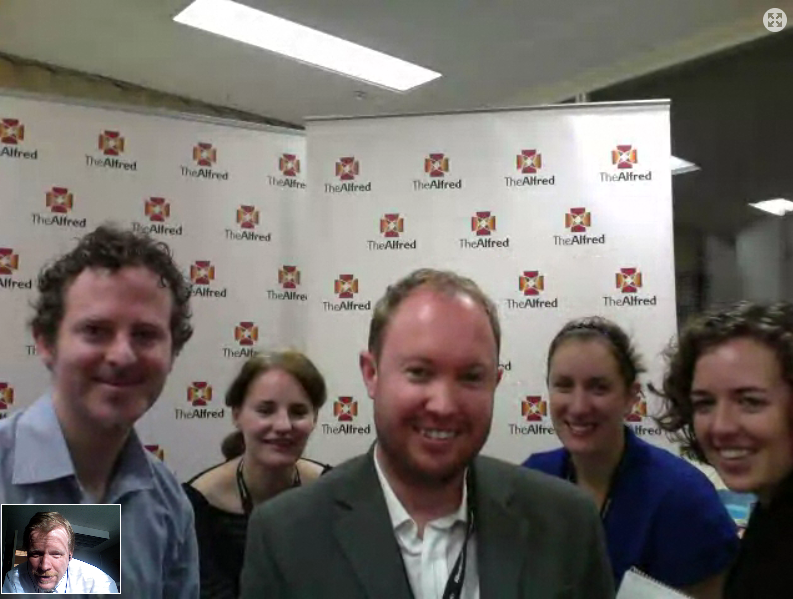
Anyway, as I tweeted earlier tonight, I had the distinct pleasure of a Skype videoconference at 6 p.m. CDT with the communications team from Alfred Health in Melbourne, Australia. It was about 8 a.m. Wednesday for them:

It was a great discussion and we covered a lot of ground in 30 minutes. Being a public hospital, their challenges are somewhat different from those we have in the U.S., but the point I made with them is not to necessarily emulate exactly what we have done with social media tools, but to see how they can be used to meet the goals for their health system.

So, for example, they may want to see how social tools can help with behavior modification, and perhaps even to provide low-cost or no-cost medical guidance to patients so that they don’t need to come to the hospital. Among the limitations we generally have in the U.S. is that there is little economic incentive for health care providers to invest in prevention, because for the most part seeing patients is the way they get paid. So instead of using social tools to make patients aware of unique services, which could lead to increased demand, they may want to apply them to prevention or support groups or guidance in when self care is appropriate.

In follow-up I mentioned our Mayo Clinic Symptom Checker iPhone app, and how that (or something like it) could play a role in helping patients be wiser about when they need to seek care.

What do you think? How can social media tools and other digital platforms be used to improve health and health care in places like Australia or Western Europe, where the health care systems are much different from the U.S.?

Debbie Weil on Social Media 101

Debbie Weil’s book on corporate blogging was one of the first I read as I was exploring social media and applying it at Mayo Clinic.

I’m honored that our work was featured so prominently in a Social Media 101 presentation she gave yesterday in Washington, D.C. She mentioned it via Twitter today, so I thought it would be good to share here:

Debbie has a lot of solid material the presentation. Her discussion of our Mayo Clinic experience is on slides 12-17, and I particularly like her Twitter tutorial that starts on slide 30. If you want to get her book, the link is below. Or you can get the updated Kindle version of the book here.