Book Review: LinkedIn Riches

About a month ago, John Nemo sent me a message in LinkedIn asking if I would like a review copy of his new book, Linkedin Riches: How I made $135,000 in just 90 Days using LinkedIn!

LinkedIn Book coverI was wary at first because of the subtitle, which made it sound like the get-rich-quick stuff of infomercials, but I overcame that initial reaction and requested a Kindle copy.

I’m glad I did. And I’m glad that somewhere through the process, John decided to take his own advice in the naming of his book. More on that in a bit.

Because of the patient-oriented nature of my day job, I have focused much more on general consumer platforms like Facebook instead of LinkedIn. Our Human Resources department has used LinkedIn successfully for recruiting. But since the audiences I have been pursuing are mostly patients and consumers, as opposed to “B2B” as they say in the biz, I have had a profile, but haven’t spent much time personally in LinkedIn. So it was good to get perspective from someone who has.

One of the main points John makes is that your LinkedIn profile should be client-facing and framed in terms of what you can do for clients. It’s not about you. And he also gives some concrete suggestions for how to implement this philosophy.

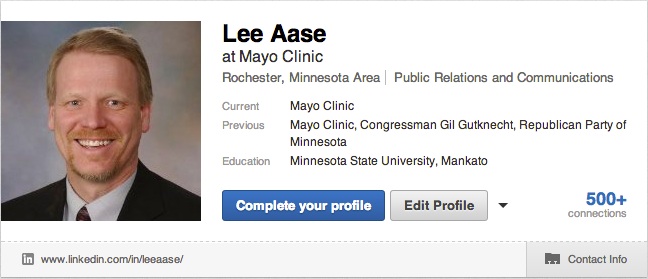
So here’s how I used his advice on my own LinkedIn profile.

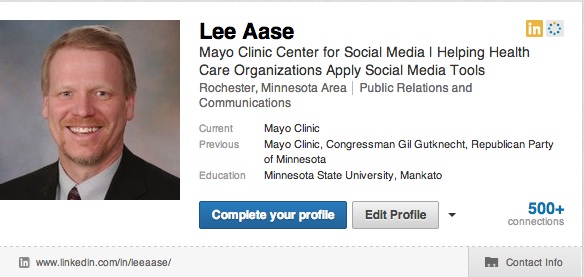
Rewriting My Profile Headline:

Before:
Before Profile


After:

LinkedIn After

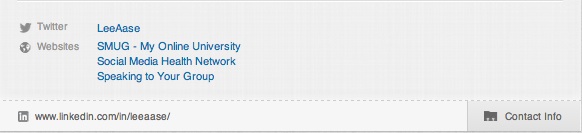
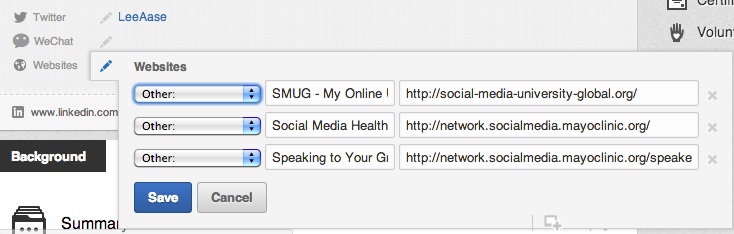
Giving Descriptive Titles to Web Links in Contact Info
Edit Web Sites

Descriptive Contact LInks

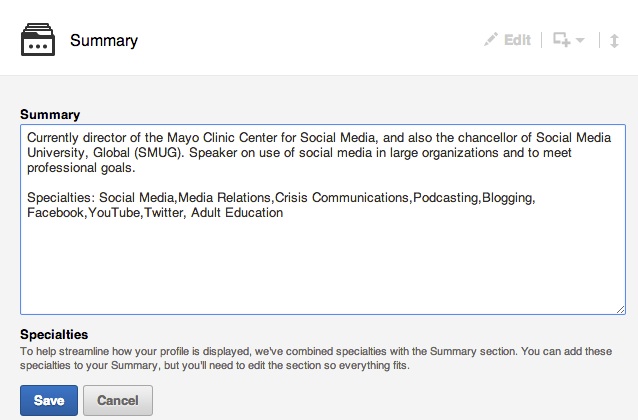
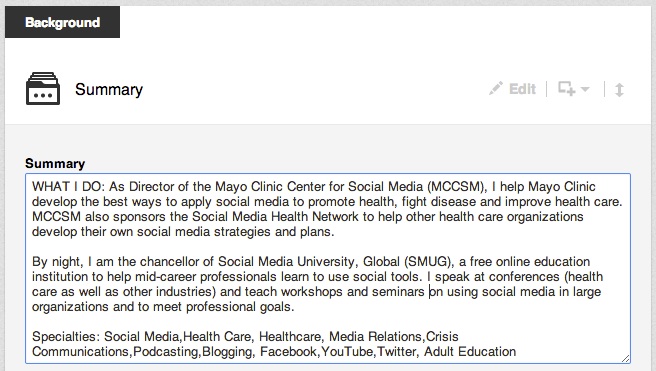
Improving My Summary:

Before:

Summary before

After:

Summary after

Those are three positive changes in my profile in just the first chapter. The combination of the client-facing mindset and some practical tips makes this a good resource.

Practicing What He Preaches

As his book is now published, it was good to see that John retitled it to follow his own client-facing advice. You will remember that the previous subtitle was all about him: “How I made $135,000 in Just 90 Days Using LinkedIn!”

While that might appeal to some, the new title is much more oriented toward benefits for the reader.

Linked In Riche$: How to Leverage the World’s Largest Professional Network to Enhance Your Brand, Generate Leads and Increase Revenue.

And if you’re looking for a quick read with some helpful tips on using LinkedIn, I think you’ll find it worthwhile.

Presenting in Columbus to Cancer Communicators

I’m pleased to be in Columbus, OH this morning to present to the NACCDO/PAN meeting. These folks work for NCI-designated comprehensive cancer centers. As you will see in the slides, this is my second time presenting to this group, and the first time was a quite memorable day for me.

We had lots of good questions and discussion, and Debra Loggia had some great insights. Check out the Twitter stream of the discussion. And if you have comments or questions, I’m glad to interact.

Integrating Social Media in Your Hospital’s Communications

I’m presenting today at the Iowa Society for Healthcare Marketing and Public Relations Spring Conference in Des Moines. I believe this is the third time I’ve been with this group, and so I’m looking forward to sharing some new material and perspectives. Here are my slides:

I welcome your questions and comments. And if you would like to pursue deeper exploration of this material, our Mayo Clinic Center for Social Media Social Media Residency program provides a day-long immersion. The next session is May 12 in Rochester.


Enhanced by Zemanta

Twitter: Social Media’s Gateway Drug

I’m doing the second in a series of adult education workshops through a grant with Rochester Community and Technical College today. The last session was a social media overview. Here are the slides from the Twitter crash course:

Enhanced by Zemanta

5 Reasons to Keep Your Twitter Disclaimer

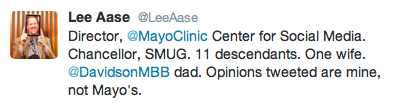
An article published by Ragan Communications yesterday suggested that the “tweets represent my opinion, not my employer’s” disclaimer in Twitter bios is unnecessary, perhaps even harmful, and urged its demise.

Screen shot 2014-03-04 at 4.33.05 PM

UK-based Stuart Bruce, in an article reprinted from Stuart Bruce’s PR Guy Musings, said disclaimers should go because 1) Many people will never see them, 2) They don’t protect you from legal liability, 3) People will associate your comments with your employer anyway, so a disclaimer can create a false sense of security and 4) the real solution is good corporate social media policies and effective employee education on the policies or guidelines.

While I essentially agree with all four of those points, I believe getting rid of what I like to call “the personal responsibility clause” would be a mistake.

Here’s why:

  1. It’s the social media equivalent of TSA screening. The security benefits of removing shoes and belts, laptops and one-quart bags with liquids and gels for x-ray examination are questionable, too. But having most passengers endure this ritual enables otherwise wary travelers to board airliners with more confidence than they would in the absence of such a process. Likewise, having the social media disclaimer enables corporate leaders to more easily reconcile themselves to having employees posting opinions publicly.
  2. It’s not an ongoing burden. You don’t include the disclaimer in every tweet. Unlike TSA screening, which inconveniences passengers on every flight, once you have added your disclaimer to your Twitter bio, you don’t need to do it again.
  3. It’s free. Maybe it “costs” a few of the 160 characters in your Twitter bio that you could otherwise use to describe yourself, but having the disclaimer has no out-of-pocket cost.
  4. There is a difference between association with your employer and speaking for your employer. In a presentation I uploaded to Slideshare today, I outlined a series of “Bad and Ugly” examples of conduct on Twitter. No disclaimer can protect your employer from the impact of a truly stupid action you take, but most things you say or do on Twitter hopefully won’t fit that description. And many of the most troublesome Twitter gaffes resulted from employees mistakenly posting tweets on their employers’ accounts that had been intended for their personal accounts. The same content on personal accounts likely would not have caused the controversies.
  5. A disclaimer is a declaration of your right to express a personal opinion online. It’s not just a disclaimer of responsibility for speaking on behalf of your employer; it’s staking your claim, your right as an American (for those of us in the former colonies), to have and express opinions. The disclaimer/declaration is a reminder of that right and the associated responsibility.

Of course if part of your day job is to speak for your employer, the lines get a bit murkier. For example, our Mayo Clinic CEO doesn’t have the disclaimer on his Twitter bio; because of his office, he does speak for Mayo Clinic. The same may be true in some cases for those of us who work in PR, which may be part of Mr. Bruce’s point.

But for most employees in most organizations, the personal responsibility clause/disclaimer should stay.

At least that’s my personal opinion. It’s also in our Guidelines for Mayo Clinic Employees.

What do you think?