ASTRO Media Training Panel

On Wednesday morning, I’m in Chicago for the ASTRO 2009 Annual Meeting, where I will be part of a panel on media for this group of radiation oncologists. The panel is entitled, “The Media and Medicine, You Scratch My Back and I’ll Scratch Yours” and I’m providing a social media perspective to the discussion.

Here are my slides:

Healthcare Internet Conference Presentation

Today I’m honored to be keynoting the 13th Annual Health Internet Conference at Caesars Palace in Las Vegas. So, as Mark Ragan said a couple of weeks ago, now I can tell people, “I’ve played Caesars.” 😉

Here’s how I planned to start my presentation, though I’m not sure it will come out quite like this.

I frequently have people ask me about the frequency of my travel and how I can do it, as they follow my tweets or blog posts. This is the 55th external presentation or Webcast I’ve delivered so far this year, and in October I was in Sun Valley, Scottsdale, Milwaukee, Nijmegen and Amsterdam in the Netherlands, St. Louis, Green Bay, Madison, Minneapolis, and Philadelphia.

This month looks almost as busy. So how and why do I do it?

First, the Web and related tools like the iPhone help me stay connected with the office when I’m traveling. So I can help keep things moving along at home, even when I’m not physically present.

But in another sense, I’m keeping faith with the founders of Mayo Clinic, to whom I will be introducing you shortly. They believed it was essential for them to reach out and learn from others, but that it also was their obligation to share what they had discovered in their practice so that others may benefit.

Social media will be used in health care; the only question is whether it will be led by responsible organizations or by the purveyors of herbal, all-natural Viagra substitutes.

Despite the diffuse nature of the Web in general and social media in particular, I believe it is not only possible for us (and by that I mean all of us in healthcare, not just Mayo Clinic) to lead: I believe it’s a moral imperative. We can do well for our organizations by doing good things in social media. More importantly, patients will do better by becoming more empowered and engaged in their own health and health care. They can learn from credible experts and from each other, and apply those learnings to improve their lives.

I’ve previously said it’s not my goal to convince begrudging skeptics that they should using social media. They won’t do it well, mainly because they will see social media as an extension of the mass media era, and as a former boss used to say, “A man convinced against his will is of the same opinion still.”

My goal is to encourage you, maybe even excite you. You’re most likely here because you sense the amazing potential of the Web and social media.

If you’ve been wanting to implement social media in your organization, I hope to provide you with some concrete examples of success and powerful arguments you can use to help launch your own programs. If our Mayo Clinic example helps you remove internal barriers or work up the nerve to just hurdle them, I will count this a success.

If you are using social media already, I hope to hear your story and what’s worked for you, so we can together help continue the momentum in growth of hospital social media that Ed Bennett has done so well in documenting.

I’ve also embedded the slides from the presentation, which are substantially different from anything you’ve seen from me before. It’s the first time I’ve discussed the 35 Social Media Theses in public. So I hope you will review them and share your thoughts, criticisms, suggested edits and additions.
Looking Back a Year

Picture 12

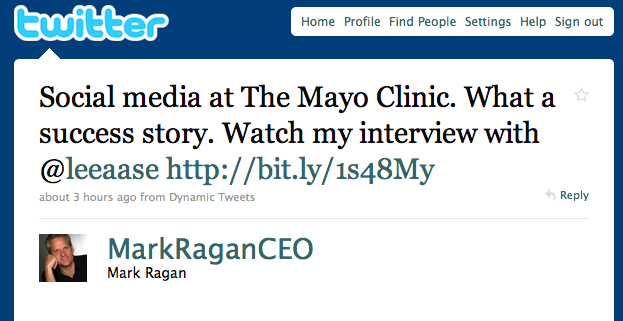
It was just about a year ago that I got a chance to do an interview with Mark Ragan after having done a presentation at a corporate communicators conference Ragan Communications cosponsored with SAS in North Carolina. Today Mark tweeted a link to his post about it on Ragan.com, but when I viewed it I saw it had an embed code that would enable me to post it here, I thought it would be good to cross-post.

Give it a view, and then I’ll be back below with a few observations (or of course you can just skip to the observations if you’d like.)

Observations:

I’ve had a few opportunities to do return engagements, addressing groups to which I had previously made a presentation. Those are fun because they give me a chance to take stock, to see how we have progressed in the time between presentations.

This video is similar for me in that regard, because it predates the launch of our Sharing Mayo Clinic blog and our active engagement in Twitter. So it’s great to see how much has developed further in our Mayo Clinic social media efforts.

It’s also fun to see that the screen shots of SMUG that Ragan showed in the video are from the days when this blog was operating on WordPress.com instead of a self-hosted version of WordPress. One of the advantages of the self-hosted WordPress is that I’m able to embed the video you see above; on WordPress.com you have much more limited options for embedding video, so if I were doing this post a year ago I would have only been able to link to the Ragan post instead of embedding.

So it’s neat to see how far we’ve come, but also to see that the basic strategy outlined in the video above hasn’t changed.

And just last month, almost a year to the date after I talked with Mark at the SAS conference, we hosted a summit on social media in healthcare with Ragan at our Mayo Clinic campus in Scottsdale, Arizona.

I’ve done some year-in-review posts previously (in 2006. 2007 and 2008) and will plan to do so again, but Mark’s tweet provided a nice opportunity for a quick look back.

Tomorrow I’m excited to provide a look forward when I do the keynote at the Healthcare Internet Conference in Las Vegas. If you’re attending the conference, I hope to get to talk to you in person. Please to stop me and say hi. If you’re not going to be there in person, I think the tweet stream to follow will be #hcic.

“Technology makes things possible. People make things happen.”

If you follow the Tweetstream from Jacqueline Fackeldey (@FackeldeyFinds) you may not get a lot from it (unless you’re one of my new friends from the Netherlands) because she mostly tweets in Dutch. But when I attended ReShape09 in Nijmegen, I had a nice opportunity to chat (in English) with this advocate of what she calls “human to human marketing.” When she used the phrase that is the title for this post, I thought it would be great to have her talk about it on camera and share it with the SMUGgles:

Meredith Gould: Great Humanitarian

Here’s a little story about the power of Twitter and the communities it helps to create, and the nice people it enables you to meet.

Earlier this week I attended the e-Patient Connections conference in Philadelphia, where I presented our Mayo Clinic social media case study.

Unfortunately, when I got to the airport (I had to leave just after lunch), I realized that I had left my Flip video camera on the podium at the conference. The video below tells what happened next, and expresses my gratitude:

The conference was a great chance for me to meet lots of great Tweeps with whom I had only interacted via Twitter and our blogs, including, in addition to @MeredithGould@danamlewis, @daphneleigh, @philbaumann, @ePatientDave, @whydotpharma and @SusannahFox. I met several more with whom I hadn’t interacted previously, but look forward to getting to know in the coming months.

Thanks to @kevinkruse for organizing a great conference, and again to Meredith for her Philadelphia airlift.