A Taste of the Tools that are Changing the World

This is my presentation today at the Rochester, Minn. Thursday Noon Rotary Club.

I was asked to provide a 101 course in Social Media in 20 minutes. It’s a nice opportunity to develop an overview presentation that is a more concise version of what I typically do. And I’ve got a little surprise in store that doesn’t show up in the slides. I’ll update with that later.

My aim for the presentation is to help the participants see the power and potential of social media, but also to remove some of the mystery so they will be encouraged to try these tools personally.

How did I do?

Update: Here’s a photo someone sent me during the presentation (click photo to enlarge):

Rotary talk photo

And the little surprise was a live Skype video conference with my daughter, Rachel, and granddaughter, Evelyn. Instead of just talking about how Skype offers Jetsons-like functionality, I decided to demonstrate.

Mayo Clinic Social Media Update

I’m making a several presentations over the next week, and delivering variations of what you see embedded below. I prefer to not distribute the slides in advance as handouts, so that people aren’t distracted and reading ahead, and so we can all literally be on the same page as we have a conversation.

I also don’t want to have people thinking they need to feverishly take notes, so it’s helpful to be able to tell people just to sit back, relax and discuss, knowing that they can go back and refer to the slides online later.

My presentations vary somewhat by audience, depending on whether I need to introduce the social media tools (and how much time I have been allotted), so what you see below is the “full meal deal.”

Here are links to some of the Mayo Clinic social media sites I will be mentioning. I invite you to check them out:

I welcome any questions or comments from any of the presentations here, or feel free to tweet them to me (@LeeAase). The great thing about having that conversation in public is that it’s not just one-on-one; on a blog (or on the really small blog called Twitter) others can learn from the discussion, too. But even more importantly, they can contribute their thoughts…so we’re all richer for having brought in diverse experiences and perspectives.

This also is helpful so I can take a snapshot of where we are in our implementation of social media at Mayo Clinic as of September, 2009.

RAQ: Do You Need to Be Unique to Profit from Social Media?

At the FUEL social media meeting in Rochester, someone asked:

Don’t you really have to be special or unique to gain from social media? I mean, if there are 200,000 T-shirt vendors on Twitter, aren’t you going to waste a lot of time trying to get noticed? What if there is nothing that really sets you apart from others. Aren’t you going to be lost in the crowd, spending a lot of time for no gain?

Given that this presentation was in early July, I guess this question no longer fits the recency criterion for an RAQ, but I think it’s still a valid question to discuss. It also reminds me of something in the printed materials my son got when starting high school. It said something like, “You’re unique, just like everyone else,” which struck him as extremely funny.

It’s a reasonable question to ask, whether you have to be a major brand like Mayo Clinic or Dell to derive value from social media. And obviously an organization like Mayo Clinic has some significant advantages, such as passionate patients and employees and a history of making its reputation through word-of-mouth.

But as we heard from Tom Vanderwell yesterday, there’s plenty of opportunity for people to derive significant benefit from being engaged in social media, even if you’re selling something that is a commodity. After all, many people are just going to shop for the best interest rates online, and a loan is a loan is a loan. Through his blog, Tom has set himself apart from many of his local peers, and also has joined a network of national professionals involved in real estate and mortgages. Because others have come to know him through blogging, Facebook and Twitter, they trust him. And he’s getting business because of it.

So does that mean there is unlimited potential for all of the other mortgage lenders in western Michigan to profit similarly from social media? Nope. There will be some room for others, but they will need to establish “tweet cred.” And the community will pretty quickly sniff out those who are just into social media as a “quick buck” tactic. Social media make it free to communicate, but they also provide mechanisms for people to fight back against those who pollute the digital commons and don’t contribute meaningfully.

If you have a passion for a subject area (like Tom does with mortgages) and want to communicate about it in a way that helps others, you’ll probably do well with it. You don’t have to necessarily be unique; in fact, it helps to have at least a few others in your digital community so you can build off each other’s contributions.

And like Tom Vanderwell, you should think about how the advent of free and easy digital communications can help you conceive your business in a way that transcends geographic limitations.

SMUGgle Interview: Aaron Hughling

I had a chance to meet Tuesday with Aaron Hughling (@aaronhughling), all-around Web guy for Scott & White Healthcare, and his colleague Rhona Williams London, who is the head of PR for Scott & White. After about a year of investigation and preparation, their system (based in Temple, TX) is getting ready to launch into Facebook, YouTube, Twitter and a couple of blogs.

Aaron and I have been interacting through Twitter and email for several months, and I met Rhona at a conference in Phoenix in June. It was great that they were in Minnesota so we could sit down for a chat among SMUGgles.

Aaron also said he’s excited to be attending, along with one or two others from Scott & White, the social media summit for healthcare Mayo Clinic is hosting with Ragan Communications in October in Scottsdale, Arizona. I’m looking forward to it, too; if you attend I believe you’ll come away both inspired to bring social media to your organization and encouraged by the examples you’ll see and hear. There’s still time to register, so I hope you’ll join us.

After our conversation, I asked Aaron if he would be willing to share some of the things he’s learned through his social media journey. Here’s what he had to say. It’s some good advice:

What lessons from your journey into social media do you think would be most helpful to others looking to get started? If you had one thing you could go back and do differently, what would it be? Or if you haven’t taken the plunge, what questions do you have?

Social Media Pyramid “Servings” need to Serve

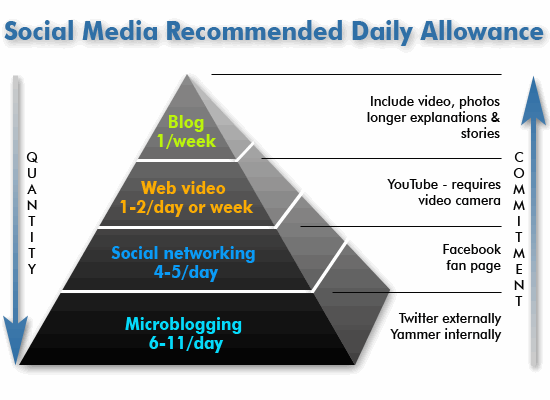
In my post on the SMUG Social Media Pyramid and the follow-up on servings and portion sizes, I recommended a basic level of each of the four basic social media “food groups” which are represented in this graphic submitted by Valeri Gungor (click to enlarge):

SMUGpyramid550x400

This led to some interesting discussion in the comments, which deserves fuller attention. Here were some of the themes:

  • Isn’t this just a “maintenance” plan? If you really want your social media influence to grow, shouldn’t you be beefing up with a lot more than what’s recommended here? Or on the other extreme…
  • Doesn’t 6-11 servings a day of Twitter encourage the kind of inane celebrity updates on personal minute-by-minute activities that give Twitter a bad name?
  • This seems like a tool-centric tactical approach, not a strategic tailoring of the tools to the particular objectives of the organization’s social media program.

So here’s some amplification of what a “serving” means.

To qualify as a serving your tweet, status update, video or blog post needs to…serve. Others, not just you. Any “servings” that don’t serve are actually subtracted from your total…they’re the social media equivalent of what Mom used to call “empty calories.” No nutritional value whatsoever.

In the food pyramid a serving is something you consume. In the Social Media Pyramid a serving is something you produce. It has to be of value to others to qualify. Otherwise it’s a negative. Five good tweets plus two pointless, self-promotional or “spammy” ones gives you a net of three servings, not seven. And some might even say a bad tweet is worth -2.

So in answer to the first two questions, I would say that the more real, valuable servings you provide, the more your influence will grow. And the more garbage you post, the more likely your Twitter followers leave, your Facebook friends and fans bail on you and you lose subscribers to your YouTube videos or your blog posts.

The third point, about strategy vs. tool-time tactics, I’ll tackle in the next post. And maybe I’ll expand on the serving scoring system.

Does this “net servings” guide make sense to you? How would you change it?