On Tuesday, August 4, I’m going to be presenting a free webinar, sponsored by Ragan Communications, on our Mayo Clinic social media experience.
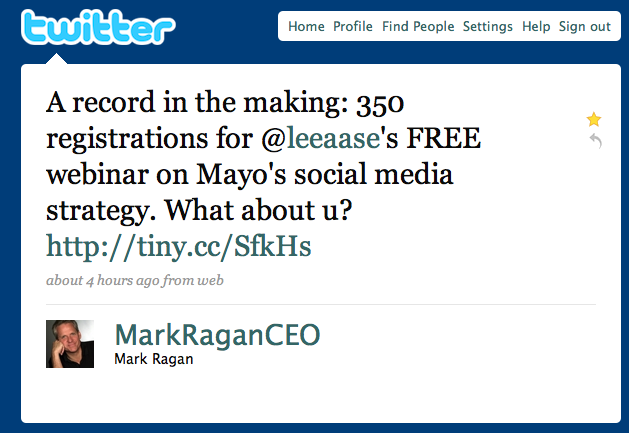
The webinar was announced this morning, and Ragan CEO Mark Ragan tweeted this afternoon that the response has been strong:
I have no idea what kind of record is in the making, or what the old record might be, but if you’re interested I hope you will sign up to join us. Please pass this along to anyone you think might find it helpful.
I was honored a few weeks ago when someone I greatly admire, Guy Kawasaki, did a blog post highlighting one of my presentations about Mayo Clinic’s use of social media on the American Express Open Forum. Apparently he had seen it on Slideshare.net and thought it was worth passing along.
I’ve been a fan of Guy’s ever since I read Selling the Dream in the early 90s. He was the original Macintosh software evangelist, who led the effort to get developers to write software for a computer that didn’t yet exist, and that was going against the IBM juggernaut. As a Mac guy, you might even say he was a hero to me.
So I was pretty jazzed when he included my presentation in his blog post, and even more excited when he said he wanted to do something more in-depth to fill in the gaps that you don’t necessarily get looking at a series of slides. He posted that interview (which we did by email) today on the American Express site, and linked to it from How to Change the World, his personal blog.
I’ve learned a lot from Guy over the years, both from his books and his blog. I especially appreciate his tips on doing good pitches and speeches, and how to be a good panelist (although he puts it less delicately). I try to incorporate his lessons into everything I do in public speaking and forums.
So while he hasn’t actually heard me speak, I’m honored that he liked my slides, and it’s been great getting a chance to interact with him by email. I hope you find our conversation useful.
Over the next couple of weeks, I’ve got a full schedule of travel with conferences, panels, webinars, workshops and the like. I’ll be showing and telling about our work in social media at Mayo Clinic, and also implications and applications for others in health care and beyond. My schedule is below. Based on what I’ve seen from the registration (and speakers/panelists) at the events, I’m going to be highly stimulated by the experience.
This week I’m going to Washington, DC on Wednesday and Thursday for the New Media Academic Summit at Georgetown University. It will be quite an experience for the Chancellor of a mythical university to interact with real-life Ph.D. professors. I’m on a Thursday afternoon panel.
In my spare time I plan to meet with some TV and radio station news and program directors to talk about our Mayo Clinic Medical Edge syndicated programs and news resources.
This is the most intense travel schedule I’ve had, but it just seemed to work out that these events were in reasonable proximity. And clearly we’re in a time in which the interest in social media is high, particularly in health care.
Of course I’ll be tweeting along the way, so you can follow (and participate in) the conversations. If you’re in any of these communities (or will be at any of these events) and would like to meet, drop me a note (or a Tweet).
Some Tweeters have taken issue with a slide I typically include in most of my presentations. It says:
Total cost for Mayo Clinic YouTube, Facebook and Twitter:
$0.00
They protest that it’s inaccurate, maybe even misleading to say “total cost” and that it should instead say “Barrier to Entry” or “Cost to Start.” “What about the staff needed to run these sites?” they ask.
I will grant that these platforms don’t automatically maintain themselves, but I’m not changing the wording or conceding the point. I believe that in the way most people would have understood the phrase for at least the last century, these tools are FREE.
And this little video explains why:
YouTube is a FREE television station that lets you broadcast to the world.
A Facebook “fan” page is (at least) a FREE multimedia “white pages” listing for your business.
Twitter is a FREE incoming/outgoing communication channel, like the toll-free phone service discussed above.
But unlike the fictional AT&T and Pitney Bowes examples I described in the video, these are 100 percent real, bona fide offers. They are better ways for your existing staff to communicate, with each other or with your customers or other key constituents.
So ask not how you’re going to afford to hire staff to use these tools. Ask how these powerful tools can make your staff more productive!
For answers, look in the advanced courses in the Facebook, Twitter and Blogging curriculum listings.
I look forward to a great discussion, as I understand the registration for the session (and therefore the interest in the topic) is strong. I will be tweeting about it using the #raqc hashtag. I invite you to follow the discussion there (although I’m not sure how much live-tweeting there will be), or share your comments and questions below.
My presentation is from 7:50 to 9 a.m. CDT, so your related tweets during that time would help to demonstrate the power of social media.
 in the early 90s. He was the original Macintosh software evangelist, who led the effort to get developers to write software for a computer that didn’t yet exist, and that was going against the IBM juggernaut. As a Mac guy, you might even say he was a hero to me.