SMUGgle Testimonials

It’s immensely satisfying for me when SMUGgles take the plunge and start a blog or a podcast, or launch a Facebook page for their organizations. Makes it all worthwhile.

And when they decide to say nice things about SMUG in one of their first posts, it’s even better!

In My Social Media Communications Compendium, which she started on Saturday, Nancy Pricer says she’s “feeling SMUG,” and here’s an excerpt.

For years I have been an active participant in several listservs relating to my job. Last fall an e-mail sent out by Roger Johnson of Newswise mentioned Lee Aase, the manager for Syndications and Social Media at Mayo Clinic.

In the e-mail, he promoted a place for PR folks to learn the social media landscape. Lee had created his own university, Social Media University, Global (SMUG), and named himself the chancellor. Students are called SMUGgles.

For months I had been trying to get a handle of the social media landscape, but was overwhelmed by various outlets, technologies, my full time job (and commute), two teenagers (they are really very good though), a loving husband, housework–you get the idea. I could not seem to take a chunk of time all at once and break the learning down piece by piece.

When I went to the SMUG Web site, I was impressed with the organization. Lee breaks it down in to categories like, Blogging 101, Blogging 102, Twitter 101, etc.

It was just what I needed to get going.

I’m  not exactly fishing for compliments, but I certainly appreciate them. If you, like Nancy, would like to help spread the word about SMUG, you could:

  1. Write a blog post about your experience (and maybe even start a blog so you have a place to do it!)
  2. Pass along some of your favorite courses to your friends using the ShareThis button at the bottom of each post. You may, for instance, decide to send the SMUG Super Bowl ad to your friends or Tweet about it.
  3. Write a recommendation on LinkedIn.
  4. Tell your SMUG story in the comments on this post.

OK, so maybe I am fishing for compliments.

But I’ll at least rationalize it somewhat by pointing out that Nancy is happily blogging today and has established a Facebook fan page for the university where she works (a real-life one, not a virtual university like SMUG) because Roger Johnson took the time to recommend SMUG to those on his email listserv.

If you know people who might appreciate the opportunity to systematically learn about social media tools like blogs, Twitter, Facebook, podcasting, YouTube and whatever comes next, I hope you’ll do like Roger (and now Nancy) and turn them on to SMUG.
SMUG Super Bowl Ad and Social Media ROI

Here’s the Super Bowl Ad you didn’t see on NBC:

[youtube=http://www.youtube.com/watch?v=9_WIBoEf730]

Among the reasons for this omission:

  • The ad 34 seconds long, instead of the customary 30;
  • I was about $2.6 million short of the cash required to pay for the airtime; and
  • I created it during the Super Bowl today.

One of the ironies of social media is that everyone asks about the ROI, or return on investment. It’s an understandable question, but one of the points I make in presentations is that as I (investment) approaches zero, ROI approaches infinity, because it is calculated as follows:

ROI = benefits/costs

My cost of producing this stellar Super Bowl ad wasn’t exactly zero, but it was zero out-of-pocket. I already had invested $150 in the Flip video camera used to record it, and the production took a bit of my time and attention as I enjoyed the game .

I expect the benefits to be non-monetary as well, measured mainly in the satisfaction of getting more people involved in exploring social media. I hope you will use the ShareThis tool below to pass this post (with its embedded ad) along to your friends and co-workers who might benefit from becoming a SMUGgle, and invite them to enroll. I think it captures the essence of SMUG in a brief video snippet (but how did I manage to leave Blogging out?!)

Then we’ll see what happens to the SMUG enrollment, currently at 261 members of our Facebook group.

Updated: I originally had embedded the ad in the Facebook player, but I’m wondering whether that might be responsible for a SMUG slowdown, so I took that version down, at least for now. But you can see the higher-resolution Facebook version in the SMUG Facebook group.

Updated 2/3/09: Here’s the same video in a Blip.TV player. Another post coming on the topic of video players soon:

Mayo Clinic Social Media Guidelines for Employees

As part of the launch of Sharing Mayo Clinic last week, we published guidelines for Mayo Clinic employees involved in blogging, social networking sites and other social media.

We previously had published the guidelines internally; our publishing them externally was inspired by our colleagues at Intel, a fellow member of the Blog Council, publishing their company’s guidelines, which are really well done.

We hadn’t considered publishing our guidelines externally until we learned that Intel had done it, and after some discussion within the Blog Council about the merits of disclosing these policies. It seems like the right thing to do, in the spirit of transparency.

From our perspective, these guidelines for social media aren’t really new policies; they mainly are applications of existing policies to new communications platforms.

So, if you’re looking to create social media policies or guidelines for your company, these are two examples you could consider.

Help Me Help You Fight the FUD

In my presentation at Blogwell, at which I introduced our new Mayo Clinic blog for patients and employees, Sharing Mayo Clinic, I closed with a Jerry Maguire appeal:

[youtube=http://www.youtube.com/watch?v=p-oHuogx6_Y]

Many of the questions I got after the presentation, and that I get in other contexts from people wanting to implement social media programs at work, began something like: “What about the concerns that …” or “What about the fears that ….”

One of my points in response is that it’s extremely helpful to have external consultants who can help reassure leadership that the social media advocates in the organization aren’t crazy, and that lots of other companies and similar groups are using blogs and social media successfully, and without major problems. Shel Holtz and Andy Sernovitz helped us.

It’s also great to be able to point to examples of success, like Nuts about Southwest.

I hope Sharing Mayo Clinic can be the kind of example you can show your leaders, and say “See! If an established organization like Mayo Clinic is using blogs and Facebook and YouTube, we can too.” I’d love it if our example can help you fight the FUD (fear, uncertainty and doubt) barrier in your organization.

Of course, a big part of you being able to use our blog as an example of corporate blogging success is…well…for us to succeed.

You can help me with that in two ways: Suggesting Improvements and Spreading the Word.

Suggesting Improvements. In response to the post I did announcing the blog Thursday, SMUGgle Scott Meis (who I got to finally meet for the first time at BlogWell), left a good suggestion in the comments that I have implemented. It tripled the number of RSS and email subscribers we got in the second full day of the blog’s operation, as compared to the first. So, I hope you’ll check out Sharing Mayo Clinic, and I’d really appreciate any further suggestions you could offer on how we can improve.

Spreading the Word. Obviously building traffic to Sharing Mayo Clinic is our responsibility, and we’re communicating with our Mayo Clinic patients and employees about it. But if you would help spread the word by blogging or tweeting about it, or posting it on your Facebook profile or sending it to your friends, that would be fantastic, too.

And hopefully by helping me, I can help you fight the FUD.

Sharing Mayo Clinic

Sharing Mayo Clinic
Sharing Mayo Clinic

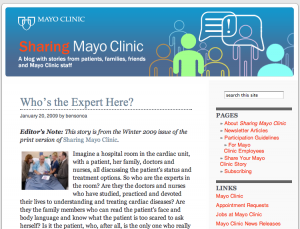
Today we take a significant step for Mayo Clinic, launching our “culture” blog for patients and staff, called Sharing Mayo Clinic. I’ll be showing it as part of my presentation at BlogWell.

Sharing Mayo Clinic (at sharing.mayoclinic.org) is in many ways the culmination of a process we’ve had in the works for the last few years, starting with our first podcasts in Sept. 2005. As you can see in the post announcing Sharing Mayo Clinic my colleague Elizabeth Rice published this morning on our Mayo Clinic News Blog, we’ve had some other significant milestones that have helped bring us to this point, such as establishing a Facebook page and a YouTube channel. (You’ll also see some video of me talking about the project.)

But in another sense, Sharing Mayo Clinic is less recent and more timeless; it’s a logical extension of what Mayo Clinic patients have been doing for more than a century. Word of mouth from patients is the number one reason people give as their source of information about Mayo Clinic. Like our Facebook page, this blog is just a new way for patients to share their stories.

Sharing Mayo Clinic also will be a way to feature the work and stories of Mayo employees in various roles throughout the organization, who all contribute to creating the Mayo Clinic experience for patients and their families.

The blog is a work in progress, and we look forward to seeing it grow into a hub for Mayo Clinic’s various social media platforms. We have some ideas for new features and functionality once we’re past the launch stage, but I’d really like to know what you think of it so far, and how you think it could be improved.

Please check it out and give me your feedback! And I’d really appreciate it if you’d take the time to pass this along to your friends using the “ShareThis” icon below.