Black, Creamy or Bulletproof

Whereas Lisa and I were previously Folger’s drinkers, now we buy the roasted beans and grind them just before brewing our morning cup(s). We usually each have a 20-ounce Contigo container per day, although we sometimes brew a second pot and have a refill.

I drink coffee one of three ways, depending on what I’m trying to accomplish with my eating patterns.

Black. If I’m in a fasting or time-restricted eating mode, I take it straight. It doesn’t break my fast, and it actually has an appetite suppressant effect. Sometimes I’ll add a half-teaspoon of cinnamon, which also isn’t a fast-breaker.

Creamy. When I’m not concerned with extending a fast, I treat myself to a creamy concoction. And by creamy I don’t mean with Half-and-Half: we’re talking full-fat, organic heavy whipping cream. I also usually add MCT oil and cinnamon. I use a hand frother to break up the fat so it’s dispersed and doesn’t float on top of the coffee. Any blood sugar or insulin spike is minimal, and hunger stays away.
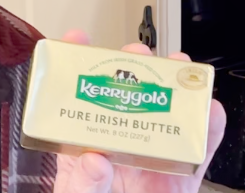
Bulletproof. On special occasions, I melt a chunk of grass-fed Kerrygold butter in the microwave and pour into my Contigo, or else just let the hot coffee do the melting. Using the same hand frother keeps the butter fat from floating to the top. I typically add a pinch of salt and a half-teaspoon of cinnamon to the mix as well. With bulletproof I don’t add the MCT oil.

What we never add to coffee is any kind of sweetener. Lisa formerly used monk fruit, but as we have learned that even calorie-free sweeteners can trick your brain into triggering insulin release, she’s decided it’s not worth it.

The common thread with all of these ways of drinking coffee is that they promote satiety and don’t spike blood sugar.

If we haven’t eaten since 6 p.m. the previous evening, our bodies are already in or approaching fat-burning mode. Creamy and Bulletproof coffee just cause us to toggle between burning the fat in our bodies and the fat in the coffee.

Once that’s gone, we’re back to burning what we already have stored. It makes it easy to skip breakfast, and sometimes even lunch.

That’s why this post is part of #BodyBabyStep Two: Seek Satiety.

If you think your friends might find this post and this series helpful, I hope you’ll share by email or on your social networks using the buttons below.

You can subscribe by email, and I’ll also post links on FacebookTwitter and LinkedIn.

How NOT to enjoy coffee

In our first three decades of marriage, Lisa and I didn’t exactly have sophisticated tastes when it came to coffee.

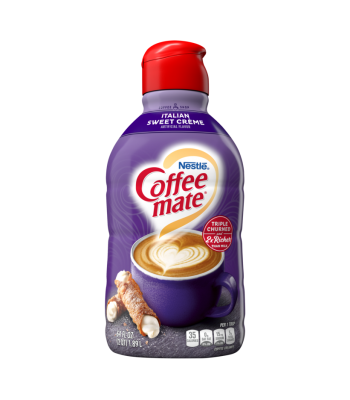
We drank Folger’s, typically flavoring it with manufactured creamers like what you see at right. As its ad copy says today:

Coffee mate Italian Sweet Creme flavor coffee creamer will transport you to a land of rich taste – right in your kitchen! Indulgently creamy and remarkably rich, the incredible flavor of Italian Sweet Creme is a silky smooth sip that’s lactose-free and cholesterol free. 

Cholesterol free! That’s got to be healthy, right?

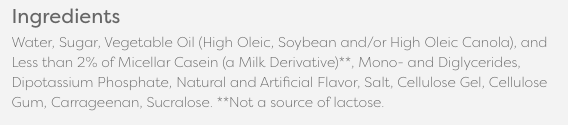
Check out the ingredients:

Water, Sugar and Vegetable Oil make up most of it.

With apologies to Meat Loaf, “Two out of three ain’t good!”

Stopping Sugar is #BodyBabyStep One, so on that basis alone you should get rid of these non-dairy creamers. Vegetable oil isn’t much better, as we’ll address in future posts.

But tomorrow I’ll show three wonderful ways you can enjoy coffee without spiking your insulin.

If you think your friends might find this post and this series helpful, I hope you’ll share by email or on your social networks using the buttons below.

You can subscribe by email, and I’ll also post links on FacebookTwitter and LinkedIn.

Juice is the Worst!

While much of what the U.S. government has done relating to food and nutrition has been counterproductive at best (such as the food guide pyramid), its incorporation of ingredient and macronutrient information in food labels is mostly helpful when read with discernment.

One thing you’ll find is that sugar is everywhere.

When you read a food label, if you see SUGAR, BROWN SUGAR, HONEY, HIGH FRUCTOSE CORN SYRUP, SUCROSE, DEXTROSE, LACTOSE or any other -OSE – especially among the first few ingredients – stay away!

Juice is a special case, though. When you review an ingredient label for 100% fruit juice, you might see lists like:

  • INGREDIENTS: FILTERED WATER, ORGANIC APPLE JUICE CONCENTRATE, ASCORBIC ACID (VITAMIN C)
  • INGREDIENTS: Grapefruit Juice (water, grapefruit juice concentrate)

What could be wrong with those? They’re “all natural” or maybe even “ORGANIC”!

It doesn’t even list sugar as an ingredient.

Well, let’s do a comparison.

Few would consider Coca-Cola (or any other sugar-sweetened carbonated beverage, for that matter) a healthy drink. (I’m not picking on Coke, here; it’s actually the soda, or “pop” depending on your region, that I have most enjoyed over the years.)

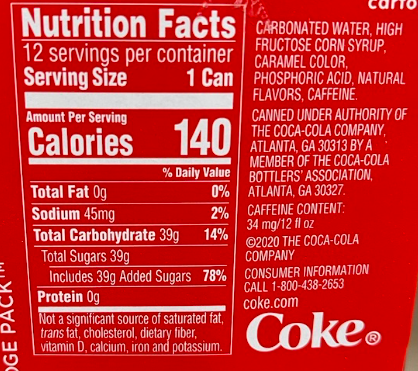
Look at its Nutrition Facts label, you’ll see plenty of warning signs:

Obviously with High Fructose Corn Syrup behind only water among its ingredients, you’ll expect this to be high in sugar. And sure enough, each 12-ounce can has 39g of Total Sugars (all of them Added Sugars.)

That’s bad, right?

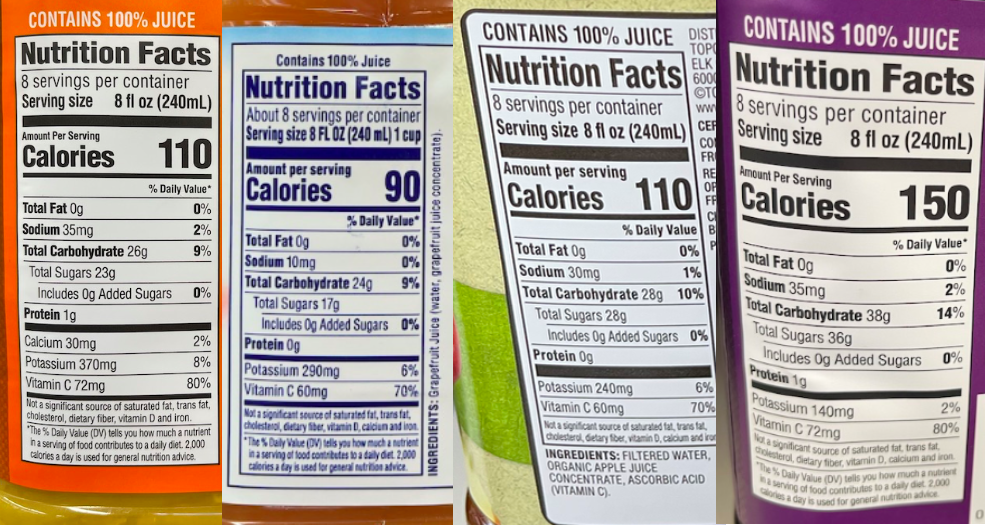
Well, let’s compare with several 100% fruit juices:

Orange, Grapefruit, Apple and Grape juice nutrition labels.

Each these lists “0g Added Sugars” as if that’s something of which the bottlers should be proud. I realize that’s an item the government requires them to note, but it detracts from the real news, which is that for an 8-ounce serving, total sugars for these juices are:

  • Grapefruit – 17g
  • Orange – 23g
  • Apple – 28g
  • Grape – 36 g

When adjusted to the same serving size as a can of Coke (and rounding down to be generous), those range from 26g to 54g for 12 ounces.

Apple juice and grape juice actually have more sugar per ounce than Coke!

Here’s my confession: in the last half of the 1990s, I would regularly stop at the convenience story on my morning commute and buy a quart of orange juice to drink on the way to work!

I actually thought that was a healthy choice! I mean, it had Vitamin C, right?

Based on the figures above, I was getting 92g of sugar before 8 a.m. almost every workday. And that was after I had eaten a bowl of cereal that typically included 16g of sugars and 41g of total carbohydrates.

I might as well have had a 48-ounce Coke for breakfast!

Fruit in reasonable quantities is good because it carries fiber with it, which fills you up and also slows the absorption of sugar into the bloodstream.

But my Nordic ancestors didn’t have fresh fruit year-round, and yet somehow here I am today. Fruit is less necessary than you may think.

So as you’re taking #BodyBabyStep One, quitting fruit juice (and all other sugar-sweetened beverages) is essential.

Don’t do as I did; do as I do now.

I drink coffee black, or with fat-based additives that don’t cause blood sugar spikes and also slow release of caffeine.

More on that next time.

If you think your friends might find this post and this series helpful, I hope you’ll share by email or on your social networks using the buttons below.

You can subscribe by email, and I’ll also post links on FacebookTwitter and LinkedIn.

The Case Against Sugar

The first step toward your healthier future is to Eliminate Sugar, which is why it leads my #BodyBabySteps.

I realize it’s a big challenge. Sugar is in everything. Especially “low-fat” processed foods. If you’re going to succeed in cutting it out, you’ll need sufficient motivation.

Dr. Robert Lustig, one of my Health Sherpas, makes a strong case, particularly against fructose.

Investigative science and health journalist Gary Taubes, another of my guides, continues the prosecution in the video below with The Case Against Sugar, a summary and introduction to his book by the same name. It’s well worth your time:

See also Taubes’ talk from the same conference on The Quality of Calories: Competing paradigms of obesity pathogenesis.

Excessive carbohydrates are a problem in our diet generally, but sugar is an extra specially bad type of carb, for the reasons Dr. Lustig and Taubes outline.

You may be surprised, as I was, to find how much sugar is in food and drink you consider “healthy.”

More on that next time.

If you think your friends might find this series helpful, I hope you’ll share by email or on your social networks using the buttons below.

You can subscribe by email, and I’ll also post links on FacebookTwitter and LinkedIn.

Meet (and follow) my Health Sherpas

Lisa and I have been amazed at the results we have gotten through some pretty simple and basic diet and lifestyle changes over the last four years, but particularly in the last 18 months.

We’ve each lost more than 50 pounds. Lisa’s gone from a tight size 14 to a comfortable size 6, and instead of a 38-inch waist on my jeans I’m down to a 32.

My waist size in high school, 40 years ago, was 34 inches. I hadn’t dreamed I could get to that size again, so imagine my surprise when those jeans became a little baggy.

These results weren’t due to our own special insights. We have learned from some really smart people who have challenged deeply flawed dietary consensus and orthodoxy.

Some are physicians or scientists or other clinical professionals. Others are journalists, science writers or patient advocates.

I keep up with what they’re learning and sharing through my Health Sherpas Twitter list. It’s a public list you can follow.

I also have created a Health Sherpas page with some additional resources that you may find helpful, including links to blog posts I’ve done featuring them, to their YouTube channels, blogs and podcasts.

Sherpas helping climbers scale Mount Everest are familiar with the terrain and also physically adapted for the journey. My Health Sherpas have been savvy guides to weight loss, improved metabolic health, strength, conditioning and body remodeling. And lots of their guidance is free on Twitter.

Sherpas don’t climb the mountain for you. You still have to do the work. But they can save you from taking a futile, dead-end route, and they also have tips to make the journey easier.

I hope you’ll join our expedition. In addition to following my Twitter list, you can subscribe by email for my new blog posts, or catch them as I share on Facebook, LinkedIn or Twitter.

If you have additional sherpa candidates to recommend, leave them in the comments below.