March Madness in July

I’ve admittedly been infrequent (some might even say derelict) recently in developing new posts here on SMUG. The main reason is my focus during this season on my son Joe’s AAU basketball team, and chronicling their spring and summer season.

Right now we are in the middle of what I call “March Madness in July.” It’s the time when NCAA coaches are able to be on the road scouting talent and offering scholarships. Joe and his cousin Tom, both seniors-to-be for Austin High School, are playing with the Minnesota Magic Elite AAU team, based in the Twin Cities. And aside from my work-related blogging, my discretionary effort recently has been on the Magic site, where we have profiles of each of the players as well as video highlights from many of their games.

As I write this, Lisa and I are in the air above Tennessee on the way to Orlando for a national AAU tournament at the Wide World of Sports complex. Next week we head to Las Vegas for the Fab 48.

I probably will do a post with more analysis of the Magic site as part of the curriculum here, but for now here is video from the first half of one of the team’s stronger efforts, from a tournament in St. Cloud at the end of June:

The Magic site is similar to the site I developed for the Austin Packer Fast Break Club, which support the Austin High School team.

Both are examples of what you can accomplish with a Flip camera and $30 or less for a custom domain on WordPress.com.

New Connections Tweetcamp

I will be in Princeton, New Jersey tomorrow for a presentation at the Robert Wood Johnson Foundation as part of its New Connections program for junior researchers. We will start with a social media overview, but then will conclude with a 45-minute focused session on Twitter. The goal is to give these researchers a taste of how they can practically use Twitter and other social media tools to be more effective in their work.

Here are the slides for second half of my Friday morning presentation:

I hope you will join me in showing the speed, reach and power of Twitter as we conduct a mini-Twitter chat. Hopefully many of the researchers will have created Twitter accounts in advance of the session, and will be able to participate directly.

Our #TweetcampRWJF chat will start at 9:45 a.m. ET on Friday. I have created a couple of questions that are included in the last slide of my presentation above, and I’m asking the participants to tweet their own questions, too.

So if you have some time to share your experience with some younger and mid-career researchers, I hope you’ll join us. Or if you can tweet some pearls of wisdom between now and then, we would appreciate that, too.

Please tweet your introduction and answers to the following, using the #TweetcampRWJF hashtag:

  • Introduce yourself and give your location (or where you work) – City, State (Province), Country
  • Q1: What is the most important benefit you have experienced in Twitter?
  • Q2: What questions do you have about using Twitter in health care or research?

During and after the scheduled chat, I hope you will also engage in dialog with the students as they tweet their questions.

Upgrade to WordPress 3.4 – Embedding Tweets

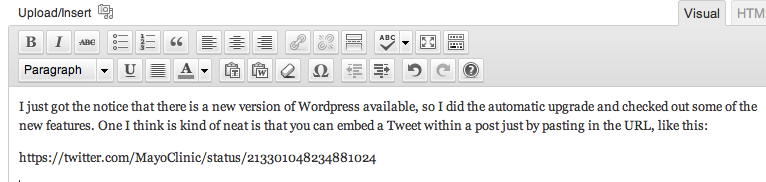
I just got the notice that there is a new version of WordPress available, so I did the automatic upgrade and checked out some of the new features. One I think is kind of neat is that you can embed a Tweet within a post just by pasting in the URL, like this:


If everything works as it should, you’ll see the tweet about our new Mayo Clinic iPhone/iPad app being featured in the Apple WWDC keynote embedded below:

So people reading your blog can interact with the tweet directly. It’s much better than taking a screen shot of the tweet and embedding the image.

Cool, huh?


Happy Birthday Caring Bridge

USA Today has an article this morning (in which I’m quoted) about Caring Bridge celebrating its 15th birthday.

CarePages, a similar health-focused social network that launched in 2000, does accept advertisements.

Both “provide a good service in that they enable the loved ones or caregiver to update the site once to tell a lot of people who care what’s going on,” says Lee Aase, director of the Mayo Clinic’s Center for Social Media.

“It really does help relieve a burden” of constantly having to call or text, he says.

Thirty years ago, patients would come to Mayo Clinic for a few days of tests or hospitalization, and they or accompanying family members would go to their hotel room to call friends and family with updates.

Twenty years ago, as cell phones became more prevalents, that was the key update method.

In both scenarios, the calls involved repeating a lot of the same information, and added some stress to an already challenging situation.

Then Caring Bridge came along to make it possible for the patient to update a Web site and share news with family and friends once instead of through multiple calls. CarePages began offering a similar service a few years later.

Now patients have even more options, such as a closed or secret Facebook group among them, for sharing news with their loved ones. But still, many patients find these specialized services attractive because they may not want medical information connected to their Facebook.

So if you think social networking in health care is new or radical, Caring Bridge and CarePages both have more than 10 years experience serving patients and their families that suggest otherwise.

Beyond Hyphenation

As enrollment in rural schools declines, smaller communities have been left with no viable alternative but to consolidate their schools with neighboring towns.

Typically this leads to a lot of hyphenated names for the resulting school districts, such as (in our part of Minnesota) Zumbrota-Mazeppa, Elgin-Millville, Dover-Eyota and the like. Sometimes the district comes up with a whole new name for the school, as when Rose Creek, Adams and Elkton combined to become Southland.

I believe my wife Lisa’s home district set the hyphenation record when New Richland-Hartland combined with Ellendale-Geneva to become…you guessed it…New Richland-Hartland-Ellendale-Geneva, which the sportscasters abbreviate as NRHEG. Sometimes they’ll pronounce each letter, but if they’re in a hurry they just say NURR-heg.

A similar phenomenon has happened over the last half-century in the newspaper business, as competing newspapers in a community combined because neither could sustain themselves economically. So in Minnesota’s largest city the Minneapolis Star and the Minneapolis Tribune, which I remember as separate papers in the 1980s, became the Minneapolis Star Tribune. Likewise in Milwaukee the Journal and the Sentinel became the Journal Sentinel in 1995.

Hyphenated or not, you can probably think of several combo newspapers like this (e.g. Seattle Post-Intelligencer) – feel free to chime in with your examples in the comments.

But what happens when even the combined papers can’t make it? When even hyphenation can’t make the business model work?

We’re seeing that this week with the announcement that the Times-Picayune of New Orleans will be ceasing daily publication in the fall, moving to three days per week: Wednesday, Friday and Saturday.

If a metropolitan area of 1.2 million people can’t support a daily print newspaper, that’s a significant milestone in the decline of the traditional newspaper business model. Employee layoffs are coming there, too, which is the continuation of a trend being tracked at Paper Cuts.

As Seth Godin and others have said, newspapers aren’t primarily selling news to subscribers; they’re attracting subscribers and renting their attention to advertisers. The new publishing schedule of the Times-Picayune makes this explicit, as Wednesday is the traditional day for advertising inserts.

With so many choices for consumers in how they will get their news and entertainment, the mainstream media oligopoly is much less profitable than it was a generation ago. Those traditional media players have some built-in advantages. but the barriers to entry that formerly protected them (FCC licenses and the huge amounts of capital needed to buy transmitters or printing presses) are now practically non-existent.

That’s why I have often said:

Don’t just pitch the media. Be the media.

Do pitch the media. Work with the existing outlets as a resource and help them serve their audiences.

But be the media too. If you have a story to tell, you can do it through a blog. And you aren’t just limited to text: you can embed video, audio, slide presentations, photos and other resources. It costs you literally nothing to start.

Have you taken the blogging plunge? If not, why not?