Getting Twitter “Traction” in Health Care

I have enjoyed working with Chris Seper at MedCity News (on this story, for example) but I think he misses the point of @EdBennett‘s list of hospitals ranked by number of Twitter followers.

And therefore I think his recommendation also is off.

Certainly some hospitals (and other organizations) have just had their Twitter accounts on autopilot, sending Tweets based on an RSS feed. If they’ve done that, though, they aren’t putting a lot of effort (or any time) into Twitter. So even if they don’t have a lot of followers, you can’t really say the project has been a failure, because the cost has been essentially zero. We did this for several months with our @mayoclinic account at the start, and while it isn’t the best approach it can be a good defensive move (see my bottom-line recommendation below.)

But comparing hospitals to celebrities like Ashton Kutcher makes no sense. In fact, as I wrote in a comment (currently awaiting moderation) on the post Chris did about Ed’s list:

Look at the TV stations in the Cleveland market: @wkyc – 3883 followers; @fox8news 2,686; @19ActionNews 1,520; @WEWS 2,098. Only one of those would crack the top 5 hospitals, and one wouldn’t match the hospital numbers at all.

I think Chris is presenting not just a false choice, but a wrong-headed recommendation, when he says:

Hospitals may be better served setting up accounts for high-profile doctors and managing those accounts, rather than trying to gain followers for an institution.

I think this is wrong on two counts:

First, it isn’t an either/or situation, i.e. to  develop an institutional Twitter presence OR encourage individual physicians to engage. There is a place for both.

Second, if the alternative would be “setting up accounts for high-profile doctors and managing those accounts” then that’s really missing the point of social media. Public affairs staff can provide guidance and training for MDs who want to use Twitter, but as Ed says, “docs will do SM on their own if so inclined. Hospitals can’t make them do it.” And hospital PR staff shouldn’t pose as MDs and “manage” accounts for them.

I’m pleased with the progress we’ve made on our @mayoclinic account: our number of followers has quadrupled in the last six months as we have become more interactive. And we also have individual physicians like @vmontori and @davidrosenman getting active in Twitter. They’re both doing some really interesting innovation projects in health care, and are interested in the application of social media.

But we’re not managing the accounts for Dr. Rosenman or Dr. Montori. And the reason DrVes, Dr Val and KevinMD have gained lots of followers is because of their personal involvement, not because someone has “managed” their accounts for them.

The Bottom Line:

  1. Hospitals, or other organizations for that matter, should have a Twitter account, if for no other reason than to keep someone from brandjacking them. But the more they engage, the more valuable they will find even this corporate account.
  2. They should encourage and train individuals who are interested to get involved personally. You can’t manufacture passion, though. If doctors and other leaders are excited about engaging, they will likely be successful. But ghost-tweeting by PR staff would be the wrong approach.
BlogWell MSP Presentation

Here’s the presentation I’m giving today at General Mills in Minneapolis, where the Social Media Business Council (socialmedia.org) is holding its BlogWell conference.

I unfortunately won’t be able to stay for the entire event because I have another presentation to do back in Rochester in the later afternoon, but I look forward to following the Twitter stream at #BlogWell. And hopefully I’ll get to meet lots of folks in the time before my 1:30 CDT presentation.

LifeScience Alley Presentation

This morning I have the opportunity to present at a LifeScience Alley educational forum. The title of the presentation is Leveraging Social Media to Reach Customers and Improve Organizational Effectiveness: The Mayo Clinic Perspective.

Here are my slides:

I’m looking forward to this presentation and the ensuing discussion, and hope the conversation will continue here.

Five Sweet New HootSuite Benefits

Picture 11

I got an invitation last week to upgrade my HootSuite account to version 2.0, and I’m really liking what I see.

I’ve long appreciated the ability within Hootsuite to pre-schedule tweets, and to manage multiple Twitter accounts. So, for example, when I was doing an event (such as Tweetcamp III), I have scheduled tweets for various times throughout the course of the presentation, to include links to particular items I was referencing. It’s particularly helpful for highlighting key Web sites or blog posts when part of the group is participating remotely.  And in the middle of a presentation I have to stay focused, not taking a minute to send a tweet.

Among the improvements of Hootsuite 2.0 I like the most:

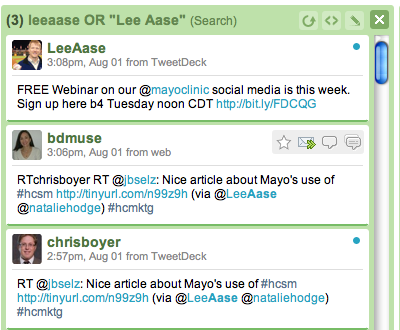
  1. The “columns-to-go” feature lets you create a widget based on any search in Twitter, to incorporate within a blog post or your sidebar. So I created the widget above based on a search for “leeaase” or “Lee Aase” and put it within my SMUG sidebar.
  2. The columns for direct messages, mentions or any search term essentially duplicate the functionality of Tweetdeck (which I like a lot, too.)
  3. The ability to set automatic Tweets from an RSS feed. I used to do this using Twitterfeed for our @mayoclinic account. This is a good way to make sure each of our new Sharing Mayo Clinic blog posts gets tweeted at least once, because I know we’ve forgotten to tweet some of them. I think it’s especially OK given the fact that we are highly personally interactive in our Twitter account. Turning this feature on through Hootsuite was a lot easier than Twitterfeed, which had a complicated OpenID process when I used it, although it may have improved in the intervening months.
  4. The statistics package seems pretty strong. You need to use the Ow.ly link shortening built into Hootsuite to take advantage of this, but that doesn’t seem to be a major burden. I look forward to seeing how that works.
  5. Multiple Users. It seems this was added to keep pace with CoTweet, which lets multiple users tweet from the same account without sharing the username/password. This is a benefit because as administrator you don’t want to give every user the master password, because that could enable a disgruntled employee to change the password and lock you out of the account.

Twitter’s open platform that enables outside programmers to add new functionality is one of its best features, and I think Hootsuite has made some significant advances to incorporate a lot of the best features in some of the desktop clients and Web-based  platforms for Twitter.

What tools do you find most helpful in making Twitter more productive?

Mayo Clinic Social Media Webcast

This afternoon I’m scheduled to present a Webcast on our Mayo Clinic experience with social media. The handout we provided to registered participants was somewhat abbreviated (leaving out some of the intermediate steps in the closing case study), and I added a few other slides after Friday morning, when I had to submit the handout.

If you haven’t yet registered for this FREE webcast, you can still do so until noon CDT today (8/4/09). Go here to join.

Here is the updated slide deck, and I’ve also included some key links below:

See the Press page for some of the stories about social media in health care for which I have been interviewed, including the Forbes.com story from last week and the resulting Information Week piece from yesterday, as well as the interview with Lee Odden he published yesterday.

Our Mayo Clinic blogs include Sharing Mayo Clinic, which has links to the rest of our social media platforms, including the various blogs and our Facebook fan page, Twitter account and YouTube channel.

Here is the link to the Wall Street Journal Health Blog post that incorporated our YouTube video. Here is a recent post on the Mayo Clinic News Blog with both downloadable audio and video clips and a YouTube video. And here is the post where we embedded the “Octogenarian Idols” video.

I hope you will feel free to ask your questions or make comments either below or via the #mayoragan hashtag in Twitter.

If you’re interested in healthcare use of social media, please consider registering for this social media summit Mayo Clinic is hosting and cosponsoring with Ragan Communications. It will be at our Scottsdale, Arizona campus in early October. I think we have a strong faculty and it should be a great gathering of people with a common interest.

Please be sure to vote in the SMUG seal contest, and if you want an example of the SMUG curriculum, the Podcasting courses give you a good taste. See the front page for more of a SMUG overview.