Speaking at BlogWell

I’m looking forward to participating in my third BlogWell conference on Thursday, August 13 in Minneapolis. I presented in Chicago in January and attended in New York in May. Both were excellent.

BlogWell is sponsored by the Social Media Business Council (formerly called the Blog Council.) The August version of the event will be held at General Mills headquarters, and in addition to my Mayo Clinic presentation will include case studies from:

  • General Mills
  • H&R Block
  • CME Group
  • Ford
  • McDonald’s
  • Walmart
  • Progressive insurance

If you’re in Minnesota (or can get there…we do have fine airlines serving our state) and are interested in seeing and hearing examples of how large organizations are using social media, this is a great chance to pick up some tips and to find models you can emulate in your organization. It’s a fast-paced afternoon and I’m sure you’ll find it worthwhile.

Feel free to contact me if you have any questions about it, or go here to register.

RAQ – Why are Auto Direct Message Replies in Twitter Bad?

In Tweetcamp III, as in previous Tweetcamps, I have provided Twitter etiquette guidance for those new to Twitter. More recently, thanks to @shwen, I’ve called that section “How to build ‘Tweet Cred.'”

One of my strong recommendations is to avoid using services that send automatic direct messages to your new Twitter followers. If you’ve been in Twitter and have followed even a few people, you’ve probably gotten some messages like this in reply to some of your follows:

Thanks for the follow! I’m so glad we’ve connected. Looking forward to your tweets.

This was sent by a robot, not a person. And it’s a step away from what Twitter is all about, which is real conversations with real people.

A SMUGgle recently asked, “So why are these automatic direct messages so bad?” So in keeping with our “Recently Asked Questions” format, I’m answering here to make it available to everyone.

And if others have additional comments or reasons (or even a contrary opinion, though I’m doubtful of that based on the reactions I saw in in the #Tweetcamp3 stream), please add them in the comments below.

Let me give you a real-life analogy taken from our recent experience with high school graduation parties. My wife Lisa and I are at the stage in life in which we attend lots of these, both for extended family and friends of our kids. And of course it is the common courtesy for graduates that when someone attends your graduation open house and gives you money, you should be sure to send a thank you note. (My daughters are still finishing theirs.)

The thank you notes we received from two grads, whose open houses were held he same day, illustrate why auto direct messages to new Twitter followers are a bad idea.

Let’s call these young men Tim and Mark (not their real names.) We received notes from both “Tim” and “Mark” at about the same time. The language on both was similar…something to the effect of “Thanks for coming to my graduation party and for the gift of money for my graduation. I’m going to use the money to help pay for college expenses.”

But while “Tim’s” was written by hand, “Mark” had photocopied the text and pasted it into the card, and then just signed his name.

Which do you think gave us a warmer feeling?

Lessons for Twitter:

  1. When someone new follows you, it’s not necessary to send a direct message to acknowledge it. It’s better to not acknowledge a new follower than to have a machine do it for you.
  2. Save your direct messages for personal, special communications. Many users choose to have text messages sent to their phones when they get direct messages, so if you are sending an impersonal “form” tweet as a direct message you are likely alienating followers.
  3. If you want to acknowledge your new followers, do it personally, either through a direct message you write based on having checked their profile and tweets or, better yet, through an @ reply that indicates to your followers that this person has interesting things to say.

Twitter is a person-al medium. Let’s keep it that way!

What do you think? Do you have other reasons why auto d messages in Twitter are bad? Or do you think there is any place for them?

PR and Social Media Measurement Award Program

For those SMUGgles who are working in PR and who have used PR research and measurement extensively in one of your PR campaigns this past year, you might want to consider entering the Jack Felton Golden Ruler Award for Excellence in PR Measurement & Evaluation.  Entries of all types are welcome – including research using social media!  The award recognizes superb examples of research used to support public relations practice. Winners are honored at the Institute for Public Relations Summit on Measurement in October in Portsmouth, NH.
Entries are due August 15th.  Here are examples of previous winners’ entries: Padilla Speer Beardsley’s Winning 2007 entry or Shell’s 2008 entry – and there are more on the site.
I was in Portsmouth for the IPR meeting two years ago when Padilla Speer was recognized, and the campaign they did (and the recognition they received) was quite impressive. This isn’t “just another” award program. I’m now a member of the IPR measurement commission, and this award is intended to be a really rigorous, worthwhile program to highlight the best measurement work being done in PR.

FUEL Social Media Presentation

I had the opportunity late this afternoon to do a presentation to FUEL, a relatively new group sponsored by the Rochester, MN Chamber of Commerce, on “how to use social media to grow your business and advance your career.”

Here are the slides:

After my presentation, we had a panel discussion that included Wade Beavers and Joe Shriver of DoApp, Becky Ross of Fox Sports North and Fox Sports Wisconsin and Alan De Keyrel of Corporate Web Services.

We started a Twitter hashtag for Rochester community conversations, #RSTMN.

It was a great discussion with lots of good questions, and I appreciated the perspectives the other panelists brough. Becky made the great point the given the intensity of sports fans, it was important for @FSNorth to keep up a strong Twitter stream, because people who follow them. Alan beat me to the punch in saying that people need to stop thinking about the separation of personal and professional lives in social media, and realize that the distinction is really futile. I don’t think it’s even really desirable. Wade and Joe also brought a lot of good insights.

“Don’t Try This at Home…”

Normally when you hear a warning like that, the implication is that the task should only be done by a trained professional, not by amateurs.

I had a different experience of this admonition today as we were getting ready for Tweetcamp III. Instead of using a phone conference call or professional video Webcasting, as we had done for our first two tweetcamps, I thought it would be great to do this one via uStream.tv.

I even tested it “at home” Saturday night, with my very first ChancellorCast embedded here on SMUG.

It seemed like the perfect solution. Put the slides on Slideshare.net. Use the PC in the room to show the slides to the local audience, and use the built-in camera on my MacBook Pro to Webcast video and audio to the 100+ participants from all over the U.S. and Canada (and even one from the Netherlands.)

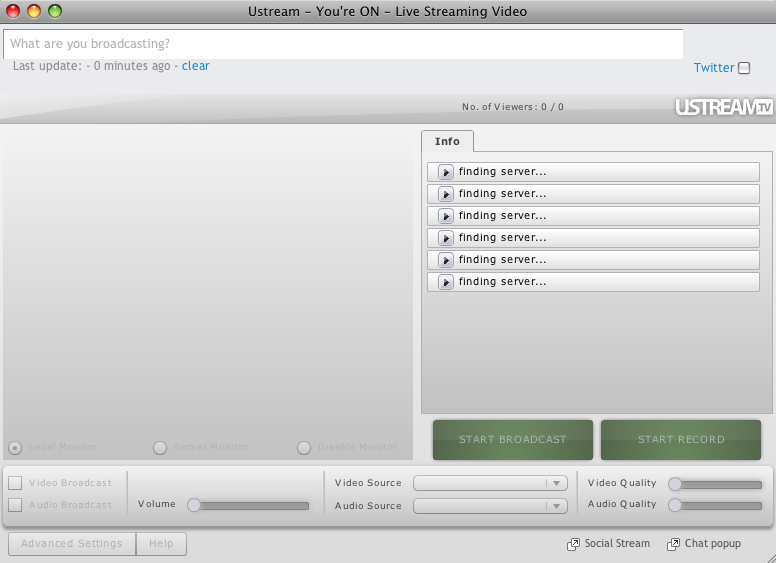
Unfortunately, when I went to uStream.tv at about 8 minutes before the scheduled start of #tweetcamp3, here’s what I saw when I hit the Broadcast Now button:
findingserver

It said it was “Finding Server” but the reality was different.

So after trying to get through for about 7 minutes, at 1:59 CDT I decided we needed to revert to the audio conference method…and after a few hiccups with getting the right number and authorization code, we were able to get going about 2:13.

In some ways it was an interesting audio representation of the “Tribe” that had gathered, because for the better part of five minutes we had a popcorn-like sound of beeps as new callers joined.

It also showed the power of Twitter, in that by using the #tweetcamp3 hashtag we could get word to almost everyone, and switch probably more than 100 participants from video Webcast to phone conference in less than 15 minutes.

My takeaway: “Don’t try this at home” has a second meaning beyond the traditional. Just because something works at home in testing doesn’t mean it will work in a presentation. It’s important to do a run-through in the exact room where the presentation is taking place, and using all of the technology that will be used in the actual event.

I generally have my slides for presentations uploaded to Slideshare.net for two reasons:

  • I don’t like to give out the presentation in hard copy, because I want to have people looking at me and the screen instead of their laps. I don’t want them reading ahead either. By having the presentation on Slideshare, I can tell them where they will be able to refer later, and we can just engage in discussion.
  • In a pinch, I can present from the Web instead of my computer, so if for some reason my computer doesn’t talk nicely with the LCD projector I can use one that does.

It’s what grandpa used to do when he would wear both a belt and suspenders to ensure that his trousers stayed put.

It’s good that we had audio conferencing as another option. It would have been better to try the broadcast from within the room when I arrived there about 25 minutes before the program’s scheduled start. I just though that since I could get to uStream.tv from behind the firewall I wouldn’t have any problem connecting to the Video server.

I know better now.

And let this be a lesson to you, too.

Thanks to everyone who participated in Tweetcamp III today. I hope you found it helpful and worthwhile. I look forward to going through the #tweetcamp3 tweets and seeing what I can learn.

I won’t thank you for your patience, because I don’t know whether you were patient or not. Maybe you were secretly stewing. But at least nobody flamed me. So I’ll thank you for that, and for hanging in as we worked out the kinks.

Update 8:45 p.m. 7/13: I was able to record the video Webcast tonight, so now I think the Tweetcamp III post is a nice archive you could share with people you want to introduce to Twitter.