“Best of Blogwell” Presentation

I’m doing an update of my presentation to BlogWell at noon CDT today. Here are the slides. You can still register for the FREE audio conference here at the GasPedal site.

Here are a few links to highlight:

The relevant Twitter hashtag is #gaspedal, so please follow the conversation and feel free to tweet your questions or comments.

View more presentations from Lee Aase.

FREE “Best of Blogwell” Conference Call Thursday

On Thursday, April 2 at noon CDT, I’ll be offering a recap of the presentation I did at BlogWell in Chicago, through a free conference call sponsored by the Blog Council. I hope several SMUGgles will be able to join the call and discussion of what we’ve learned about applying social media to our work at Mayo Clinic. Register here.

Aase at ASAE

I’m looking forward to participating in the 2009 Healthcare Association Conference sponsored by ASAE & The Center for Association Leadership (the acronym for which, oddly enough, is an anagram of my last name) in Baltimore on Tuesday. See the conference agenda (PDF).

Here’s the overview for the panel discussion I’ll be joining on Tuesday:

The growing popularity and power of social technologies creates both new challenges and opportunities for healthcare associations, as well as for the healthcare system itself. While the social web opens broader access to medical knowledge, enables greater collaboration among health professionals, and is actively transforming both healthcare advocacy and medical education, issues of information accuracy and patient privacy are enduring sources of concern. Listen to a candid and thought provoking dialogue on the present and future impact of social technologies on healthcare from players in different parts of the system.

I’m particularly pleased that this discussion will take place in two 75-minute segments, which will enable an in-depth exploration. As the brochure describes the focus of each:

  • In part one of this session, the panel will explore the current state of social technology use in healthcare, and some of the key strategic challenges and opportunities created by social technologies.
  • In part two of this session, the panel will focus specifically on how healthcare associations should be thinking about the application of social technologies to their work, as well as the future of social technology in the world of healthcare.

I’ll be joining Jeff De Cagna, chief strategist and founder, Principled Innovation, LLC (moderator) (@pinnovation); Gina Ashe, chief marketing officer, Sermo, Inc.; Ted Eytan, MD, MS, MPH, (@tedeytan) medical director, delivery system operations improvement, The Permanente Federation, LLC; Frank Fortin, director of communications, Massachusetts Medical Society (@frankfortin). We’re all going to be trying to follow Guy Kawasaki’s advice for panelists, and I’m sure Jeff will be a great moderator, too, involving the “audience” in the discussion. No long, boring PowerPoints: we will each have no more than three (3) slides.

I’ll be blogging about our discussion after the fact, and maybe tweeting occasionally during or between the sessions. But mainly I look forward to engaging in an interesting discussion, not just among the panel but with the whole group. I enjoy giving presentations about what we’re doing in social media at Mayo Clinic, but it will be even better to learn through the interchange with others.

I’m also excited that I’ll get to meet Ed Bennett (@EdBennett), who manages Web sites for the University of Maryland Health System and compiled the listing of hospitals using social networking. This again demonstrates the power of Twitter; I saw him offering rides from Baltimore to HealthCamp Philly…which led me to ask whether he was based in Baltimore…and we discovered he works across the street from where I will be on Tuesday. So we’ve arranged to get together after the conference. How cool is that?

Twitter 131: Sensitivity and Specificity in Twitter Search

In the medical field, we consider both the sensitivity of a diagnostic test and its specificity.

Sensitivity refers to the proportion of the times that a test yields true positives. The closer the sensitivity is to 100%, the more likely a positive result actually means that the patient has a disease. Specificity refers to the proportion of the time that a test yields true negatives. The closer the specificity is to 100%, the more likely a negative result means that the patient is truly disease-free.

The perfect screening test is 100 percent sensitive (it finds every person who has the disease) and 100 percent specific (it doesn’t identify someone as having the disease who really doesn’t.)

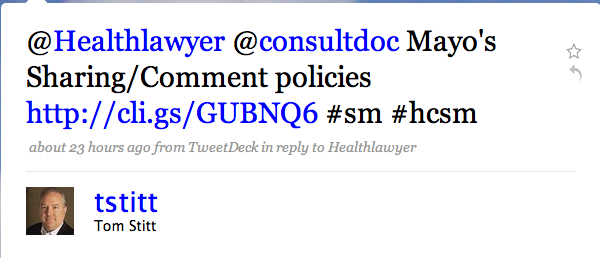
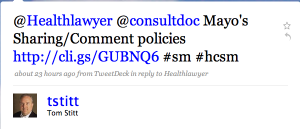
I got to thinking about this, and how it relates to social media monitoring (particularly for Twitter), when I saw this post in my Tweetdeck this morning:
picture-2


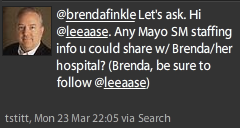
That led me to do a little investigation to find the original tweets that led Tom Stitt to include me in his @ reply:

picture-31

picture-4


My normal set-up for Tweetdeck includes panes for All Friends, Replies, Direct Messages and a search for “mayo clinic” – which is why I didn’t see the original exchange between @brendafinkle and Tom. It left off the word “clinic.”

That got me wondering whether I should consider having my regular search be for “mayo” instead of “mayo clinic” so I wouldn’t miss tweets like this.

In other words, was my “mayo clinic” search too specific, but not sensitive enough?

As it turns out, thanks to lots of people tweeting about their condiments, the NBA basketball player, Simon Mayo and the Mexican holiday (and other Spanish-tweeters with their references to events in the fifth month), searching for just “mayo” dramatically reduced the specificity of my Twitter test without appreciably increasing the number of tweets I found that were really about Mayo Clinic. 

I was overwhelmed with irrelevant tweets. (Not that they weren’t important to the people who sent them….) In fact, of 134 current tweets in the “mayo” search pane on my Tweetdeck, there were only 4 that were about Mayo Clinic that didn’t include both “mayo” and “clinic.” This only increased my Twitter search sensitivity by 3 percent, but drove my specificity from 99+ percent to about 20 percent. I had been finding virtually all the relevant tweets already.

So the sensitivity and specificity of the “mayo clinic” search makes it the preferable diagnostic test for me. By searching for just “mayo” we might find a few more Mayo Clinic-related conversations, but we also would be greatly increasing the work required to sift through all the extraneous material. The signal-to-noise ratio would be seriously diminished.

And since the answer to Brenda’s original question is “Only about 1.5 FTE dedicated to social media, but we’re providing training and encouraging the rest of our Public Affairs staff to include social media elements in their communication planning” (I know, that’s more than 140 characters), we can’t afford to make the monitoring more labor intensive by making the search less specific.

And with Twitter friends like Tom, I’ll hopefully keep getting alerted to the tweets that I miss through the more specific search.

Assignment:

  1. Do your own Twitter search for variations of terms that are important to you, either in Tweetdeck panes or in different windows or tabs on search.twitter.com. You also might want to experiment with searches including a hashtag. For example, my friends at United Parcel Service could search for #ups instead of  just ups. That way they wouldn’t get push-ups, sit-ups and other variations, but would get tweets specifically tagged as being about their company.
  2. Let your fellow SMUGgles know what Twitter search strategies are working for you, in the comments below.