Phillies Fun

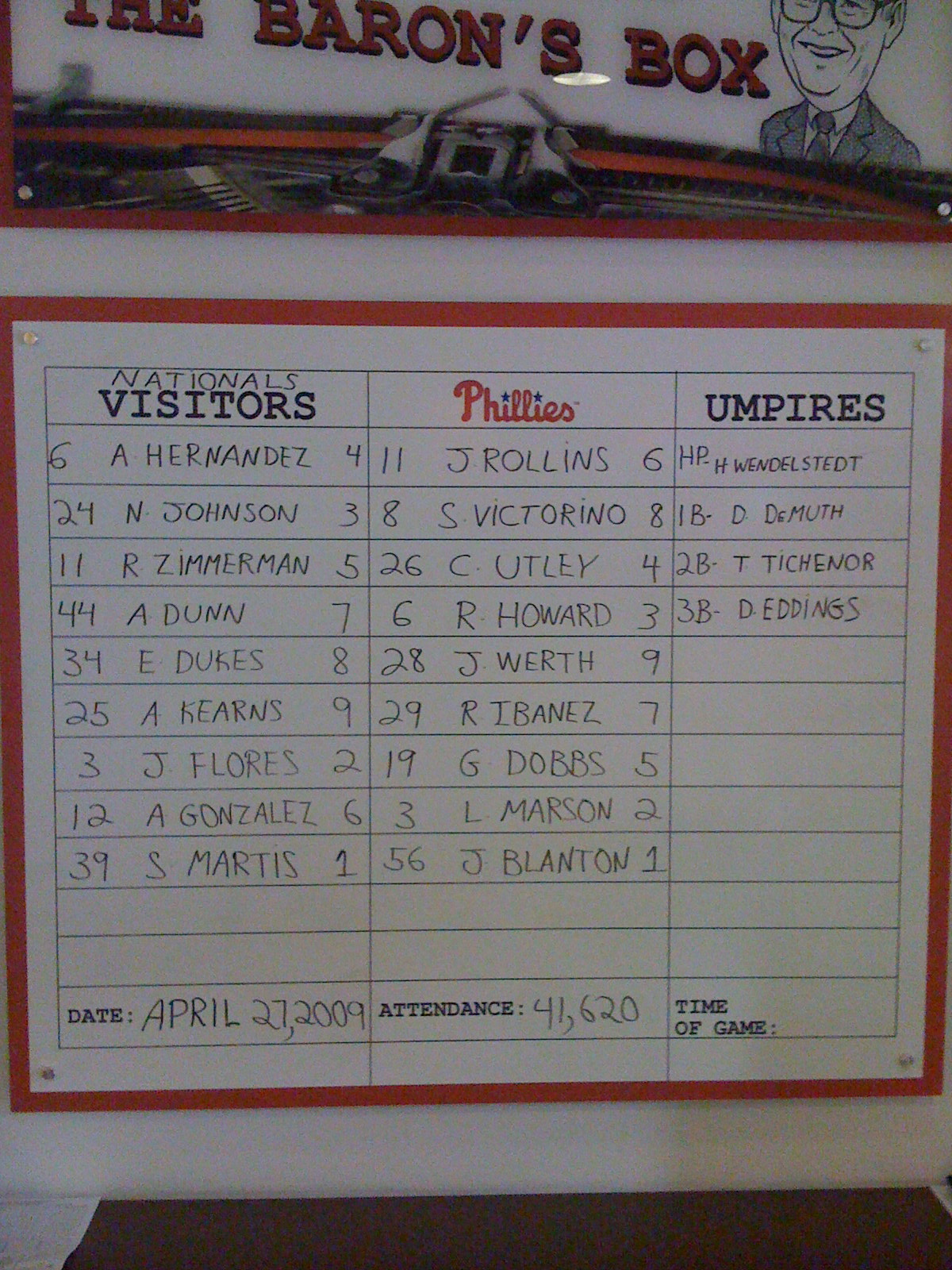
As I write this I’m sitting in the press box at Citizens Bank Park in Philadelphia, where the Phillies have just defeated the Washington Nationals 13-11. It was a come-from-behind victory that featured two grand slams by the Phillies (one by Ryan Howard and the other by Raul Ibanez.) Here’s the mlb.com wrap-up of the game.

I was in town to give a presentation on social media to the National Cancer Institute Public Affairs Network, and I got media credentials for the day in order to interview Jayson Werth, the Phillies’ starting right fielder, whose career was resurrected by seeing Dr. Richard Berger, a Mayo Clinic orthopedic surgeon and wrist specialist. I’ll have a post with my interview with Jayson on the Sharing Mayo Clinic blog in the next day or so.

Update: here’s the post with the video interview of Jayson.

But meanwhile, here are a few of the photos from my excellent adventure (click to enlarge):

The statue of Mike Schmidt from outside the ballpark
Me, in the Phillies' media room


The view of batting practice from the dugout


The lineups for the game (in the press box)


The grounds crew cleans up after the game

Thanks to the Phillies organization for their hospitality, and to Jayson for being willing to do the interview. He has a really great story, and I look forward to being able to have him tell it in his own words on Sharing Mayo Clinic.

Social Technologies in Health Care – Part IV

In Part III of this series, I offered a recommendation for health care associations with regard to Twitter:

Create a Twitter account for your association, if only for defensive purposes. Use Twitterfeed to automatically tweet. 

I think that was fine, as far as it went, and I think it is an essential step. But in the last two months I have seen immense potential for beneficial engagement by actively becoming involved with Twitter at the organizational level. It needs to be more than just a defensive measure.

I see Twitter being valuable not just for communication with members, but also for outreach to people who share your organization’s goals but may not yet be members. I believe it’s really worth your time to understand it, and to that end recommend the SMUG Twitter curriculum (or for an overview, going through the #tweetcamp2 course, for which the slides and accompanying videos from the Webcast archive  are embedded below.)

Social Technologies in Health Care – Part III

Note: This is the third in a series of posts based on material I provided in advance for  a two-part panel in March sponsored by ASAE & The Center for Association Leadership, “Social Technologies in Healthcare: Applications, Implications and What’s Next?

Question Three: How should medical associations/societies capitalize on social technologies in their work?

Societies and their members should get hands-on experience with social tools so they can see for themselves what the most productive uses would be. If they are concerned about HIPAA or patient privacy concerns, start by using the tools within your organization, apart from any direct patient-care application.

With that appropriate disclaimer, I’’ll offer a few practical steps to help you get started, and while step 5 may be most important I put it last so that you don’’t get so hung up in strategy that you don’’t do anything.

  1. Use the tools to help run the associations and as an added member benefit. Build outposts on the general-purpose social networking sites, particularly Facebook.
  2. Create a YouTube channel. Feature your members. Encourage them to create YouTube channels. Subscribe to each other’s’ channels and become “friends.” “Favorite” each other’s’ videos.
  3. Create a Twitter account for your association, if only for defensive purposes. Use Twitterfeed to automatically tweet. 
  4. Create one or more blogs. You’’ve got a Web site, right? That’s all a blog is: an easy-to-publish Web site that allows comments, interaction and sharing. You can make your blogs part of your site, or you can have your blog become your site.
  5. Think about how you will tie them all together into a coherent strategy. But don’t let yourself become paralyzed, waiting until you have the perfect strategy before you execute anything. You’ll learn as you go, and these tools are highly reconfigurable. But it’s a lot easier to modify your direction if you’re already moving than it is to get going from a dead stop. So start.

It won’t surprise SMUGgles that I advised diving in and getting hands-on experience. While not necessarily disagreeing, Frank Fortin, one of my fellow panelists, highly commended the POST method as outlined by Charlene Li and Josh Bernoff in Groundswell: Winning in a World Transformed by Social Technologies. I agree that this framework is helpful and also recommend reading Groundswell, but think the first step should be developing personal familiarity with the tools so you can envision potential applications for your organization.

I originally answered these questions about a month in advance of an event that was about a month ago, so my thinking has continued to evolve. In the final post in this series, I will highlight at least one area in which I now think a more aggressive strategy is in order.

Social Technologies in Health Care – Part II

Note: This is the second of three posts based on material I provided in advance for  a two-part panel in March sponsored by ASAE & The Center for Association Leadership, “Social Technologies in Healthcare: Applications, Implications and What’s Next?“ 

Question Two: What are the biggest challenges to the effective use of social technologies in health care?

Fear, Uncertainty and Doubt (FUD) are probably the biggest barriers. Concerns about potential implications of disclosure of private medical information must be addressed. Making data security as bulletproof as possible must be a priority; if I can send money anywhere in the world from my Web browser without concern about theft, I should be able to do the same with medical information. Alternatively, or perhaps concurrently, we should work to reduce the potential harm that could come from medical data being disclosed, by ensuring that such information couldn’t be used to deny insurance coverage or employment.

Technically, it’’s a matter of convening standards bodies to enable data portability while protecting data security, and encouraging software engineers to develop a user experience that builds upon or is at least equivalent to the general purpose social networks.

While some FUD is reasonable (we do, after all, live in an uncertain world), some of the fears about social media in health care seem to go beyond what the data would dictate. Worst-case scenarios are envisioned and assigned high probabilities, which prevents the serious contemplation of far more likely beneficial outcomes. We need to understand that keeping the current delivery system and just reducing reimbursements and cutting the length of doctor appointments is a guaranteed path to declining quality and patient satisfaction, and that social tools hold the promise to enable more in-depth interactions with physicians when necessary while creating communities of smarter patients who can help each other.

These tools also have immense potential for helping teams to work smarter together. The idea of the corporate firewall fortress also may limit some organizations’’ willingness to consider Software-as-a-Service solutions.

For the answer to Question One, go here.

Social Technologies in Health Care

In late March, I had the opportunity to participate in a two-part panel sponsored by ASAE & The Center for Association Leadership, “Social Technologies in Healthcare: Applications, Implications and What’s Next?”  I did a recap post of the event here.

To set up the conversation, each of the panelists were asked to respond to a series of questions. I thought it would be helpful to post here the answers I provided there. I don’t know that they’re profound, and I hope they’re not totally unique, because then I’d be seriously off base. And as always, what you see written here is my perspective, and doesn’t represent my employer.

Question One: What is your long-term vision for the impact of social technologies on health care?

Social technologies already are important in health care, in that they give voice to individuals and enable them to connect with others who have similar experiences, conditions and concerns. Word of mouth has always been important in health and health care, dating back even to biblical times when reports of miraculous healings would cause thousands to gather on a hillside in Galilee. So it’’s no surprise that patients are using powerful social technologies to spread the word about their health care experiences.

Patients also are forming virtual communities and support groups that overcome geographic barriers. It has been impractical to form many of these communities of interest locally because the conditions are too unusual to provide for a critical mass of individuals with common interests. But social technologies eliminate these barriers to group formation and enable patients to learn from each other.

In the longer term, we must find ways to incorporate social technologies into management of chronic diseases and conditions such as diabetes. The shortage of primary care physicians will worsen, calling for more emphasis on mid-level providers. But nurses and physician assistants (PAs) will be in short supply as well.

It will be physically impossible to provide quality management for a growing population of Baby Boomers with chronic conditions, even with increased reliance on mid-level providers. But virtually it may be possible. And since many of those conditions are substantially influenced by behavior, peer networks mediated by social technologies have potential, with appropriate medical provider involvement, to provide social support to reduce the burden of disease.