Thesis 20: Social media tools enable authentic communication if you don’t purposefully complicate things

Among the most important benefits of social media tools are their ease of use. While updating a static Web site can be onerous, and video shooting, editing and distribution also can be complicated, the beauty of blogs, Flip cameras (or Kodaks) and YouTube is the nimble authenticity they bring to communication.

Of course, it’s possible to develop bureaucratic processes that will completely erase the advantages of social media. By trying to fix perceived shortcomings of the standard social media tools by upgrading production values, you can lose their freshness and authenticity.

Don’t do that. Don’t complicate things.

To encourage you in this, I’m sharing a couple of examples from our Mayo Clinic experience, in which the nimbleness of social media tools enabled us to capture compelling stories that formerly would have been impossible, or at least impractical.

Exhibit A: Sharing Patient Stories

On Friday, September 18, 200, I received a late-afternoon call from one of our Mayo Clinic cardiologists, Dr. Michael Ackerman, telling me about an infant patient from the San Francisco area he had been evaluating. The call came about 3 p.m., and within an hour I was interviewing Trevor’s mom in the courtyard near their hotel. Here’s what she had to say:

See the rest of Brenda’s story.

The Kings were leaving for home the next morning, and if I had been unable to shoot the interview, we would not have been able to tell this story. Getting one of our professional videographers to break away on short notice would have added one more complicating factor to the equation, making it unlikely to work. But with the Flip, we captured the authentic moment.

Here’s another story from Sharing Mayo Clinic about Dr. Ackerman that will warm your heart. It doesn’t necessarily fit the theme of this post, but you should check it out anyway.

Exhibit B: Late-Breaking News

On Tuesday, June 3, 2008 at 8:45 a.m. I got some good news and some bad news. The good news was that one of our Mayo Clinic researchers, Dr. Victor Montori, had a paper being published in a major medical journal, Journal of the American Medical Association, or JAMA.

The bad news: the paper was being published that day, and was coming “off embargo” in just over six hours. This left us no time to prepare a formal news release or shoot and edit broadcast-quality video. In the era before our Mayo Clinic News Blog, we would have had no good options for calling attention to this research.

But since we had the blog and the Flip camera, called Dr. Montori and interviewed him at 10:20. By 11:55 we had uploaded the video to YouTube and had also prepared this blog post about the diabetes research. We sent “pitches” by email and Facebook to some journalists starting at noon, and the next day the Wall Street Journal Health Blog carried the story and embedded this video from our YouTube channel:

These are just two case studies of the practical advantages of using social media tools as more efficient and effective means of doing your work, if you don’t purposefully complicate things.

How have you used the Flip or similar tools for authentic storytelling?

Thesis 14: Strategic Thinking about Social Media is no Substitute for Action

At a certain level, it’s important to think strategically about how your organization will use social media.

After all, if Thesis 4 is true, and if social media really are the defining communications trend of the third millennium, then using these powerful tools in a way that aligns with your overall strategy just makes good business sense.

Strategy is “a plan of action or policy designed to achieve a major or overall aim.” Aimless use of social media is no better than aimless advertising or product development research. It’s never a good idea to devote your organization’s time and resources to an activity that doesn’t relate in some way to an overall strategy. Aimless is pointless.

As B.L. Ochman has chronicled, there’s no shortage of self-proclaimed gurus, experts, specialists and strategists — nearly 16,000 at her last count — on Twitter. She also has a good post on “The only two questions you need to ask your prospective social media agency.” The problem I see with many of the self-proclaimed “gurus” is that they lack experience in tying social media to organizational strategy, and as B.L. says, “they’ll be learning on your dime.”

It’s much better for YOU to learn on your dime. Or your time.

After all, you know the strategic initiatives in your organization. The outside consultants and agencies don’t. Instead of paying them to learn about your organization, why not take the time to learn about social media so you can see how these tools can support your goals?

There is certainly a place for agencies to help in this area, especially if you have more money than time. They may be able to help you refine your plans, and bring perspective from other similar organizations to help you sell management on your plans.

But instead of insisting that you have a grand, fully developed strategy before embarking in social media (and which is accompanied by a hefty planning and consulting price tag that will make the ROI harder to prove,) I would suggest there are some goals compatible with social media strategies that apply for most organizations.

So here are a few goals you might want to pursue in the new year, using social media:

  1. Improving communication and collaboration among employees. Find a work unit in part of your organization that doesn’t deal with your most proprietary or confidential information, and encourage those employees to pilot use of Yammer, PBWiki or other networking and collaboration tools.
  2. Preventing brand-jacking. Claim your organization’s name on popular social networking sites to keep impostors from posing as you. That’s what we did with our Mayo Clinic Twitter account, Facebook page and Mayo Clinic YouTube channel.
  3. Improving customer service. Use social media tools like Twitter to listen to customers. Comcastcares is an example of this.
  4. Reaching niche “audiences” with in-depth content, and helping those “audiences” coalesce into communities. A YouTube channel, blogs and podcasts all may be good tools to use in reaching this goal, as you can provide information and resources to people who really want it, instead of using expensive advertising to interrupt those who don’t.
  5. Learning all you can about social media. By becoming conversant in social media and accustomed to its norms and mores, you’ll see many more specific applications for your work that will support your organization’s goals. I can recommend lots of books, but hands-on experience is essential to understanding. That’s why you might want to become a SMUGgle.

Your social media strategy doesn’t have to be perfect right away. In fact, I believe it should continually evolve as you learn more about the tools and see new applications.

The other point I want to emphasize from the definition of strategy is that it is a “plan of action….” Action without a goal is likely unproductive, but planning without action is even worse. By acting rashly without full consideration you might possibly do the right thing: you could just get lucky. But analysis paralysis means you will consume resources with no hope of accomplishing anything.

So those who seem to be the greatest defenders of strategy run the risk of undermining it.

To avoid this, identify one or two goals for your use of social media, either picking from the list above or something else you have in mind. Goal #5 can always be your personal entry point, if necessary.

Then execute against that plan, putting your strategy into action. General (and later President) Dwight Eisenhower famously said “plans are useless, but planning is indispensable.” I believe his wisdom is best applied in an almost continuous planning process that is accompanied by continuous execution and modification.

Remember, it’s a lot easier to steer a moving car than it is to get it started from a dead stop. If you find yourself going off course, you can always steer back or even tap on the brake. And by choosing some small but well-defined (and likely successful) social media projects, you can build momentum.

In a future post, I’ll tell how we used a series of mini-plans at Mayo Clinic to grow into full-scale incorporation of social media. We’ve had some minor course corrections along the way, but through the process we’ve learned a lot and built momentum that will help carry us forward.

Thesis 4: Social Media are the Third Millennium’s Defining Communications Trend

I don’t think this should really need lots of discussion and proof. In the era of Gutenberg and Luther, only the most profound works could be published via the printing press. Thus Luther’s 95 Theses and other works of eternal significance were candidates for mass distribution. Not much else was considered worthy of the expensive paper on which it would be printed.

And of course in those days mass distribution didn’t mean exactly universal distribution, but only to those who had the unusual opportunity and gift of literacy.

But even with limited literacy, Luther’s theses spread like a virtuous version of pandemic flu. They got people talking.

Over the ensuing 480 years or so, the ability to publish remained scarce and therefore precious. And for the last half century, there was a unique development in that a privileged class of editors and programmers could make tastes, and could decide what news was fit to print or worthy for airing.

So journalists attached to someone who owned a printing press, or (in the U.S.) an FCC-granted monopoly license, were unique in their ability to spread news and views to their community. News organizations sold their wares to consumers, or as Chris Anderson, Clay Shirky and others have noted, more accurately sold (or rented) their audiences to advertisers.

The economics of digital abundance and what Shirky calls unlimited perfect copyability, along with development of tools for self-publishing, means that we no longer are hostage to this privileged class. People like us can start a blog, or a podcast, or a YouTube channel that can be accessed from around the globe.

It doesn’t mean we necessarily have a huge audience for our views, but it does give us access, at least loosely based on merit, as judged by individuals instead of only the tastemakers.

The fact that only perhaps 10 percent of potential publishers actually avail themselves of these tools doesn’t lessen their significance.

In warfare the credible threat of force can be just as effective in accomplishing goals as the use of force is. Likewise, the fact that almost everyone has a digital camera at all times (thanks to the ubiquity of camera phones) means the potential cost of an organization treating someone badly is much higher.

In my presentations, I frequently illustrate this point with portions of the Social Media Revolution video, which begins with two questions:

Is social media a fad? Or is it the biggest shift since the Industrial Revolution?

While I agree the development of social media tools is as significant as anything since invention of the steam engine, the cotton gin and other outgrowths of the Industrial Revolution, I prefer to consider social media in the context of communications trends. In that regard, I believe it’s the biggest shift since Gutenberg. At least since Marconi.

In Thesis 3, I will discuss the anomalous (that’s a pretty sophisticated, Chancellor-like word, isn’t it?) nature of the mass media era, and why the era has ended, even as we continue to have mass media outlets in our communications ecosystem.

The fact that Gutenberg’s invention defined the 16th through the 19th centuries didn’t mean it completely replaced verbal communication. And broadcast media didn’t completely replace print in the 20th century. But each defined their era.

Likewise, social media define the Third Millenium, even though they haven’t (and won’t) completely replace mass media.

Meanwhile, here’s a screen shot from the Social Media Revolution video that puts it all in context in just a single frame:

Picture 8

If you have 4:22 to spare, here’s the video in its entirety:

So how do you answer those questions? To what would you compare the social media revolution?

Thesis 10: Social Media Can’t Make Up for Bad Products or Poor Service

Picture 7

Social media are not the panacea for all that ails the relationship between organizations and their customers or other stakeholders.

If you treat people badly, they now have not only the opportunity to take the story public, which they always had, but also the ability to tell the story themselves instead of having to rely on third parties like the news media to spread the word.

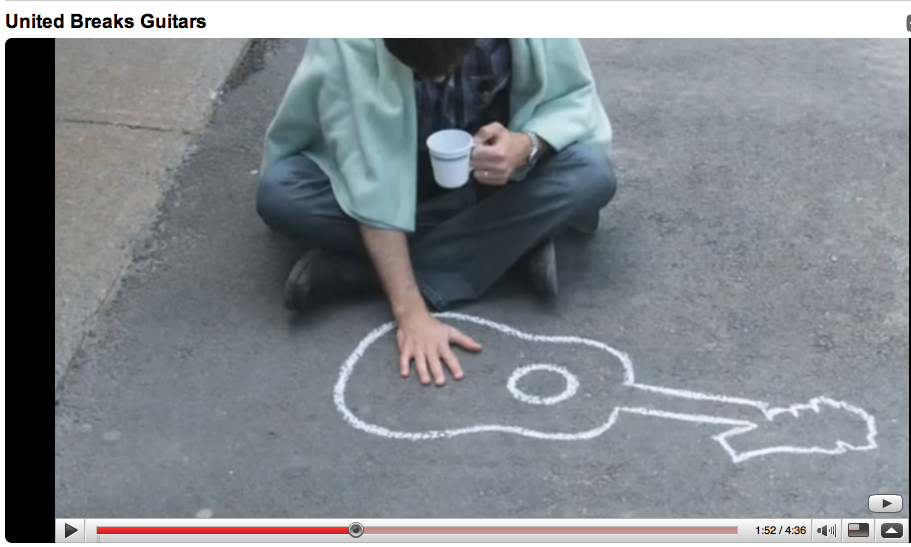
And of course, as we saw this year in the case of Dave Carroll’s spat with United Airlines, sometimes the story can both go viral and lead to mainstream news media coverage.

The basic story, if you haven’t heard, is told in this United Breaks Guitars video. The customer service representative could have kept the video from being made by simply agreeing to Mr. Carroll’s request for $1,200 in flight vouchers to reimburse his expense for fixing is $3,500 Taylor guitar. It would have cost United nothing in cash, but when Ms. Irlwig said “no” he said something to the effect, “Fine, I will just make a series of three YouTube videos with my story.” Here’s the second installment. If you haven’t watched both of those, take a minute to do so now. I’ll wait.

OK, now that you’re back, here are a few lessons or observations from this saga:

  1. This video didn’t happen because United had a YouTube channel. One of the fears some people have about engaging in social media is, “What if people say bad things about us?” But this video wasn’t posted to the United channel: it was on the SonsofMaxwell channel, which belonged to Mr. Carroll’s band.
  2. This video resonated, which is why it went viral. Anyone who has traveled by air extensively likely has some kind of horror story about poor customer service. If the video didn’t fit built-in perceptions, it wouldn’t have gotten anything like this attention.
  3. Treating the customer right is the solution. After nine months of haggling, Mr. Carroll was just looking for a way to recover what he had spent on guitar repairs. From his perspective, flight vouchers would have been almost as good as cash, as it would at least let him pay less out of pocket for future travel. If Ms. Irlwig agrees, the video doesn’t happen.

Social media can provide great listening tools to alert you to a problem that could blow up into a PR nightmare. But they don’t do any good if you don’t act based on what you hear. In this case, Mr. Carroll was right in Ms. Irlwig’s ear. No complicated listening tools needed. If you’re not going to do the right thing for your customers, social listening tools will be of little value.

As Amy Mengel put it at the time, the secret to avoiding a YouTube crisis is: “Don’t suck so much in the first place!

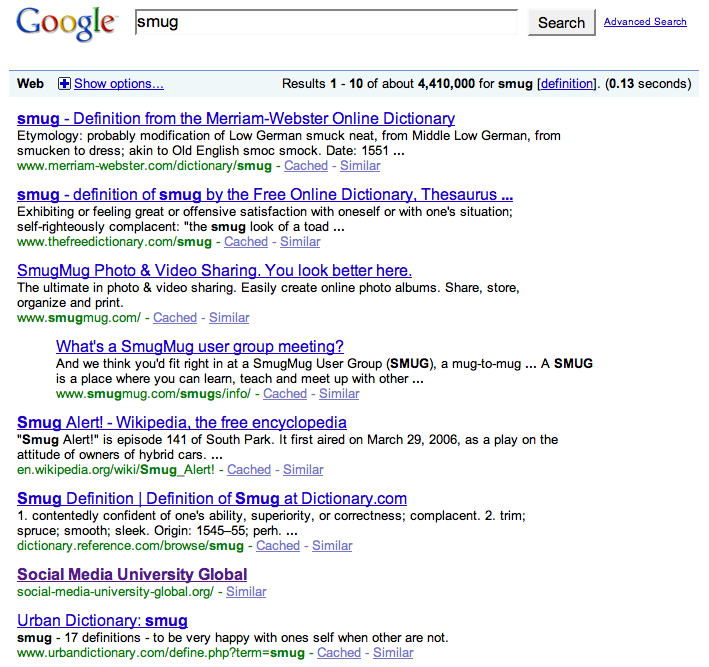
Is SMUG on your first page of Google results for smug?

When I tell people how to find SMUG, I usually tell them to search for Lee Aase in Google, or alternatively SMUG U. When you do that, SMUG shows up as the top search result.

Previously, when I just searched for SMUG, our beloved university seemed to show up on the third or fourth page of Google results which, as you all know, is pretty worthless. Between SmugMug and various Macintosh User Groups, we were far from the first page.

So last night I was surprised to see this when I entered the term smug in Google (click to enlarge):

Smug

So in my results (I wasn’t logged into Gmail, so hopefully it wasn’t just a case of Google relating the search to me), Social Media University, Global (SMUG) showed up in position #7.

I’d like your help with this. What position does this university have in your Google results for smug? First page? If so, what position?