A Nice Article about My Day Job

On Sunday the Minneapolis Star Tribune ran an article about our social media work at Mayo Clinic which began:

ROCHESTER – A few years ago, Lee Aase was just another flack for the Mayo Clinic, issuing press releases on cue and calling news conferences for doctors to present carefully scripted messages.

These days, Aase is a walking, talking, blogging, Twittering, Facebooking, YouTubing force who’s blasting Mayo into the social networking world faster than you can say “Mayo Brothers.”

I didn’t particularly like the lead because “flack” and “carefully scripted” carry some negative connotations, but given how positive the rest of the story was, I obviously have no basis for complaint. 

We have a great team involved in social media at Mayo Clinic, and it’s been exciting to see the enthusiasm grow.

The story became available online Wednesday after being print-only for three days. The irony of having a social media story be print only escaped no one’s notice, but it’s part of the Star Tribune’s effort to increase Sunday print circulation. I guess I’m honored that they would think this story might help.

I don’t know how long this will be available at no charge on StarTribune.com, but if you haven’t yet seen it, check it out here.

Phillies Fun

As I write this I’m sitting in the press box at Citizens Bank Park in Philadelphia, where the Phillies have just defeated the Washington Nationals 13-11. It was a come-from-behind victory that featured two grand slams by the Phillies (one by Ryan Howard and the other by Raul Ibanez.) Here’s the mlb.com wrap-up of the game.

I was in town to give a presentation on social media to the National Cancer Institute Public Affairs Network, and I got media credentials for the day in order to interview Jayson Werth, the Phillies’ starting right fielder, whose career was resurrected by seeing Dr. Richard Berger, a Mayo Clinic orthopedic surgeon and wrist specialist. I’ll have a post with my interview with Jayson on the Sharing Mayo Clinic blog in the next day or so.

Update: here’s the post with the video interview of Jayson.

But meanwhile, here are a few of the photos from my excellent adventure (click to enlarge):

The statue of Mike Schmidt from outside the ballpark
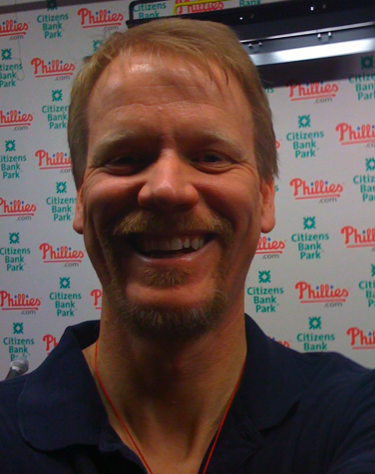
Me, in the Phillies' media room


The view of batting practice from the dugout


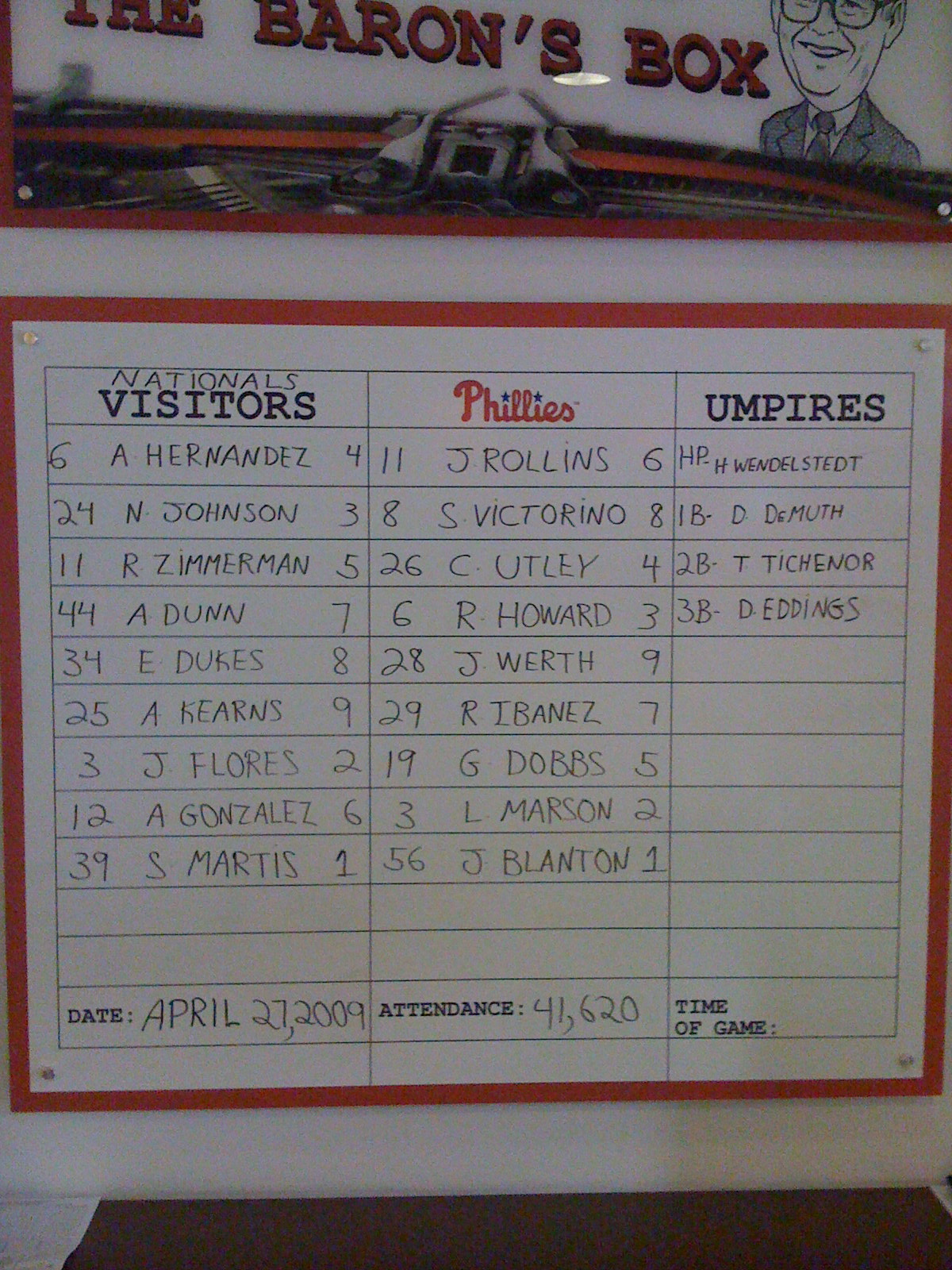
The lineups for the game (in the press box)


The grounds crew cleans up after the game

Thanks to the Phillies organization for their hospitality, and to Jayson for being willing to do the interview. He has a really great story, and I look forward to being able to have him tell it in his own words on Sharing Mayo Clinic.

Social Technologies in Health Care – Part IV

In Part III of this series, I offered a recommendation for health care associations with regard to Twitter:

Create a Twitter account for your association, if only for defensive purposes. Use Twitterfeed to automatically tweet. 

I think that was fine, as far as it went, and I think it is an essential step. But in the last two months I have seen immense potential for beneficial engagement by actively becoming involved with Twitter at the organizational level. It needs to be more than just a defensive measure.

I see Twitter being valuable not just for communication with members, but also for outreach to people who share your organization’s goals but may not yet be members. I believe it’s really worth your time to understand it, and to that end recommend the SMUG Twitter curriculum (or for an overview, going through the #tweetcamp2 course, for which the slides and accompanying videos from the Webcast archive  are embedded below.)

Social Technologies in Health Care – Part III

Note: This is the third in a series of posts based on material I provided in advance for  a two-part panel in March sponsored by ASAE & The Center for Association Leadership, “Social Technologies in Healthcare: Applications, Implications and What’s Next?

Question Three: How should medical associations/societies capitalize on social technologies in their work?

Societies and their members should get hands-on experience with social tools so they can see for themselves what the most productive uses would be. If they are concerned about HIPAA or patient privacy concerns, start by using the tools within your organization, apart from any direct patient-care application.

With that appropriate disclaimer, I’’ll offer a few practical steps to help you get started, and while step 5 may be most important I put it last so that you don’’t get so hung up in strategy that you don’’t do anything.

  1. Use the tools to help run the associations and as an added member benefit. Build outposts on the general-purpose social networking sites, particularly Facebook.
  2. Create a YouTube channel. Feature your members. Encourage them to create YouTube channels. Subscribe to each other’s’ channels and become “friends.” “Favorite” each other’s’ videos.
  3. Create a Twitter account for your association, if only for defensive purposes. Use Twitterfeed to automatically tweet. 
  4. Create one or more blogs. You’’ve got a Web site, right? That’s all a blog is: an easy-to-publish Web site that allows comments, interaction and sharing. You can make your blogs part of your site, or you can have your blog become your site.
  5. Think about how you will tie them all together into a coherent strategy. But don’t let yourself become paralyzed, waiting until you have the perfect strategy before you execute anything. You’ll learn as you go, and these tools are highly reconfigurable. But it’s a lot easier to modify your direction if you’re already moving than it is to get going from a dead stop. So start.

It won’t surprise SMUGgles that I advised diving in and getting hands-on experience. While not necessarily disagreeing, Frank Fortin, one of my fellow panelists, highly commended the POST method as outlined by Charlene Li and Josh Bernoff in Groundswell: Winning in a World Transformed by Social Technologies. I agree that this framework is helpful and also recommend reading Groundswell, but think the first step should be developing personal familiarity with the tools so you can envision potential applications for your organization.

I originally answered these questions about a month in advance of an event that was about a month ago, so my thinking has continued to evolve. In the final post in this series, I will highlight at least one area in which I now think a more aggressive strategy is in order.