G’Day Alfred Health

I’m sure they’ve never been greeted like that before. Kind of like my work colleague, Sara Bakken, who married a guy named Eric Lee. Now nobody doesn’t like her. Or my friend Kevin, who after the first Matrix movie grew tired of being called “Missss-ter Anderson.”

Anyway, as I tweeted earlier tonight, I had the distinct pleasure of a Skype videoconference at 6 p.m. CDT with the communications team from Alfred Health in Melbourne, Australia. It was about 8 a.m. Wednesday for them:
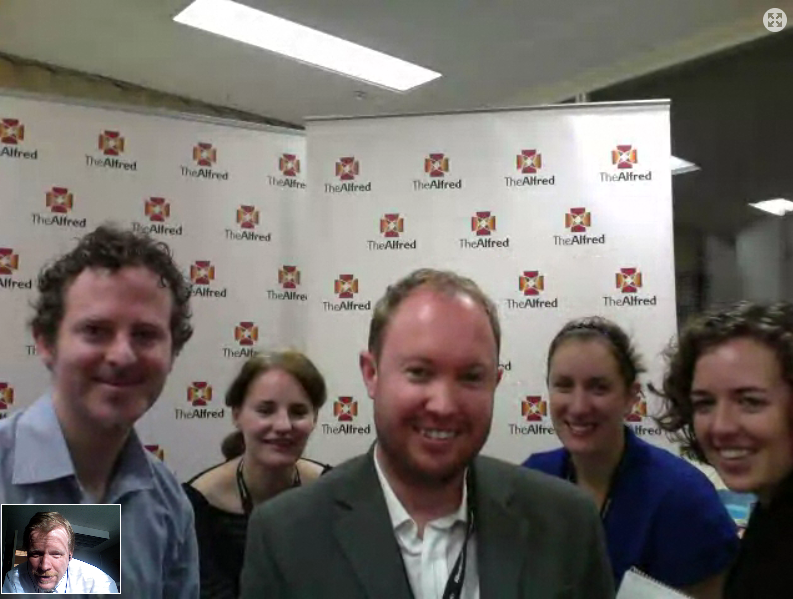
It was a great discussion and we covered a lot of ground in 30 minutes. Being a public hospital, their challenges are somewhat different from those we have in the U.S., but the point I made with them is not to necessarily emulate exactly what we have done with social media tools, but to see how they can be used to meet the goals for their health system.

So, for example, they may want to see how social tools can help with behavior modification, and perhaps even to provide low-cost or no-cost medical guidance to patients so that they don’t need to come to the hospital. Among the limitations we generally have in the U.S. is that there is little economic incentive for health care providers to invest in prevention, because for the most part seeing patients is the way they get paid. So instead of using social tools to make patients aware of unique services, which could lead to increased demand, they may want to apply them to prevention or support groups or guidance in when self care is appropriate.

In follow-up I mentioned our Mayo Clinic Symptom Checker iPhone app, and how that (or something like it) could play a role in helping patients be wiser about when they need to seek care.

What do you think? How can social media tools and other digital platforms be used to improve health and health care in places like Australia or Western Europe, where the health care systems are much different from the U.S.?

An “Aha!” Moment in Massachusetts

As detailed here and here, I had an opportunity this morning to join Larry Weber, founder of Weber Shandwick, in a seminar on social media for the Massachusetts Hospital Association.

During the Q&A session that followed, Lorie Martiska of Heywood Hospital in Gardner, Mass. said she had experienced a real “Aha!” moment during the presentation, so I asked her if she would be willing to share it with the world. She was, so here it is:

It’s really gratifying to be able to help people like Lorie who feel pinched for resources, and to help them see the potential of some of these inexpensive (or even free) technologies. The tools are great if you have staff and resources, but they’re even more important if you don’t, because they help you stretch what you do have.

Top SMUG Book Recommendations

While we have a SMUG book store that I plan to reorganize and upgrade, I wanted to take a moment to highlight three books that most professionals thinking about applying social media will find particularly helpful.

Getting Things Done, by David Allen, is my absolute first recommendation, particularly if you just don’t think you have the time or energy to fit another thing, social media, into your already overcommitted life. This blog started out as a way for me to learn about blogging, and Getting Things Done (or GTD) was a key element of my posts for the first year or so. Just type “GTD” in the search box at right and you’ll see several of those posts. A good way to get an intro to GTD, before you buy the book.

On a similar topic, I recommend The 4-Hour Workweek by Tim Ferriss, particularly for his observations relating to email and meetings. He’s snarky bordering on sarcastic and I don’t buy into his “new rich” goals for life, but he has some excellent and immensely practical observations on how to get the most out of your work time.

Finally, on a more theoretical note, I offer Free: The Future of a Radical Price by Chris Anderson. This book won’t help you swim through the torrents of email and other commitments, but it will give you perspective on how and why it makes economic sense for services like YouTube, Facebook and Twitter to be free to users. And it may help stimulate your thinking about you work or business, and how you can incorporate free into your business model.

I’ve reviewed each of these books in more detail here on SMUG, so look in the book review category for background. If you click the affiliate links above and buy the books, SMUG would get a dollar or two. But if you have an Audible.com account, you can get this last book for free. The other two also are available on Audible.com, which leads to no SMUG kickback. It doesn’t matter to me…get them however you would like, but I really think you’ll find these books helpful.

Another Facebook Baby

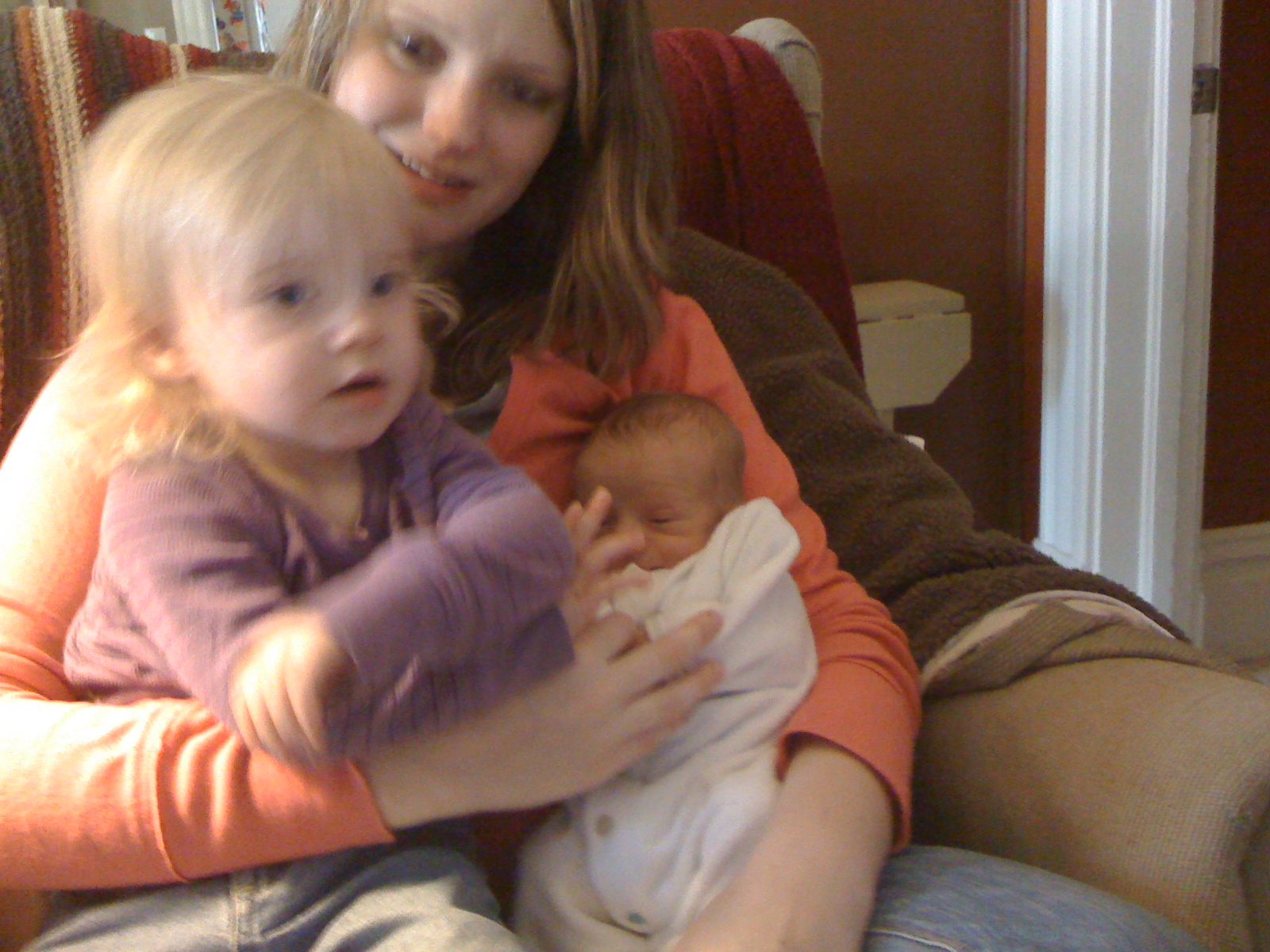
In my presentations I frequently introduce my granddaughter, Evelyn, as someone who owes her existence, humanly speaking, to Facebook. As a Presbyterian elder I believe God ordains everything, but also know that He uses secondary causes to bring about His purposes. In Evelyn’s case, Facebook was the means by which her father, Kyle, met her mother (my daughter, Rachel.)

I would call that a really significant ROI from social media.

This weekend I got to travel to Grand Rapids, Michigan to meet Evelyn’s baby brother, Judah, who was born on April 9th (and pick up my wife, Lisa, who had flown there to help Rachel.) He’s a pretty sweet little guy, and here are a couple of photos:

Judah Scott Borg

You can see more pictures from our visit….you guessed it… on Facebook.

Meanwhile, here’s a video update on Evelyn:

‘Tis the gift to be simple…

[ratings]

I had the delightful experience yesterday of meeting Dr. Carl May (@CarlRMay), a British collaborator of Mayo Clinic’s Dr. Victor Montori (@vmontori) on the concept of minimally disruptive medicine. I was honored that he wanted to meet with me during his visit to Mayo, and based on something he said during coffee I asked (or rather compelled) him to share his perspective on what makes social media valuable and successful in health care, and what he appreciates about our Mayo Clinic approach.

Here is some of what he had to say (shot in front of the famous bronze doors of the Plummer building):

Dr. May had earlier said that what he appreciates about our Mayo Clinic YouTube videos is that they are what the Quakers might call “plain” (although I’m not certain members of the Society of Friends would go for using video at all. But maybe I’m over-interpreting.”) Still, one of the famous Quaker (check that…Shaker) ditties extols the virtues of simplicity:

‘Tis the gift to be simple, ’tis the gift to be free,
‘Tis the gift to come down where we ought to be,
And when we find ourselves in the place just right,
‘Twill be in the valley of love and delight.
When true simplicity is gain’d,
To bow and to bend we shan’t be asham’d,
To turn, turn will be our delight,
Till by turning, turning we come round right.

I appreciated Dr. May’s compliments and wanted to share and react to them to illustrate a few points.

  1. It’s always good to have a video camera with you. If I hadn’t had my Flip camera, I would not have been able to capture this video. I almost always carry a camera in my coat pocket or laptop bag. That enables me to take advantage (in the best sense of the word) of opportunities.
  2. We do our best to make the quality of video the best it can be, given the circumstances. I would have like to have had a tripod to keep the camera completely steady, but it’s most important to get the video. It also would have been better to perhaps be a step back from him, but we were in front of a door through which people were entering and exiting, and it was slightly drizzling. We needed to be closer. And I also wanted to be sure viewers could hear him. Thus, being closer was the right solution for the situation.
  3. Unadorned video does appear more genuine and authentic, but we don’t pursue that for its own sake. The point is to be nimble and cost-effective, making valuable information and stories available. Some of the videos we put on our Mayo Clinic YouTube channel are from TV news segments our team produces, and others may be extended sound bites from those same broadcast-quality interviews, like this one on deep brain stimulation. Having those in the mix is great for YouTube, and the point is to make good information available in a nimble, resourceful way. If you have some video shot for TV with a broadcast-quality camera and lighting, by all means use that on YouTube too. But if the only video you put up is highly polished you will have some problems, which I will discuss in a future post.

Finally, here is a video of Dr. Montori discussing minimally disruptive medicine, which is among the videos Dr. May appreciated: