This question comes from Chris Patota (@WestchesterPR), and is shared with permission:
I just came across your blog today, and I think it’s a great resource for people like me who are trying to leverage social media for business. I have a quick question for you…what is your preferred Twitter Chat technology? I would like to use a Twitter chat for one of my clients’ events, so I wanted to see if you had any recommendations.
Answer:
Thanks, Chris. As I describe in this post on “3 Steps to Joining or Leading a Twitter Chat,” I’ve mainly been recommending using the basic Twitter interface, because it requires less training than some other options.
Especially for newbies, that seems to be the most straightforward, so users don’t need to install Tweetdeck or some other application. There is enough to learn without complicating the process with another application.
Tweetchat.com is OK too, and saves the need to enter the hashtag each time…but to me the Twitter interface has gotten good enough (with a saved search, as described in Twitter 116) to make that work well.
I personally like to use Tweetdeck, and just create a search pane for the hashtag. This is especially helpful for chats that recur from week to week, such as #hcsm, or otherwise have some ongoing activity. That enables me to check at a glance whether there is anything new, instead of having to remember to click the #hcsm link on my Twitter interface.
I also would advise you to have new Tweeps sign up for their accounts and do a few tweets in advance, because I’ve noted that sometimes new users’ tweets don’t show up reliably in Twitter search. So you might want to have them do a few tweets using your proposed hashtag.
If anyone has a way to ensure the inclusion of new users’ tweets in Twitter search, please share it in the comments on this post.
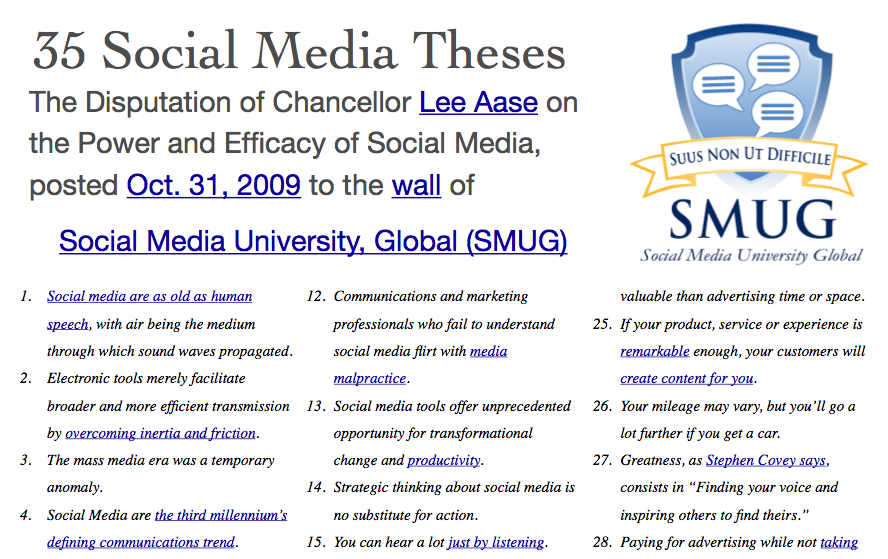
Ever since I posted the 35 Social Media Theses, 492 years after Martin Luther posted his 95, I have planned to put them in a one-page PDF, to make them more portable. Here is that document:
Please feel free to make as many photocopies of the document as you would like.
You also may email the file (it’s only 132K) to anyone you think would find it helpful.
And of course, since this is about social media, I encourage you to tweet the link or otherwise share it on Facebook, LinkedIn or other platforms. Digg?
The Creative Commons license simply requires that you not change the original document as you pass it along and that you credit the source.
You will note that within the PDF I have included links to posts or news articles on SMUG or elsewhere that support or explain the various points.
I hope this can be a good discussion starter for you in your workplace or in other organizations you’re trying to get involved in social media.
Among the most important benefits of social media tools are their ease of use. While updating a static Web site can be onerous, and video shooting, editing and distribution also can be complicated, the beauty of blogs, Flip cameras (or Kodaks) and YouTube is the nimble authenticity they bring to communication.
Of course, it’s possible to develop bureaucratic processes that will completely erase the advantages of social media. By trying to fix perceived shortcomings of the standard social media tools by upgrading production values, you can lose their freshness and authenticity.
Don’t do that. Don’t complicate things.
To encourage you in this, I’m sharing a couple of examples from our Mayo Clinic experience, in which the nimbleness of social media tools enabled us to capture compelling stories that formerly would have been impossible, or at least impractical.
Exhibit A: Sharing Patient Stories
On Friday, September 18, 200, I received a late-afternoon call from one of our Mayo Clinic cardiologists, Dr. Michael Ackerman, telling me about an infant patient from the San Francisco area he had been evaluating. The call came about 3 p.m., and within an hour I was interviewing Trevor’s mom in the courtyard near their hotel. Here’s what she had to say:
The Kings were leaving for home the next morning, and if I had been unable to shoot the interview, we would not have been able to tell this story. Getting one of our professional videographers to break away on short notice would have added one more complicating factor to the equation, making it unlikely to work. But with the Flip, we captured the authentic moment.
Here’s another story from Sharing Mayo Clinic about Dr. Ackerman that will warm your heart. It doesn’t necessarily fit the theme of this post, but you should check it out anyway.
Exhibit B: Late-Breaking News
On Tuesday, June 3, 2008 at 8:45 a.m. I got some good news and some bad news. The good news was that one of our Mayo Clinic researchers, Dr. Victor Montori, had a paper being published in a major medical journal, Journal of the American Medical Association, or JAMA.
The bad news: the paper was being published that day, and was coming “off embargo” in just over six hours. This left us no time to prepare a formal news release or shoot and edit broadcast-quality video. In the era before our Mayo Clinic News Blog, we would have had no good options for calling attention to this research.
But since we had the blog and the Flip camera, called Dr. Montori and interviewed him at 10:20. By 11:55 we had uploaded the video to YouTube and had also prepared this blog post about the diabetes research. We sent “pitches” by email and Facebook to some journalists starting at noon, and the next day the Wall Street Journal Health Blog carried the story and embedded this video from our YouTube channel:
These are just two case studies of the practical advantages of using social media tools as more efficient and effective means of doing your work, if you don’t purposefully complicate things.
How have you used the Flip or similar tools for authentic storytelling?
At a certain level, it’s important to think strategically about how your organization will use social media.
After all, if Thesis 4 is true, and if social media really are the defining communications trend of the third millennium, then using these powerful tools in a way that aligns with your overall strategy just makes good business sense.
Strategy is “a plan of action or policy designed to achieve a major or overall aim.” Aimless use of social media is no better than aimless advertising or product development research. It’s never a good idea to devote your organization’s time and resources to an activity that doesn’t relate in some way to an overall strategy. Aimless is pointless.
It’s much better for YOU to learn on your dime. Or your time.
After all, you know the strategic initiatives in your organization. The outside consultants and agencies don’t. Instead of paying them to learn about your organization, why not take the time to learn about social media so you can see how these tools can support your goals?
There is certainly a place for agencies to help in this area, especially if you have more money than time. They may be able to help you refine your plans, and bring perspective from other similar organizations to help you sell management on your plans.
But instead of insisting that you have a grand, fully developed strategy before embarking in social media (and which is accompanied by a hefty planning and consulting price tag that will make the ROI harder to prove,) I would suggest there are some goals compatible with social media strategies that apply for most organizations.
So here are a few goals you might want to pursue in the new year, using social media:
Improving communication and collaboration among employees. Find a work unit in part of your organization that doesn’t deal with your most proprietary or confidential information, and encourage those employees to pilot use of Yammer, PBWiki or other networking and collaboration tools.
Improving customer service. Use social media tools like Twitter to listen to customers. Comcastcares is an example of this.
Reaching niche “audiences” with in-depth content, and helping those “audiences” coalesce into communities. A YouTube channel, blogs and podcasts all may be good tools to use in reaching this goal, as you can provide information and resources to people who really want it, instead of using expensive advertising to interrupt those who don’t.
Learning all you can about social media. By becoming conversant in social media and accustomed to its norms and mores, you’ll see many more specific applications for your work that will support your organization’s goals. I can recommend lots of books, but hands-on experience is essential to understanding. That’s why you might want to become a SMUGgle.
Your social media strategy doesn’t have to be perfect right away. In fact, I believe it should continually evolve as you learn more about the tools and see new applications.
The other point I want to emphasize from the definition of strategy is that it is a “plan of action….” Action without a goal is likely unproductive, but planning without action is even worse. By acting rashly without full consideration you might possibly do the right thing: you could just get lucky. But analysis paralysis means you will consume resources with no hope of accomplishing anything.
So those who seem to be the greatest defenders of strategy run the risk of undermining it.
To avoid this, identify one or two goals for your use of social media, either picking from the list above or something else you have in mind. Goal #5 can always be your personal entry point, if necessary.
Then execute against that plan, putting your strategy into action. General (and later President) Dwight Eisenhower famously said “plans are useless, but planning is indispensable.” I believe his wisdom is best applied in an almost continuous planning process that is accompanied by continuous execution and modification.
Remember, it’s a lot easier to steer a moving car than it is to get it started from a dead stop. If you find yourself going off course, you can always steer back or even tap on the brake. And by choosing some small but well-defined (and likely successful) social media projects, you can build momentum.
In a future post, I’ll tell how we used a series of mini-plans at Mayo Clinic to grow into full-scale incorporation of social media. We’ve had some minor course corrections along the way, but through the process we’ve learned a lot and built momentum that will help carry us forward.
Note: This is the Aase family’s 2009 Christmas letter, but with a special twist relating to a major milestone we’re observing today.
Lisa and I have so much for which we are thankful, as God has blessed us so amazingly. The events of 2009, some of which I will recount below, have been mind-blowing. But this also is a significant year for us as a couple, and today is a particularly momentous day, as we celebrate our 25th wedding anniversary. In frequent flyer parlance (you’ll understand the reason for me using the analogy in a bit), I guess that’s the marital equivalent of “Silver Elite” status.
On December 22, 1984 we stood together in front of St. Peter’s Lutheran Church in New Richland, MN, after our wedding:
A quarter of a century later, she’s every bit as beautiful as she was on that bright and snowy day.
We’ve been blessed not only with each other, but with six delightful children, a son-in-law and a granddaughter. And earlier this year, when we were visiting Grand Rapids, Michigan for Evelyn’s first birthday, we learned that she had a sibling on the way. Here’s how Rachel and Kyle decided to spring the news to us, using Aunt Rebekah as the foil:
We found out this month that “Thermie” is a boy, and his name will be Judah Scott. Here’s one of his first baby pictures:
Judah Scott Borg
In other late-breaking news, we got a call from our oldest son, Jacob, on Saturday night. He announced that he had popped the proverbial question to Alexi Iler and they are now engaged. No date has been set, but we’re looking forward to welcoming her to the family sometime next year.
Jacob and Alexi
Rebekah and Ruth graduated from high school and Riverland Community College this year, and moved on to continue studies at University of Wisconsin-La Crosse, where Rachel and Jacob had both graduated. They live in a house just off campus. The girls are planning to go into nursing, and Jacob is going back to school to become a physical therapist, and so Bekah and Jake were in the same Chemistry class this fall. That was kind of neat. And I guess Jake has been spending a fair amount of time visiting his sisters, although the fact that Alexi is one of their housemates may be a contributing factor.
We had a great trip to Indianapolis in July for the National Bible Bowl competition, as the team led by Ruth but also including Rebekah and Joe took fifth place. You can read about that trip here, here and here.
Joe went to high school this fall, so John is the only one Lisa is still home schooling. Joe is adjusting well academically, and as a 6’5” freshman is playing with the sophomore basketball team. While Bekah and Ruthie made the transition from home school to high school seem stressful, Joe requires much less maintenance. He’s a pretty easygoing guy. It probably comes in part from being the fifth of six kids.
John is our youngest (11), and earlier this month he and I developed another thing in common: he was diagnosed with celiac disease. I was diagnosed with celiac disease in March, after about 20 years of intermittent IBS-like symptoms. What got us looking in my case was iron deficiency anemia discovered when I tried to give blood. We were thankful the anemia wasn’t due to colon cancer or something else that involves internal bleeding, but it’s been an adjustment to not be able to have wheat, rye or barley products. If you want to know more about this disease, check out this celiac disease post on our Mayo Clinic News Blog that gives background and also some recent Mayo research.
Anyway, we would never have suspected celiac disease in John if I hadn’t been diagnosed, but since it’s hereditary and since he was having some intestinal symptoms, we got him tested. Joe is in the clear, but over the next few weeks we’re going to get the others screened, too.
It was earlier that month that I had discovered the now-famous video of a delightful older couple playing the piano at Mayo and embedded it within Sharing Mayo Clinic. That kicked off an interesting journey that included me getting a chance to visit and interview them in their home in Ankeny, Iowa, and also to be with them when they played their duet live in the Times Square studio on ABC’s Good Morning America program in New York. It was great to get to meet Sharon Turner, the patient who shot the video, and her daughter, Jodi Hume, who had uploaded it to YouTube, as well as the Cowans’ daughter, DeDe Shour. As I write this, the video has been seen more than 5.3 million times on YouTube.
I traveled a lot this year to spread the word about what we’re doing in social media at Mayo Clinic, and to encourage people in health care and other industries to join the fun. I got to visit Carlsbad, Orlando, Baltimore, Philadelphia, Indianapolis, Chicago, San Francisco, Omaha, Oklahoma City, Milwaukee, New York, Phoenix, Scottsdale, Idaho Falls, Las Vegas, St. Louis, Miami, Boca Raton, London, Amsterdam and Nijmegen (the Netherlands), among others. Between travel and webinars, I did 70 presentations on social media for external audiences in 2009. One of the best parts of this was getting to meet so many people in person (or as we say in social media, IRL – “in real life”) after having first made connections on Twitter, Facebook or SMUG.
Speaking of SMUG, we’ve had an interesting year here, too. It’s hard to say what our “enrollment” is since we don’t charge tuition, but we’re on the verge of 800 “SMUGgles” who have joined the SMUG group on Facebook. The posting of my 35 Social Media Theses on the 492nd anniversary of the day Martin Luther nailed his 95 Theses to the church door at Wittenberg was a highlight, and I hope that in 2010 we will continue to see a social media Reformation in healthcare. I have some ideas in mind for how to help drive that. Stay tuned.
As I write this, we’re enjoying having Rachel and Evelyn at “Old Main” for the week (they flew in yesterday, thanks to frequent flyer miles accumulated a couple of paragraph back), and we expect Kyle will arrive by car tomorrow. We have much to celebrate, and Lisa and I look forward to having the whole family together as we remember Jesus’ birth and also think back not only on the blessings of this year, but also a quarter century of marriage.
We expect 2010 to be quite eventful, with Judah’s arrival and Jacob’s marriage as high points. I’m also approaching my 10-year anniversary of starting work at Mayo Clinic. We hope to avoid any more serious disease diagnoses, but we’re certainly not taking our health and other blessings for granted.
This afternoon’s events provided a vivid reminder of that, as we had a near-inferno caused by Joe plopping his backpack on our kitchen table, near some candles. Here are the charred remains of the paper Joe needs to turn in at school tomorrow:
The backpack itself was a total loss, and as you’ll see in this video, the table isn’t doing that well either. We’re thankful it wasn’t worse, that Ruth was there to notice the problem and that Rachel was able to douse the flames (after Ruth had fanned them.)
We’re glad Old Main is still standing, and all decked out for a Christmas celebration.