Thesis 23: Everyone uses social media today

The growth of social networking sites like Facebook and Twitter has been phenomenal, particularly in 2009. Facebook now boasts 350 million active users, while Twitter grew by more than 1,500 percent during 2008 – and then the growth really started to take off in 2009.

Thesis 4 would be reasonable, I think, based on these factors alone. Social media are the defining communications trend of this millennium, which is not to say they are the only important means of communication or that they have supplanted TV, radio and newspaper. (OK, well maybe newspaper.) But they embody the communications characteristic that defines our time: that anyone

But Thesis 23 says social media already are bigger than most people realize, because they don’t just include networking sites for which you need an account to participate, such as Facebook, LinkedIn, Twitter and MySpace.

YouTube is in essence a social networking site for videos, and it is the world’s second-biggest search engine after Google. So everyone who watches a YouTube video is in essence participating in social media. Those videos may even be embedded on  mainstream media Web sites. But the reason we even get a chance to see them is because there is a site like YouTube which is open for anyone to upload a video at no cost. This again is how social media are defining this era.

The other reason I say everyone uses social media comes from the nature of blogs. I heard Susannah Fox of the Pew Internet Project speak at a conference in October, and she said something that validated an opinion I’ve long held. She said she expected that her organization would soon retire one of its standard survey questions because it doesn’t provide reliable information. That question asks whether respondents read blogs or not, and the affirmative percentage has held steady at about 30 percent for the last few years.

But the reality is that a blog is just an easy-to-publish Web site that allows comments. So lots of people are reading blogs as they search and surf the Web, and in most cases there isn’t a flashing icon that alerts readers that they are on a blog. I believe that anyone who spends appreciable time on the Web spends at least some time on blogs. Especially given how search engines like Google favor blogs and YouTube videos, it’s almost inconceivable that someone could do 20 Google searches without ending up on at least one site with social media elements.

So between YouTube, the most popular video source on the Web, and blogs, which are the easiest way to publish a Web site, I believe the overwhelming majority of Web users participate in some way with social media, even if it’s only as a consumer of content.

In Thesis 23 as originally posted I said:

Almost all Web surfers use social media today. They just may not know it.

For the headline of this post, and in keeping with the provocative nature of social media, I just rounded up and said “Everyone.”

I don’t think it’s much of an exaggeration. Everyone uses social media today, whether they know it or not. Even more than that, social media dramatically affect the types and amounts of content available to be consumed.

As social media grow, the proportion of time people spend on sites with social capabilities also will increase, as will the proportion of participants moving from strictly consuming content to at least commenting or rating. And many users will move from the ranks of consumers to producers, especially as the user interfaces continue to get easier.

The fact that you are reading this post means you are a social media user, at least at this moment.

Welcome to the revolution.

Thesis 4: Social Media are the Third Millennium’s Defining Communications Trend

I don’t think this should really need lots of discussion and proof. In the era of Gutenberg and Luther, only the most profound works could be published via the printing press. Thus Luther’s 95 Theses and other works of eternal significance were candidates for mass distribution. Not much else was considered worthy of the expensive paper on which it would be printed.

And of course in those days mass distribution didn’t mean exactly universal distribution, but only to those who had the unusual opportunity and gift of literacy.

But even with limited literacy, Luther’s theses spread like a virtuous version of pandemic flu. They got people talking.

Over the ensuing 480 years or so, the ability to publish remained scarce and therefore precious. And for the last half century, there was a unique development in that a privileged class of editors and programmers could make tastes, and could decide what news was fit to print or worthy for airing.

So journalists attached to someone who owned a printing press, or (in the U.S.) an FCC-granted monopoly license, were unique in their ability to spread news and views to their community. News organizations sold their wares to consumers, or as Chris Anderson, Clay Shirky and others have noted, more accurately sold (or rented) their audiences to advertisers.

The economics of digital abundance and what Shirky calls unlimited perfect copyability, along with development of tools for self-publishing, means that we no longer are hostage to this privileged class. People like us can start a blog, or a podcast, or a YouTube channel that can be accessed from around the globe.

It doesn’t mean we necessarily have a huge audience for our views, but it does give us access, at least loosely based on merit, as judged by individuals instead of only the tastemakers.

The fact that only perhaps 10 percent of potential publishers actually avail themselves of these tools doesn’t lessen their significance.

In warfare the credible threat of force can be just as effective in accomplishing goals as the use of force is. Likewise, the fact that almost everyone has a digital camera at all times (thanks to the ubiquity of camera phones) means the potential cost of an organization treating someone badly is much higher.

In my presentations, I frequently illustrate this point with portions of the Social Media Revolution video, which begins with two questions:

Is social media a fad? Or is it the biggest shift since the Industrial Revolution?

While I agree the development of social media tools is as significant as anything since invention of the steam engine, the cotton gin and other outgrowths of the Industrial Revolution, I prefer to consider social media in the context of communications trends. In that regard, I believe it’s the biggest shift since Gutenberg. At least since Marconi.

In Thesis 3, I will discuss the anomalous (that’s a pretty sophisticated, Chancellor-like word, isn’t it?) nature of the mass media era, and why the era has ended, even as we continue to have mass media outlets in our communications ecosystem.

The fact that Gutenberg’s invention defined the 16th through the 19th centuries didn’t mean it completely replaced verbal communication. And broadcast media didn’t completely replace print in the 20th century. But each defined their era.

Likewise, social media define the Third Millenium, even though they haven’t (and won’t) completely replace mass media.

Meanwhile, here’s a screen shot from the Social Media Revolution video that puts it all in context in just a single frame:

Picture 8

If you have 4:22 to spare, here’s the video in its entirety:

So how do you answer those questions? To what would you compare the social media revolution?

Thesis 10: Social Media Can’t Make Up for Bad Products or Poor Service

Picture 7

Social media are not the panacea for all that ails the relationship between organizations and their customers or other stakeholders.

If you treat people badly, they now have not only the opportunity to take the story public, which they always had, but also the ability to tell the story themselves instead of having to rely on third parties like the news media to spread the word.

And of course, as we saw this year in the case of Dave Carroll’s spat with United Airlines, sometimes the story can both go viral and lead to mainstream news media coverage.

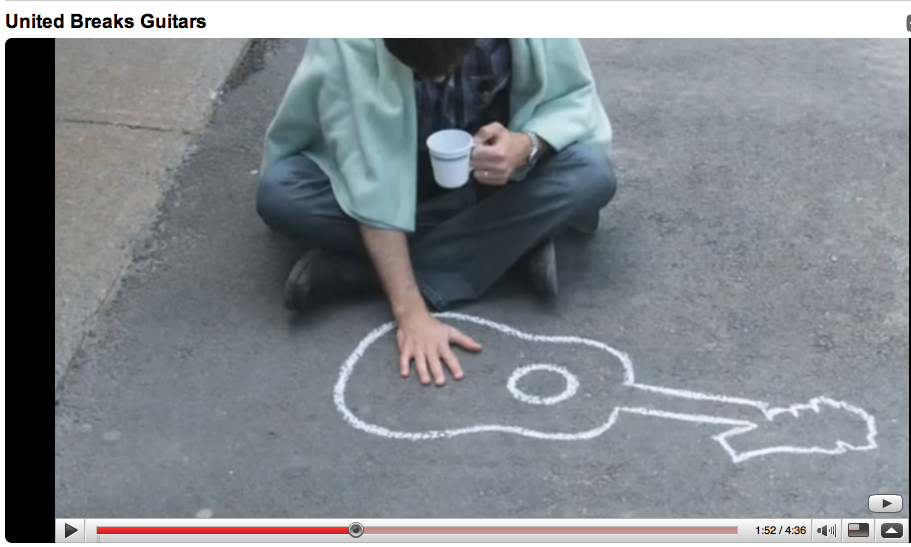
The basic story, if you haven’t heard, is told in this United Breaks Guitars video. The customer service representative could have kept the video from being made by simply agreeing to Mr. Carroll’s request for $1,200 in flight vouchers to reimburse his expense for fixing is $3,500 Taylor guitar. It would have cost United nothing in cash, but when Ms. Irlwig said “no” he said something to the effect, “Fine, I will just make a series of three YouTube videos with my story.” Here’s the second installment. If you haven’t watched both of those, take a minute to do so now. I’ll wait.

OK, now that you’re back, here are a few lessons or observations from this saga:

  1. This video didn’t happen because United had a YouTube channel. One of the fears some people have about engaging in social media is, “What if people say bad things about us?” But this video wasn’t posted to the United channel: it was on the SonsofMaxwell channel, which belonged to Mr. Carroll’s band.
  2. This video resonated, which is why it went viral. Anyone who has traveled by air extensively likely has some kind of horror story about poor customer service. If the video didn’t fit built-in perceptions, it wouldn’t have gotten anything like this attention.
  3. Treating the customer right is the solution. After nine months of haggling, Mr. Carroll was just looking for a way to recover what he had spent on guitar repairs. From his perspective, flight vouchers would have been almost as good as cash, as it would at least let him pay less out of pocket for future travel. If Ms. Irlwig agrees, the video doesn’t happen.

Social media can provide great listening tools to alert you to a problem that could blow up into a PR nightmare. But they don’t do any good if you don’t act based on what you hear. In this case, Mr. Carroll was right in Ms. Irlwig’s ear. No complicated listening tools needed. If you’re not going to do the right thing for your customers, social listening tools will be of little value.

As Amy Mengel put it at the time, the secret to avoiding a YouTube crisis is: “Don’t suck so much in the first place!

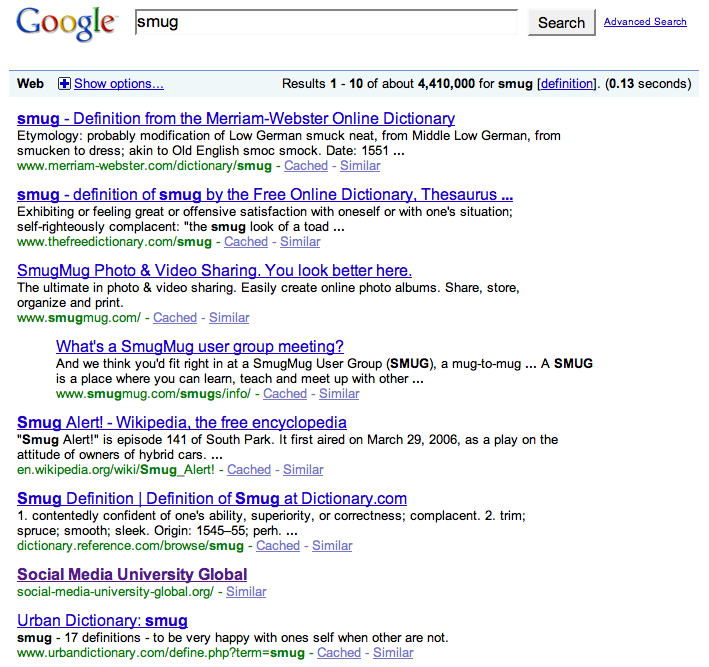
Is SMUG on your first page of Google results for smug?

When I tell people how to find SMUG, I usually tell them to search for Lee Aase in Google, or alternatively SMUG U. When you do that, SMUG shows up as the top search result.

Previously, when I just searched for SMUG, our beloved university seemed to show up on the third or fourth page of Google results which, as you all know, is pretty worthless. Between SmugMug and various Macintosh User Groups, we were far from the first page.

So last night I was surprised to see this when I entered the term smug in Google (click to enlarge):

Smug

So in my results (I wasn’t logged into Gmail, so hopefully it wasn’t just a case of Google relating the search to me), Social Media University, Global (SMUG) showed up in position #7.

I’d like your help with this. What position does this university have in your Google results for smug? First page? If so, what position?

Flip Video Camera vs. Kodak Video Camera

In many of my presentations this year I have used the video embedded immediately below to illustrate the quality available through consumer-grade video cameras, such as the Flip video camera. With my daughter Rachel’s permission, here’s an example of what you get from the Flip UltraHD, from my granddaughter Evelyn’s first birthday party in August:

Here is an example of a video I shot earlier in April with the standard definition version of the Flip video camera (before we got HD), with Philadelphia Phillies outfielder Jayson Werth, in a room behind the dugout at Citizens Bank Park in Philadelphia:

You will note that in this video there is background noise from the indoor pitching machine and batting cage, but I think in both cases the quality of the video is perfectly acceptable for use on the Web. And since the HD only costs $50 more, I think it’s well worth the extra cost. (Of course, I’m kind of partial to the subject of that HD video .)

Kodak has some similar consumer-grade video cameras, such as the Kodak Zi8 HD, and their key advantage is that they have an external microphone jack, which could improve the audio quality in some cases. If I had used that camera for the interview with Jayson Werth, for instance, the batting cage noise probably would have been less pronounced. The good news: you can put in a huge memory card to get really long recording times without having to download the files to your computer. The bad news: extra cost.

Here’s an example of a video we shot with the external microphone, and uploaded to YouTube:

One additional advantage of the Kodak is it can record in 1080p, but can also downshift to 720p or even standard definition. Here’s a brief sound bite to that effect from my colleague Joel Streed, shot and edited as 1080p.

The downside of 1080p is that for a video of any length, the processing power required is pretty immense, without much of a perceptible difference in image quality, at least for Web video.

If you don’t see yourself complicating the recording process by attaching a remote microphone to the interview subject, the Flip video camera is fine.

So, to sum up, here are the advantages I see for each of these cameras (as compared with each other):

Flip UltraHD Camcorder, 120 Minutes (Black)(Amazon Affiliate link – currently $149.99)

  1. Simplicity and cost. One-button operation and a ready-to-go camera. With the Kodak, by contrast, you really can’t shoot video unless you have purchased an SD memory card. And if you’re going to take advantage of the external microphone, that means you need to buy an external microphone. So the Flip video camera price is pretty much “all inclusive” while you will have some additional costs for the Kodak. Given the $70 difference on Amazon you see here currently between the Flip and the Kodak, you’ll likely spend at least $100 more for the Kodak.
  2. Solid, durable design (the Kodak’s USB connector seems a bit more flimsy)
  3. Can use AA batteries. (With the Kodak, you could possibly be stuck with a temporarily unusable camera if the built-in rechargeable batteries run down. On the Flip Ultra HD, if you’re in that situation you can swap out the rechargeable pack and replace it temporarily with AAs.)

Kodak Zi8 HD Pocket Video Camera (Amazon affiliate link – Currently $219.99)

  1. External microphone jack. If you’re shooting in a noisy environment, this gives you the possibility of using a remote microphone to get better sound. With the Flip you need to choose where you shoot if the sound quality is important.
  2. Flexibility in storage. The Flip UltraHD holds two hours of video in its 8 GB memory. With the Kodak you can use a bigger card and record longer, although a larger card adds to the camera’s cost.
  3. Multiple resolution choices. You can record 1080p, 720p or standard definition. The Flip UltraHD is just straight 720p.

The really good news to take away from this is that there are at least a couple of good options for capturing video using consumer grade cameras for use in your professional efforts in social media, whether it’s posting videos to YouTube, Facebook or some other sharing site. Both of these cameras are light, small and therefore easy to carry in a coat pocket or purse, so you’ll never need to worry about missing an opportunity to capture video.

The first rule of video is that you can’t edit what you don’t shoot, so these cameras both make it more likely you’ll get some good material for editing.