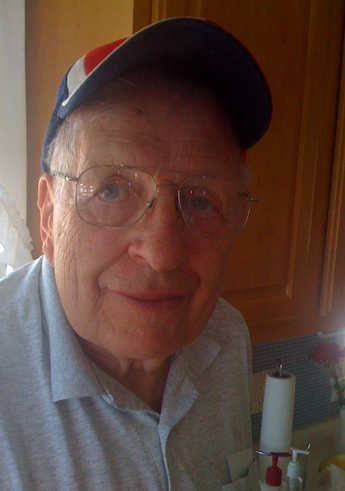
Husband of one, father of six, grandfather of 15. Chancellor Emeritus, SMUG. Emeritus staff of Mayo Clinic. Founder of HELPcare and Administrator for HELPcare Clinic.
Millions of people know the character Richard Dean Anderson (a Minnesota boy, by the way) played on TV: MacGyver. So when I did a presentation in Chicago called, “The $4-a-week online newsroom (and other MacGyver tips)” people immediate “got” what it was about.
Although he is highly regarded in our community, relatively fewer people know my dad, Lewis Aase. That’s a pity, and it’s a situation I hope to rectify in some small measure through this post.
Dad
I wasn’t a huge MacGyver fan, in part because it began its run a year after Lisa and I were married, when we had four kids in six years. I didn’t have a lot of time for TV.
But another reason why I think it wasn’t “must-see TV” for me was that I didn’t think what he was doing was all that unusual. I grew up seeing my dad do things like that all the time. Dad never (to my knowledge, at least) used his problem-solving skills in death-defying situations, but he was (and still is) an amateur expert.
By “amateur expert” I mean someone who doesn’t have formal training, and perhaps doesn’t do things exactly like the professionals. But whether it was putting in a new shower by laying cement blocks in our basement (and eventually finishing it with ceramic tile) or fixing plumbing, installing light fixtures, laying carpet or linoleum (this was the 70s, remember!) or innumerable other projects, Dad just always seemed to figure it out.
Dad has had a strong influence on both of his sons, giving us a common-sense, no-nonsense approach to problem solving, as well as a can-do spirit. My brother Mark (of whom I’m really proud), got Dad’s home remodeling skills. In fact, they flipped a house together last year; maybe not as quickly as they would have liked, but they worked through everything.
I got more of Mom’s academic inclinations, so I’m pretty limited in use of Tim Allen-style power tools. The power tools I use instead are those designed for communication, such as Twitter, blogs, YouTube and everything else we cover in the SMUG curriculum.
Dad being a professional educator (he was an elementary school principal) gave me an interest in teaching. He also was an innovator who developed many new approaches and programs to better serve kids and help them learn. He didn’t just think about how things should change: he made change happen.
Malcolm Gladwell’s newest book, Outliers, highlights two reasons why I’m thankful to God for my dad and mom. First, Gladwell shows that so-called accidents of birth play a huge role in individuals’ success. For example, Bill Gates and Steve Jobs were born at just the right time and place to become software tycoons. But Gladwell’s other point is that this favorable environment needs to be accompanied by 10,000 hours of skill development to become world-class in anything. No one becomes successful without hard work…and lots of it.
That’s why I have been triply blessed. My dad and mom not only provided me the advantages of education and a spirit of inquisitiveness, but also the example of what Dad called “stick-to-it-iveness.” I have many memories of Dad just continuing to methodically work through problems until they were solved, or tasks (like cleaning the garage) until they were finished. And most importantly, they raised and instructed Mark and me in the Christian faith.
The life lessons continue to this day. Dad is now 78, but here is his current remodeling project, tearing a hole in the wall to create a main floor laundry room so Mom doesn’t have to go up and down the stairs so much with her arthritic hip.
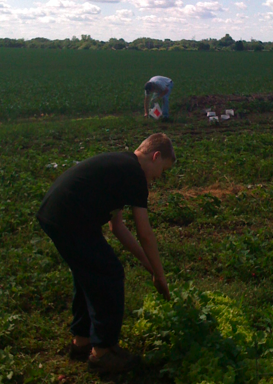
And having my kids get to spend time with their grandparents (including working with them in the garden) is a true joy. Here’s my youngest, John, out with his grandpa yesterday:
Being born and raised in the land of MacGyver to parents who continue to exemplify that can-do spirit (as well as the Spirit) is cause for great gratitude on Father’s Day.
Over the next couple of weeks, I’ve got a full schedule of travel with conferences, panels, webinars, workshops and the like. I’ll be showing and telling about our work in social media at Mayo Clinic, and also implications and applications for others in health care and beyond. My schedule is below. Based on what I’ve seen from the registration (and speakers/panelists) at the events, I’m going to be highly stimulated by the experience.
This week I’m going to Washington, DC on Wednesday and Thursday for the New Media Academic Summit at Georgetown University. It will be quite an experience for the Chancellor of a mythical university to interact with real-life Ph.D. professors. I’m on a Thursday afternoon panel.
In my spare time I plan to meet with some TV and radio station news and program directors to talk about our Mayo Clinic Medical Edge syndicated programs and news resources.
This is the most intense travel schedule I’ve had, but it just seemed to work out that these events were in reasonable proximity. And clearly we’re in a time in which the interest in social media is high, particularly in health care.
Of course I’ll be tweeting along the way, so you can follow (and participate in) the conversations. If you’re in any of these communities (or will be at any of these events) and would like to meet, drop me a note (or a Tweet).
The Jetsons was one of my favorite non-Looney Tunes cartoons from my youth. Flying cars and the 15-hour workweek were highlights for me of the Hanna-Barbera vision of the world of 2062.
Obviously those predictions haven’t come to fruition yet (at least for me), but one that has become reality in a big way is the video phone. Remember how George used to talk to Jane face-to-face from his office through a video screen? And how Mr. Spacely would always seem to appear on the video screen at inopportune times?
My wife Lisa and I played Jetsons a couple of nights ago with our daughter, Rachel, and granddaughter, Evelyn. They live about 500 miles away from us, in Grand Rapids, Michigan. Here was their first experience with Skype:
In the 1960s — when many long-distance phone calls were operator assisted and the per-minute charges for a simple voice call were exorbitant and only the big three television networks and their affiliates had video cameras — the idea of being able to talk by video across the miles was as outlandish as levitating cars seem to us today.
Which brings me back to the subject of my post about whether Facebook, YouTube and Twitter are free. If you had told anyone in 1962 (when The Jetsons ran in prime time), that they would be able to do what Lisa, Rachel, Evie and I did Tuesday night (along with our cat, Zeke), they would have shaken their heads in disbelief.
Most probably would have doubted it even in 1992, or would have thought the cost of such a service would be exorbitant. Remember AOL, Prodigy and similar services that set time limits on Web access?
But like YouTube, Facebook and Twitter, Skype is FREE! Yes, you need a computer with a webcam to take advantage of it (and a MacBook with built-in iSight is a great choice), but for computer-to-computer voice calls or videoconferencing, there are no charges with Skype.
If you’re reading this, you already have access to a computer. You may even have a webcam, but if not you can get one for about the cost of a cheap DVD player (another technology that’s becoming ridiculously inexpensive.)
Here is the key question to ask yourself (and doubters in your organization): If our competitors are paying nothing to communicate more effectively with their customers (and ours) by using this technology with the staff they already have, wouldn’t our failure to take advantage of these tools be a significant competitive disadvantage for us?
For some great reading on why all these tools are being made available for FREE, check out this article in Wired by Chris Anderson. It’s also the subject of his new book, to be released next month. I’ll be reviewing it here soon after it comes out.
Meanwhile, if you want to give Skype a try, download it and I would be happy to be your first videoconference conversation partner. Just tweet me (@LeeAase) and be sure you’re following me on Twitter, and we can connect via direct message to set a time for a face-to-face talk on Skype.
Some Tweeters have taken issue with a slide I typically include in most of my presentations. It says:
Total cost for Mayo Clinic YouTube, Facebook and Twitter:
$0.00
They protest that it’s inaccurate, maybe even misleading to say “total cost” and that it should instead say “Barrier to Entry” or “Cost to Start.” “What about the staff needed to run these sites?” they ask.
I will grant that these platforms don’t automatically maintain themselves, but I’m not changing the wording or conceding the point. I believe that in the way most people would have understood the phrase for at least the last century, these tools are FREE.
And this little video explains why:
YouTube is a FREE television station that lets you broadcast to the world.
A Facebook “fan” page is (at least) a FREE multimedia “white pages” listing for your business.
Twitter is a FREE incoming/outgoing communication channel, like the toll-free phone service discussed above.
But unlike the fictional AT&T and Pitney Bowes examples I described in the video, these are 100 percent real, bona fide offers. They are better ways for your existing staff to communicate, with each other or with your customers or other key constituents.
So ask not how you’re going to afford to hire staff to use these tools. Ask how these powerful tools can make your staff more productive!
For answers, look in the advanced courses in the Facebook, Twitter and Blogging curriculum listings.