Tomorrow I’m giving a presentation at the e-Patient Connections conference (#ePatCon) in Philadelphia, at the Park Hyatt Bellevue. It’s a really neat hotel, but the broadband “tubes” have a serious case of atherosclerosis.
Here are my slides.
I’m really looking forward to meeting a lot of people with whom I’ve only Tweeted previously. Just met @epatientdave in the lobby on the way up to my room. Will hopefully see @PhilBaumann, @MeredithGould and @DanaMLewis tonight too…and lots more tomorrow, including @SusannahFox.
“Men who can’t Pee” helps company that can’t spend
At Healthcamp Minnesota this morning we heard from John Reid, from a rural Minnesota company called AbbeyMoor Medical that has a stent aimed at the problem referenced in the title of this post. He described how using this video was really only his company’s only option for raising awareness, because they had no advertising or marketing budget. He showed how traffic to the company Web site went up significantly after this video was posted to YouTube:
John says he has now become a big believer in social media because it’s measurable and low-cost.
This is an interesting application of social media in healthcare, but from outside the hospital/provider community, and here’s a write-up about it on a Star Tribune blog.
5 Theses on Social Media in Healthcare
I’m honored to be kicking off Healthcamp Minnesota this morning with a keynote at 8:10 a.m. CDT. Here are my slides, and while you’ll see some familiar information if you’ve been a SMUGgle for some time, there are also some significant new elements, including the section that gives this post its title. I expect to be amplifying on that in future posts, but for now, here’s the deck for reference:
I hope to see lots of Twin Cities Tweeps at the event, but for those who can’t make it, please follow the live video stream (available from the HealthcampMN site) and the #hcmn hashtag, and join the discussion.
Speaking Engagements
I’ll be out on the road quite a bit in the next month, spreading the word about social media tools and their application in health care, and sharing our Mayo Clinic experience and perspective. If you’d like to participate in any of these conferences, I’m sure the organizers can get you details on how to join.
- Oct. 24: Healthcamp Minnesota (#hcmn) at the University of Minnesota in Minneapolis. My keynote is at 8 a.m., and it should be a great day. I’m looking forward to lots of connections. Thanks to @AlbertMaruggi and @ArikHanson for organizing!
- Oct. 26: e-Patient Connections 2009, Philadelphia (#ePatCon). Other speakers on the program I’m looking forward to meeting include @SusannahFox, @DanaMLewis and @ePatientDave, but I’m expecting to meet about 250 new friends, according to the conference organizers.
- Nov. 2-3: 13th Annual Healthcare Internet Conference, Las Vegas. I’m honored to be kicking off this conference with a keynote on Monday at 2:30. After this I’ll be able to say I’ve played Caesars.
- Nov. 4: ASTRO (the radiology association, not the Jetsons’ dog) conference in Chicago. I’m on a media training panel in the morning.
- Nov. 11: Kellogg School’s 10th Annual Business of Healthcare Conference in Chicago, at Northwestern University.
- Nov. 12: Oklahoma Hospital Association, Oklahoma City. I’m doing a presentation with @EdBennett, and look forward to meeting @cpazzo, @brendafinkle, @joymcgill and @susiemoo.
- Nov. 18: AHIP Communications Conference, Chicago.
- Nov. 19: Minnesota Association of Government Communicators, St. Paul, “Government Communications on an Even Shorter Shoestring.”
I look forward to getting to meet a lot of folks in real life after only having interacted via Twitter. If I’m going to be in your area, I hope we can Tweetup!
Privacy begins at home
It seemed like a good idea at the time.
Last week when I was in the Netherlands (See “Putting the ‘Global’ in SMUG”) I had the opportunity on Wednesday to help lead a couple of master classes on Web 2.0 for health care communicators from UMC Radboud, one of six academic medical centers in the Netherlands, in Nijmegen.
I often like to demonstrate Skype and its videoconferencing capabilities (and the fact that it’s FREE) in my presentations. It’s one thing to say, “Skype is like the video phone in The Jetsons.” That gets heads nodding. But it’s entirely different to show just how easy and cool it is. So I have sometimes Skyped with my daughter Rachel and granddaughter Evelyn, and also have done videoconferences with Darrin Nelson (a Mayo patient from Rochester, NY who shared his story about robotic heart surgery here, here, here and here on Sharing Mayo Clinic.) In those cases I had sent messages on Facebook (for Rachel) or Twitter (for Darrin) to arrange the times for our conversations and to ensure that they would be available.
Our Wednesday morning master class in Nijmegen went off flawlessly, as @JohnSharp and @CiscogIII and I tag-teamed as teachers, but in the afternoon they had to head back to Amsterdam, so I was on my own (along with my host, Lucien Engelen.)
I was doing fine until I got to the reference in my slides to Skype, and then I got what I thought was a great idea: I went to Skype and saw that my lovely wife, Lisa, was on-line.
So (on the spur of the moment, not to mention a classic case of y-chromosome poisoning), I decided to just “surprise” Lisa with a Skype call without advance warning. I’ll let the Facebook conversation she started tell the rest (click to enlarge):
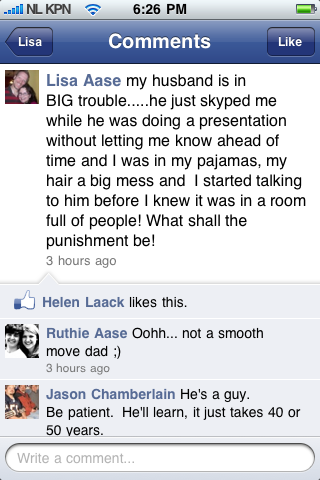
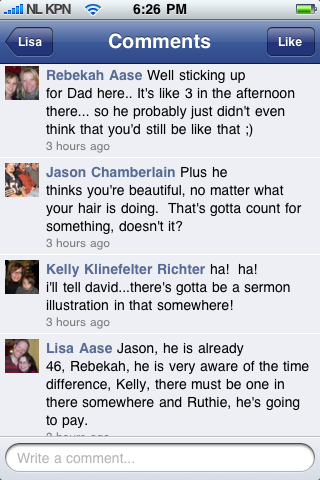
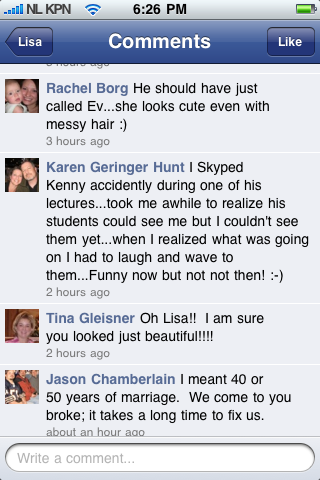
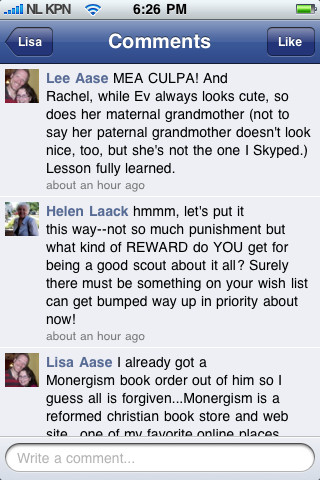
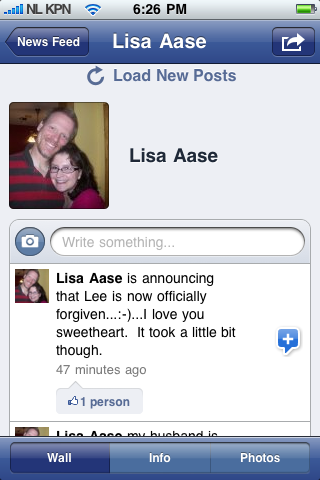
Lesson Learned: Privacy isn’t just something to be concerned about from a HIPAA perspective. It begins at home.
And a special note of thanks to Lucien for providing his own peace offering (although he personally had done nothing to offend), in the form of this beautiful bouquet of roses, pictured below next to my now fully showered bride of nearly 25 years.
