Social Technologies in Health Care – Part III

Note: This is the third in a series of posts based on material I provided in advance for  a two-part panel in March sponsored by ASAE & The Center for Association Leadership, “Social Technologies in Healthcare: Applications, Implications and What’s Next?

Question Three: How should medical associations/societies capitalize on social technologies in their work?

Societies and their members should get hands-on experience with social tools so they can see for themselves what the most productive uses would be. If they are concerned about HIPAA or patient privacy concerns, start by using the tools within your organization, apart from any direct patient-care application.

With that appropriate disclaimer, I’’ll offer a few practical steps to help you get started, and while step 5 may be most important I put it last so that you don’’t get so hung up in strategy that you don’’t do anything.

  1. Use the tools to help run the associations and as an added member benefit. Build outposts on the general-purpose social networking sites, particularly Facebook.
  2. Create a YouTube channel. Feature your members. Encourage them to create YouTube channels. Subscribe to each other’s’ channels and become “friends.” “Favorite” each other’s’ videos.
  3. Create a Twitter account for your association, if only for defensive purposes. Use Twitterfeed to automatically tweet. 
  4. Create one or more blogs. You’’ve got a Web site, right? That’s all a blog is: an easy-to-publish Web site that allows comments, interaction and sharing. You can make your blogs part of your site, or you can have your blog become your site.
  5. Think about how you will tie them all together into a coherent strategy. But don’t let yourself become paralyzed, waiting until you have the perfect strategy before you execute anything. You’ll learn as you go, and these tools are highly reconfigurable. But it’s a lot easier to modify your direction if you’re already moving than it is to get going from a dead stop. So start.

It won’t surprise SMUGgles that I advised diving in and getting hands-on experience. While not necessarily disagreeing, Frank Fortin, one of my fellow panelists, highly commended the POST method as outlined by Charlene Li and Josh Bernoff in Groundswell: Winning in a World Transformed by Social Technologies. I agree that this framework is helpful and also recommend reading Groundswell, but think the first step should be developing personal familiarity with the tools so you can envision potential applications for your organization.

I originally answered these questions about a month in advance of an event that was about a month ago, so my thinking has continued to evolve. In the final post in this series, I will highlight at least one area in which I now think a more aggressive strategy is in order.
Social Technologies in Health Care – Part II

Note: This is the second of three posts based on material I provided in advance for  a two-part panel in March sponsored by ASAE & The Center for Association Leadership, “Social Technologies in Healthcare: Applications, Implications and What’s Next?“ 

Question Two: What are the biggest challenges to the effective use of social technologies in health care?

Fear, Uncertainty and Doubt (FUD) are probably the biggest barriers. Concerns about potential implications of disclosure of private medical information must be addressed. Making data security as bulletproof as possible must be a priority; if I can send money anywhere in the world from my Web browser without concern about theft, I should be able to do the same with medical information. Alternatively, or perhaps concurrently, we should work to reduce the potential harm that could come from medical data being disclosed, by ensuring that such information couldn’t be used to deny insurance coverage or employment.

Technically, it’’s a matter of convening standards bodies to enable data portability while protecting data security, and encouraging software engineers to develop a user experience that builds upon or is at least equivalent to the general purpose social networks.

While some FUD is reasonable (we do, after all, live in an uncertain world), some of the fears about social media in health care seem to go beyond what the data would dictate. Worst-case scenarios are envisioned and assigned high probabilities, which prevents the serious contemplation of far more likely beneficial outcomes. We need to understand that keeping the current delivery system and just reducing reimbursements and cutting the length of doctor appointments is a guaranteed path to declining quality and patient satisfaction, and that social tools hold the promise to enable more in-depth interactions with physicians when necessary while creating communities of smarter patients who can help each other.

These tools also have immense potential for helping teams to work smarter together. The idea of the corporate firewall fortress also may limit some organizations’’ willingness to consider Software-as-a-Service solutions.

For the answer to Question One, go here.

Social Technologies in Health Care

In late March, I had the opportunity to participate in a two-part panel sponsored by ASAE & The Center for Association Leadership, “Social Technologies in Healthcare: Applications, Implications and What’s Next?”  I did a recap post of the event here.

To set up the conversation, each of the panelists were asked to respond to a series of questions. I thought it would be helpful to post here the answers I provided there. I don’t know that they’re profound, and I hope they’re not totally unique, because then I’d be seriously off base. And as always, what you see written here is my perspective, and doesn’t represent my employer.

Question One: What is your long-term vision for the impact of social technologies on health care?

Social technologies already are important in health care, in that they give voice to individuals and enable them to connect with others who have similar experiences, conditions and concerns. Word of mouth has always been important in health and health care, dating back even to biblical times when reports of miraculous healings would cause thousands to gather on a hillside in Galilee. So it’’s no surprise that patients are using powerful social technologies to spread the word about their health care experiences.

Patients also are forming virtual communities and support groups that overcome geographic barriers. It has been impractical to form many of these communities of interest locally because the conditions are too unusual to provide for a critical mass of individuals with common interests. But social technologies eliminate these barriers to group formation and enable patients to learn from each other.

In the longer term, we must find ways to incorporate social technologies into management of chronic diseases and conditions such as diabetes. The shortage of primary care physicians will worsen, calling for more emphasis on mid-level providers. But nurses and physician assistants (PAs) will be in short supply as well.

It will be physically impossible to provide quality management for a growing population of Baby Boomers with chronic conditions, even with increased reliance on mid-level providers. But virtually it may be possible. And since many of those conditions are substantially influenced by behavior, peer networks mediated by social technologies have potential, with appropriate medical provider involvement, to provide social support to reduce the burden of disease.

Three Reasons Why Mayo Clinic Health Manager Matters

As regular readers know, I work for Mayo Clinic, so my opinion on this isn’t exactly objective, but I think the launch today of Mayo Clinic Health Manager is pretty significant.

I’ve had the opportunity over the last several months to learn about this product as it’s been in development, and it’s got some neat advantages that I think make it a step beyond what’s available currently in the world of personal health records.

  1. Portability. Some other products are sponsored by employers or health plans. In Mayo Clinic Health Manager, the record belongs to you, so if you change jobs you don’t have to worry about having to re-enter data.
  2. Personalized Mayo Clinic guidance. Based on the data you put into the program, you’ll get tailored recommendations for steps you can take to improve your health, screening tests you should have, and the like. The more data you provide, the more useful recommendations you will receive.
  3. Being connected to Microsoft HealthVault. This gives a couple of important benefits. First, you have strong security for your data. When I set up my account, it made me choose a password that was a lot stronger than what I typically use, for example on my Facebook account. And as more pharmacies, hospitals and medical devices provide for automatic upload of data to HealthVault, that will improve the personalization of recommendations you can get from Mayo Clinic experts.

I did a post last year about Turbotax and how much I like it for doing my personal income taxes, and how I could do my taxes in an hour because all of the data from my six children (some of whom are no longer dependents) could be carried over from year to year, saving me having to enter the data anew each year. At the same time, I don’t worry at all about the safety of my tax records. I’m confident that Intuit has it covered. And it’s great to have the deduction finders, and audit alerts and error checking, not to mention electronic filing.

I think the same principles will hold with Mayo Clinic Health Manager. Getting the data entered once into a safe place will simplify managing your health. You’ll be able to produce an immunization report, for instance, with a couple of clicks. You’ll get expert guidance tailored to your health situation. And you can make notes of the questions you wanted to be sure to cover in your visit to the doctor, so that you can print it out and take it with you. No more worrying about forgetting to cover your important concerns because you freeze up in that anxious moment with your health care provider. It should make those visits more orderly and productive, too.

But while Turbotax charges for electronic filing of your federal and state tax returns, Mayo Clinic Health Manager is completely free. The other thing I like about the program is that it lets you enter data in small chunks as you have time. I just added my height and weight, along with my history of colon cancer screenings.

Unlike the IRS, Mayo Clinic Health Manager doesn’t require you to meet a deadline for “completing your return.” In fact, you’re never really done. But as you put in more information, and as the product grows in providing more tools to give you guidance based on your data, it will improve your ability to manage your health (and that of your loved ones who grant you access to their records, such as aging parents, your spouse or children.)

You can read more about Mayo Clinic Health Manager, and see an introductory video, on the Mayo Clinic News Blog, or sign up for your free account.

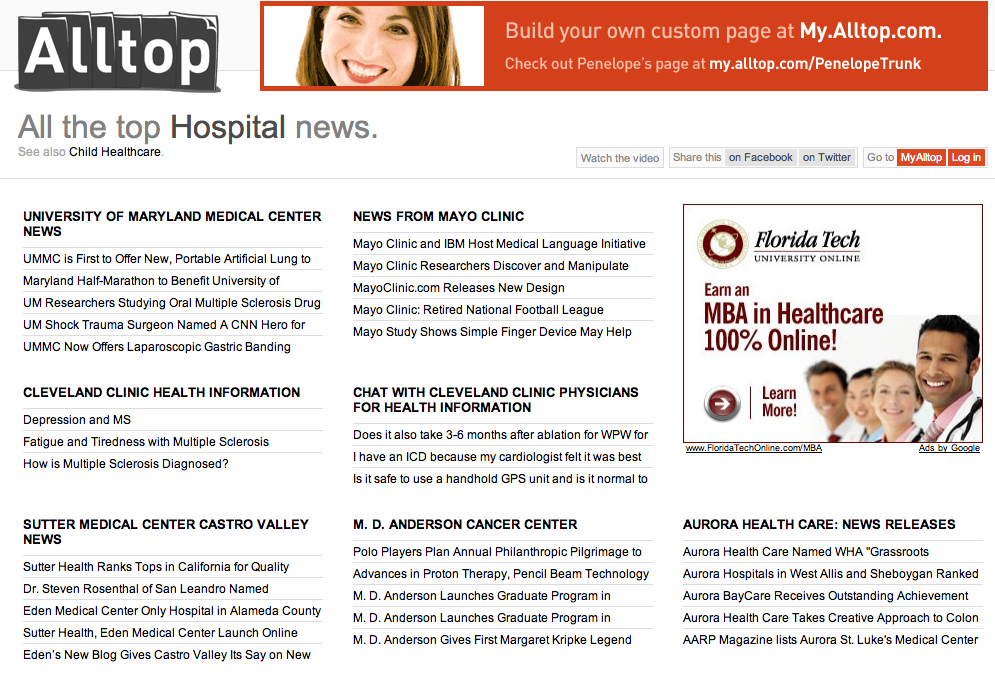
Alltop Releases New Top Hospital News Site


Alltop Top Hospital News Page

In response to suggestions raised in the #hcsm group discussion on Twitter, Alltop has created a new site, hospital.alltop.com, that aggregates RSS feeds of news releases from several top hospitals. You might want to bookmark or “favorite” it.

For people working in healthcare public relations, it’s a good way to see at a glance what kind of news your peers are releasing. It’s also a good news source for others interested in healthcare news. Besides Mayo Clinic, other institutions featured at launch include University of Maryland Medical Center, Cleveland Clinic, Sutter Medical Center, M.D. Anderson Cancer Center, Aurora Health Care and about 20 others. 

If you’re unfamiliar with Alltop, check out my earlier post, “Alltop: RSS without the RSS.”

Thanks to @guykawasaki and the Alltop team for creating this site, and to Tom Stitt (@tstitt) for his leadership in helping to make it happen.