Healthcare Associations and Social Networks

Last Tuesday I had the opportunity to participate in a two-part panel discussion on Healthcare and Social Technologies, sponsored by ASAE & the Center for Association Leadership. It was part of the organization’s first Healthcare Association Conference, bringing together leadership from many different medically oriented associations. Acronym, which is ASAE & the Center’s aptly-named blog, has posts recapping session one and session two.

Ordinarily when I attend a conference I try to live-blog the sessions I attend, and for my presentation I create a post in advance to publish just before my session. But this was such a fast-moving discussion (even though the two sessions were 2.5 hours with an hour of that as Q&A, I think they could have gone much longer), that it wasn’t possible for me as a panelist to even surreptitiously tweet.

So I’m writing what I think will be a few posts with observations and highlights of the sessions from my perspective, a few days after having arrived home from Baltimore, having digested both the discussion and Jeff Jarvis’ What Would Google Do?, which also has important related implications for associations and healthcare.

Big Idea #1: As Frank Fortin, Communications Director for the Massachusetts Medical Society (which publishes the highly respected New England Journal of Medicine) said, “Associations need to figure out what business they’re in.” He has a blog post to that effect here.

By confusing how they do their business with what it really is, businesses lose perspective of why they got customers in the first place. They build their businesses around the artifact of the transaction, rather than on the value they deliver.

What is the business of the association? You might argue it’s publishing journals, holding conferences, or doing trade shows. But you would be wrong – very wrong.

I’m sure no medical journal is more lucrative than the one Frank’s organization publishes. But as Jarvis says, “Beware the cash cow in the coal mine.” Often the existing business model hamstrings organizations, keeping them from exploring new services lest they “cannibalize” their current profitable operations. But again, as Jarvis points out, if you resist cannibalizing your own profitable products or services, that just means another organization will feast on yours.

The example of Craigslist and newspaper classified ads is appropriate here, and it’s one I mentioned in the session. I recall paying north of $2,500 a few years ago for a job-recruitment ad in the Minneapolis Star Tribune. Then monster.com came in with price of a few hundred dollars, and its candidate pool wasn’t limited geographically as the newspaper’s was. And now Craigslist makes the ad free in most markets, or at most the charge is $25.

Great for employers. Bad for newspapers. They (understandably) wanted to milk the cash cow as long as they could. But now the damage is irreversible in the loss of classified ads, because how could they possibly undercut the free service Craigslist provides?

Here’s the topper, as Jarvis noted (quoting the Wall Street Journal) in his “Inefficient Print” post on Buzzmachine:

Last March, Baylor Health Care System, a large Dallas-based nonprofit, began purchasing keywords on Google, Yahoo and employment-related search engines SimplyHired.com and Indeed.com. The search-engine ads generated more applicants, at less cost, than the other recruiting methods, says Eileen Bouthillet, director of human resources communications.

In the first six months of the program, Ms. Bouthillet says, the search-engine ads delivered 5,250 applicants, at an average cost of $4. By contrast, Baylor paid an average of $30 for each of the 3,125 applicants who came via job boards, and $750 each for the 215 applicants who replied to a newspaper or magazine ad.

As a result, Ms. Bouthillet says Baylor has reduced spending on job boards and print ads. . . .

Was that last line really necessary?

Application: As we discussed in our sessions, social networking tools have the capability of providing many of the benefits members have traditionally received from belonging to associations. If associations don’t provide for easy connection among their members, someone else will.

So think about what business you’re in, and what unique value you can provide to your members. Take into account where they are on the spectrum of social media propensity, as outlined in Groundswell, so you don’t create platforms your members won’t use. 

You may want to use general purpose sites like Facebook or LinkedIn, or create-your-own social network sites like Ning, or even one of the many so-called “white label” alternatives that let you create a standalone network. Or maybe what you really need is a blog.

But realize that in a world in which establishing and re-establishing connections is ridiculously easy (as the 29 members of my Austin High School Class of 1981 group in Facebook can attest), these tools are not just a threat to your current business model, but are great potential aids to help your organization (and its members) accomplish the goals you all share.
Aase at ASAE

I’m looking forward to participating in the 2009 Healthcare Association Conference sponsored by ASAE & The Center for Association Leadership (the acronym for which, oddly enough, is an anagram of my last name) in Baltimore on Tuesday. See the conference agenda (PDF).

Here’s the overview for the panel discussion I’ll be joining on Tuesday:

The growing popularity and power of social technologies creates both new challenges and opportunities for healthcare associations, as well as for the healthcare system itself. While the social web opens broader access to medical knowledge, enables greater collaboration among health professionals, and is actively transforming both healthcare advocacy and medical education, issues of information accuracy and patient privacy are enduring sources of concern. Listen to a candid and thought provoking dialogue on the present and future impact of social technologies on healthcare from players in different parts of the system.

I’m particularly pleased that this discussion will take place in two 75-minute segments, which will enable an in-depth exploration. As the brochure describes the focus of each:

  • In part one of this session, the panel will explore the current state of social technology use in healthcare, and some of the key strategic challenges and opportunities created by social technologies.
  • In part two of this session, the panel will focus specifically on how healthcare associations should be thinking about the application of social technologies to their work, as well as the future of social technology in the world of healthcare.

I’ll be joining Jeff De Cagna, chief strategist and founder, Principled Innovation, LLC (moderator) (@pinnovation); Gina Ashe, chief marketing officer, Sermo, Inc.; Ted Eytan, MD, MS, MPH, (@tedeytan) medical director, delivery system operations improvement, The Permanente Federation, LLC; Frank Fortin, director of communications, Massachusetts Medical Society (@frankfortin). We’re all going to be trying to follow Guy Kawasaki’s advice for panelists, and I’m sure Jeff will be a great moderator, too, involving the “audience” in the discussion. No long, boring PowerPoints: we will each have no more than three (3) slides.

I’ll be blogging about our discussion after the fact, and maybe tweeting occasionally during or between the sessions. But mainly I look forward to engaging in an interesting discussion, not just among the panel but with the whole group. I enjoy giving presentations about what we’re doing in social media at Mayo Clinic, but it will be even better to learn through the interchange with others.

I’m also excited that I’ll get to meet Ed Bennett (@EdBennett), who manages Web sites for the University of Maryland Health System and compiled the listing of hospitals using social networking. This again demonstrates the power of Twitter; I saw him offering rides from Baltimore to HealthCamp Philly…which led me to ask whether he was based in Baltimore…and we discovered he works across the street from where I will be on Tuesday. So we’ve arranged to get together after the conference. How cool is that?

Social Media 210: Growing an Organ Donation Community

I’ve known Bob Aronson for nearly a decade, as I described here and here. As a heart transplant recipient, Bob is grateful for the additional years he has been given and has dedicated himself to promoting organ and tissue donation. And while his former career was in mainstream media relations, he’s taken to social media in his new vocation, with a blog called Bob’s NewHeart and a Facebook group as his main vehicles.

One of Bob’s goals is to get at least 5,000 members in that Facebook group, and to have people sharing their transplant and organ donation stories so their Facebook friends will realize how important donation is. In a recent email, he asked me for ideas on how he could increase the group membership (he’s had some recent success, as the group has grown from 300+ to 472 as I write this.)

Instead of responding by email, I thought it would be good to expand on my Seven Steps to Promoting Transplant through Social Media by adding some Twitter-related ideas, and also to throw it open to the SMUGgles for your additional thoughts.

To Bob’s credit, he has started a Twitter account (@bobsnewheart), which is an important way to connect with people who have common interests, and who you don’t yet know. I described this process and gave an example in Twitter 130: Listening with Twitter.

So here are my suggestions for how Bob can grow the Organ Transplant Patients, Families and Friends group in Facebook. And of course you can probably generalize the suggestions for particular applications you may have.

First, make the Web link associated with your Twitter profile the one that is your top priority, and that is most descriptive of you and your mission. So instead of his blogsbybob.wordpress.com URL, I would recommend that Bob feature either bobsnewheart.wordpress.com or the Facebook group.

picture-101

Second, start Tweeting about Transplant. Look for interesting articles and news stories on Web sites, and do brief posts on Twitter about them. Do it every day. This will help people who come across your Twitter profile understand what you’re all about, so as you engage in the next steps, they won’t consider your a Twitter spammer.

Third, apply Twitter 106 and Twitter 130 to your goals. Get Tweetdeck to make your interactions in Twitter much more efficient. Set up search tabs for “organ donation” and “transplant” as well as for Replies, Direct Messages and All Friends.

Fourth, Engage in Conversations. When you see an interesting Tweet in your search tabs, use Tweetdeck to follow the person, reply and — if you think it’s particularly interesting — re-tweet the post to your followers. As you get to know the individuals, you can invite them to join the Facebook group.

And you may find other valuable projects and initiatives with which you can connect. For example, you may find other people blogging about transplant that you can add to your blogroll; maybe they’re reciprocate. You may find other related Facebook groups that you would like to join.

The bottom line: if you’re focused on creating or passing along valuable, interesting content and making connections among like-minded people, you’ll be successful.

What other ideas do you have for growing a community?

Honoring a Mayo Clinic Innovator

Dr. Earl Wood, who helped Mayo Clinic pioneer heart surgery and also invented the G-suit that made high-altitude flight and space travel possible, died this week at age 97. You can read about him and see a documentary about his work here on the Mayo Clinic News Blog.

As I was searching for some related links for that post (as part of my “day” job), I came across the documentary you see below, which won the “Legacy Award” from the Minnesota Historical Society’s Greatest Generation Film Contest in 2008. For technical reasons, I couldn’t embed this in the News Blog post, so I decided to do it here, to honor a great inventor who made a difference.


Inventing the G-suit: The Life story of Dr. Earl Wood from Dusty Road Productions on Vimeo.

Patients and Social Media

In many ways, SMUG has been my personal laboratory for learning about social media and how I can apply these tools to my work at Mayo Clinic. I’ve been able to experiment with blogs, Facebook, Twitter, YouTube and other platforms with my personal accounts, which then helps me see how they can be used for a health care provider like Mayo Clinic.

So we’ve established a Mayo Clinic YouTube channel, a Facebook page, and several podcasts and blogs — including, most recently, Sharing Mayo Clinic.

As of Friday the 13th, however, I’m also approaching social media from the patient perspective: yesterday I was diagnosed as having celiac disease.

So what did I do to find good information about how to cope?

My first step, of course, was the celiac disease section on MayoClinic.com.

And I recalled that my team at work had produced a TV story about living with celiac disease, which is also on our Mayo Clinic YouTube channel:

[youtube=http://www.youtube.com/watch?v=yGmWf0et4hg] 

But I also turned to Twitter, and was amazed at the response.

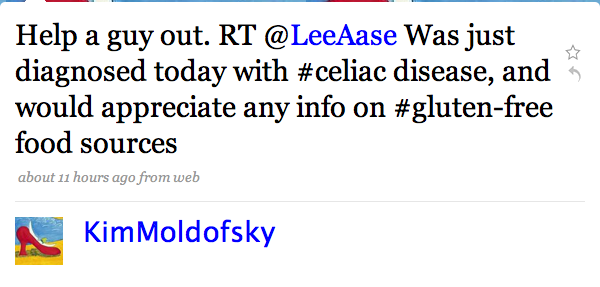
@KimMoldofsky re-tweeted my call for help:

kimtweet

Bonnie Sayers (@autismfamily) alerted me to the #gfree hashtag and the Gluten Free Twitter Party she’s hosting on April 3.

Gluten Free Twitter Party

@FrannLeach shared a Gluten Intolerance group on Squidoo, along with some recipes.

Kayla Eubanks (@BallinOnABudget) told me about Pizza Fusion, and Nina (@lovingyouiseasy) pointed me to @wholefoods and @KarinasKitchen. Karina’s “The Morning after the Diagnosis” post on her blog was particularly helpful. Kristie S. (@KristieTweets) had a couple of suggestions, and Tom Stitt (@tstitt) helped me get an answer as to whether Coke is OK (it is!) I also found out about lots of resources available at celiac.com.

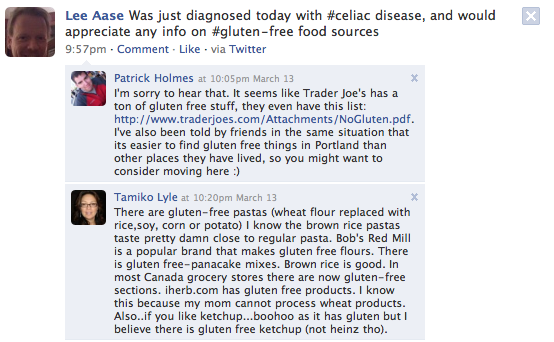
And because I Tweeted about it, my celiac disease diagnosis also was posted to my Facebook profile:

picture-19

…which led to several Wall comments (including a couple you see above that came within a half hour of my Tweet), and also some messages in my Facebook inbox. And I also found a Celiac Disease group in Facebook.

Some people are justifiably concerned about potential dangers of self-diagnosis through the Internet, but once a diagnosis has been made, social media tools are extremely powerful means of getting information and gathering support. 

As I write this, I’ve had my diagnosis of celiac disease for about 34 hours, and the learning about the condition I’ve been able to do in this time has been amazing.

And out of this experience, I’m also going to be getting my wife Lisa (@LisaAase) to use her Twitter account to participate in the #gfree discussions. She set up her account nearly two years ago, but has only done a dozen updates. And right now I’m her only follower. But now she has a reason to use Twitter, and I think she’s going to find it helpful in learning how we deal with gluten in our family diet.