Transplant Games 2008 Highlights

The games haven’t even started yet; today was just the first half-day of registration and setting up our Mayo Clinic booth.

I heard some great stories, both from organ recipients and from donor families (as well as some from families in which one member had donated to another) and we uploaded them to the Mayo Clinic YouTube channel.

Here’s one that was especially touching for me, because it involved a Dad (about my age, or maybe a bit younger) with five kids (I have six), none of whom had been born when he received his donated kidney.

[youtube=http://www.youtube.com/watch?v=97nMz3MdaHo]

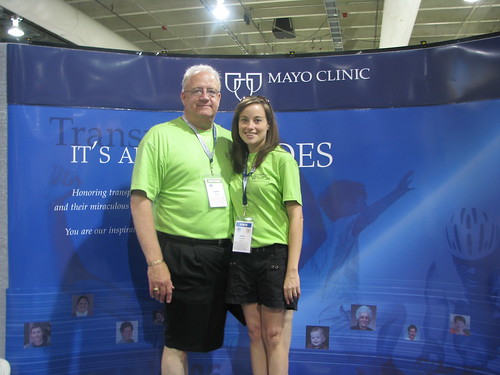
Here’s a photo taken on the medal stand in the Mayo Clinic booth, of Katie Schnell and her father, who was her kidney donor.

Picture 051

You also can listen to Kati tell her story on YouTube.

There were lots of other moving and inspirational stories, and you can see them by clicking here (more will be uploaded soon) or by searching for transplantgames08 on YouTube. More videos will be shot and uploaded tomorrow, and I hope others who are staying for the entire games will shoot videos, and upload photos, and write blog posts giving them the transplantgames08 tag, so we can see and hear more about the difference transplant can make.

Seven Steps to Promoting Transplant through Social Media

I’m in Pittsburgh for the 2008 Transplant Games, an event sponsored by the National Kidney Foundation “to demonstrate the success of transplantation, honor those who have given the gift of life, and call attention to the need for more organ donors.”

I am accompanying a couple of staff members from the Mayo Clinic Transplant Center in our Mayo Clinic booth. They’re the experts in transplant and medicine, and I’m helping them work with the transplant recipients, living donors and their family members who are here to promote organ and tissue donation through social media.  Here’s a description of what we’ll be doing.

More than any type of patient I know, transplant recipients seem to be especially grateful for the opportunity at a new life they have been given through transplant. Whereas some patients may want to keep the fact of their medical conditions private (which is absolutely their right), my experience with transplant patients is that they have an evangelical zeal to let people know how important organ and tissue donation is.

It seems to me that social media, whether it be networking sites like Facebook and MySpace, or through sharing videos on YouTube or photos on Flickr or via a blog, present unique opportunities for transplant advocates to spread the word. Here’s why:

Continue reading “Seven Steps to Promoting Transplant through Social Media”

Mayo Clinic Social Media Progress Report

After presenting at a Web 2.0 Summit last week in Oakland, CA, I got to thinking it would be good to do an update on where we are with Mayo Clinic‘s engagement in social media. We’ve made a lot of progress in the last three years from a completely “old media” focus to a more balanced approach, continually increasing our attention to what Charlene Li calls “the Groundswell.” And hopefully when I do another update in a few months, I’ll be able to look back on many more exciting developments.

Here’s a list of where we are as of today in our social media exploration and adoption. For those areas in which I can pinpoint a starting date, I’ll do so.

Care Pages – Mayo Clinic provides this service for hospitalized patients, enabling them to provide updates to family and friends on a secure Web page. This helps keep loved ones informed without the undue burden of repeating information by cell phone for each individual, and it enables concerned friends and family to send greetings to the patient. We’ve had this service for a few years, and I know many patients appreciate how it makes staying in touch while hospitalized easier.

Podcasts – Mayo Clinic’s first podcast was based on our Medical Edge radio program, and launched in Sept. 2005 through what was then the iTunes Music Store. This gave us our first taste of the potential interest in and power of “new media.” In January 2007 we began offering video podcasts of Mayo Clinic Medical Edge television segments, and in July 2007 followed with extended podcasts in several categories: Men’s Health, Women’s Health, Children’s Health, Heart, Cancer and Bones & Muscles. In April 2008, we moved these podcasts to podcasts.mayoclinic.org, so users could find and listen to individual segments of interest, instead of subscribing to a particular feed.

RSS/Web Feeds – Also in Sept. 2005, we began offering really simple syndication (RSS), a.k.a. Web Feeds. You can sign up for Mayo Clinic News from all three campuses (or can choose to receive only Arizona, Florida or Minnesota news), health information news, science news or business-related news.

Syndicated Video – Mayo Clinic began using Voxant in 2007 to make its Medical Edge video segments available for syndication to other Web sites. Instead of making people go to our mayoclinic.org site to view the videos, we wanted to put them where people are going, such as in on-line news sites. The Mayo Clinic YouTube channel was started just last week; expect to see the look improve significantly yet this month. Here’s our latest addition, a video tour of the new Mayo Clinic Hospital in Jacksonville, Fla.

[youtube=http://www.youtube.com/watch?v=4UT6vmldLRw]

Facebook – with Mayo Medical School and several other health-related science schools (and with our mayo.edu e-mail addresses), Mayo has had people in Facebook for a long time. In the last six months we’ve seen the number of Mayo participants in Facebook more than double, to over 2,100. When “fan” pages became available to organizations and brands in November 2007, we established one immediately (partly because of what you see when you go to myspace.com/mayoclinic.) We revised and re-categorized the official Mayo Clinic Facebook page in January 2008, and have 1,053 fans as of this writing. In another effort to prevent domain name “squatting,” we also have established accounts in Twitter (twitter.com/mayoclinic) and Flickr.

Finally, we’ve begun sponsoring some official blogs. The first was in conjunction with an event, a symposium on innovation in health care in November 2007. It was hosted on wordpress.com and customized somewhat, but we didn’t map to a mayoclinic.org subdomain. We followed that in March 2008 with our Health Policy blog, our podcast blog and a blog about diversity in education at Mayo. These have all started in the last two months, and we hope and expect to continue developing new blogs.

Meanwhile, our colleagues at our sister site, MayoClinic.com, which is Mayo Clinic’s consumer health information site, have been starting blogs and a podcast, too. The blogs cover topics like Alzheimers’ Disease, Nutrition, Stress, Pregnancy and Depression.

Mayo Clinic is one of the United States’ best places to work (Fortune magazine has had us in its top 100 for the last five years.) I feel exceptionally blessed to be able to work for an organization like Mayo, working with such interesting subject matter during this exciting time of innovation and change in the media world.
Charlene Li Forrester Web 2.0 Presentation

I had the pleasure yesterday of presenting at a Web 2.0 Summit sponsored by Kaiser Permanente. Our panel was moderated by Ted Eytan, M.D., who also presented on his blogging experience from the last four years as part of Kaiser’s sister (or cousin, or some other relation I don’t completely understand) organization, Group Health. He’s an interesting guy who also has a passion for LEAN in Health Care, which is the topic of the other blog on which he is a collaborator. I also got to meet and hear Tim Collins from Wells Fargo, whose company has official blogs that include Guided by History, The Student LoanDown and one that supports Stagecoach Island, its virtual world. TIm says Wells Fargo was the first big brand in Second Life, but that they got out just as many others were starting to get in. Now they have a world of their own.

Charlene Li from Forrester Research opened the Summit with an overview of Web 2.0. She’s also the co-author of Groundswell, a book I just bought at Audible.com (It’s also here on Amazon, and I’ll be reviewing it after I listen to it over the next few days). Before her presentation, we got to talk about our experience with audio books, and I recommended some from Patrick Lencioni that I think most people in business would find extremely helpful (and which I have reviewed on this blog): The Five Dysfunctions of a Team and Silos, Politics and Turf Wars. (I thought I had reviewed Death by Meeting, too…but I guess that’s on my to-do list.)

I’ll have my full review of Groundswell, but meanwhile here are some of the high points and recommendations from Charlene’s presentation:

Focus on the relationships, not the technologies. At Forrester, they have developed a four-step process using the acronym POST. You should consider:

  • People – for those you want to reach and with whom you want to interact, consider their characteristics and what kinds of social media involvement they have already. Getting seniors into a 3D virtual world may be a mismatch, unless the group you’re targeting is retired Microsoft or IBM engineers.
  • Objectives – Decide what you want to accomplish
  • Strategy – Plan for how relationships with customers will change
  • Technology – Decide which social technologies to use

Charlene’s blog has a fuller discussion of POST, and I’m sure Groundswell will be even more detailed.

Part of analyzing People is determining where they are on the Ladder of Participation.

Charlene had a lot of other great material in her presentation, but she closed with some Keys to Success:

  1. Start with Your Customers.
  2. Choose Objectives You Can Measure
  3. LIne Up Executive Backing
  4. Romance the Naysayers
  5. Start Small, but Think Big

I particularly like that last point, because it fits with the SMUG (It’s all Free) philosophy. It’s possible to start small because the barriers to entry are practically non-existent, but you should plan for success to that you can scale up as necessary.

For example, you can start a blog hosted on WordPress.com and map to a domain or subdomain of your choosing for $10-$20 (and can extensively customize your look and feel for another $15). Later, if your blog is successful and you decide you want to host it elsewhere to allow more use of Flash and embedded widgets, you can just download and install WordPress from WordPress.org and re-map the domain, and you won’t lose any of your links. I’ll have more on that as I build out the Blogging curriculum.

Multimedia Reporting

I’m at the Association of Health Care Journalists’ annual conference, called Health Journalism 2008, in Washington, D.C. I just met Scott Hensley from the Wall Street Journal‘s Health Blog, who is one of the panelists in this session on new media tools for telling stories. Appropriately, his presentation is going to be a blog. He set it up here free on WordPress.com.

Other panelists include Amy Eisman, director of writing programs, American University School of Communications, and Joy Robertson, anchor/reporter, KOLR-Springfield, Mo.

picture-12.png

Amy sees the following trends in news:

  • need more video, more pictures, better presentation
  • Better text – SEO
  • Social networking
  • More readers finding content “sideways”
  • Hyper-link off site
  • Mobility (information on mobile phones)
  • Transparency
  • Experimentation

She also said you need to think about what you can do on the web that you can’t do in print. Think interactivity, links to archives and multimedia. Covering an event for users who can’t attend, via liveblogging.

She recommended Steve Krug’s “Don’t Make Me Think” as a handbook for writing and web design.

picture-11.png

Scott Hensley says the WSJ Health Blog has over 2,000 posts in the last year, and more than 21,000 comments. You really should check out his presentation on the blog he set up for this purpose. Here are some highlights:

Continue reading “Multimedia Reporting”