Social Technologies in Health Care

In late March, I had the opportunity to participate in a two-part panel sponsored by ASAE & The Center for Association Leadership, “Social Technologies in Healthcare: Applications, Implications and What’s Next?”  I did a recap post of the event here.

To set up the conversation, each of the panelists were asked to respond to a series of questions. I thought it would be helpful to post here the answers I provided there. I don’t know that they’re profound, and I hope they’re not totally unique, because then I’d be seriously off base. And as always, what you see written here is my perspective, and doesn’t represent my employer.

Question One: What is your long-term vision for the impact of social technologies on health care?

Social technologies already are important in health care, in that they give voice to individuals and enable them to connect with others who have similar experiences, conditions and concerns. Word of mouth has always been important in health and health care, dating back even to biblical times when reports of miraculous healings would cause thousands to gather on a hillside in Galilee. So it’’s no surprise that patients are using powerful social technologies to spread the word about their health care experiences.

Patients also are forming virtual communities and support groups that overcome geographic barriers. It has been impractical to form many of these communities of interest locally because the conditions are too unusual to provide for a critical mass of individuals with common interests. But social technologies eliminate these barriers to group formation and enable patients to learn from each other.

In the longer term, we must find ways to incorporate social technologies into management of chronic diseases and conditions such as diabetes. The shortage of primary care physicians will worsen, calling for more emphasis on mid-level providers. But nurses and physician assistants (PAs) will be in short supply as well.

It will be physically impossible to provide quality management for a growing population of Baby Boomers with chronic conditions, even with increased reliance on mid-level providers. But virtually it may be possible. And since many of those conditions are substantially influenced by behavior, peer networks mediated by social technologies have potential, with appropriate medical provider involvement, to provide social support to reduce the burden of disease.
Blog Council Names Dell’s Bob Pearson President

I received a note from Andy Sernovitz yesterday, about an exciting new development with the Blog Council, an organization of large business organizations (and not-for-profits like Mayo Clinic and Kaiser Permanente) that are engaged in social media.

Bob Pearson — former vice president of Communities and Conversations at Dell — is joining us as President of the Blog Council.  Bob’s experience as one of the first executives to build a full social media function in a global enterprise will add a new level of knowledge and credibility to the team and our industry.   

With more than 25 years at three Fortune 500 companies and as one of the pioneers of corporate social media, Bob brings a wealth of experience and knowledge to GasPedal and the Blog Council — and he’s as excited as we are to make our communities a better experience for all of our members. 

I think this move is an important signal that social media is going mainstream. Under the duress of Jeff Jarvis’ “Dell Hell,” Bob helped Dell transform itself from a company with a “look, but don’t touch” approach to bloggers to one that actively listens to customers and solicits their ideas. Dell is a different company today because of that experience.

Don’t get me wrong; I’m still a Mac guy. But Dell made important strides under Bob’s leadership, and I believe he’ll champion that same approach in his new role with the Blog Council.

We’re moving beyond the experimental phase in social media. In the near future, a company without a social media strategy will seem seriously antiquated. I’m excited to be part of a group that’s working hard to make sure we do it right, and that we help keep social media in the enterprise from sinking to the level we saw with the email spammers half a generation ago. With Bob’s leadership we’ll continue working to realize the promise of social media, stressing ethics and transparency and proving the benefits of social media done right.

We’re going to have our first Blog Council member call with Bob in his new role on Thursday, and I look forward to what he and Andy have to say about the future direction of the organization, and what that will mean for accelerating adoption of social media in the business world.

Update: The Blog Council’s blog has a post with this announcement and further details.

Patients and Social Media

In many ways, SMUG has been my personal laboratory for learning about social media and how I can apply these tools to my work at Mayo Clinic. I’ve been able to experiment with blogs, Facebook, Twitter, YouTube and other platforms with my personal accounts, which then helps me see how they can be used for a health care provider like Mayo Clinic.

So we’ve established a Mayo Clinic YouTube channel, a Facebook page, and several podcasts and blogs — including, most recently, Sharing Mayo Clinic.

As of Friday the 13th, however, I’m also approaching social media from the patient perspective: yesterday I was diagnosed as having celiac disease.

So what did I do to find good information about how to cope?

My first step, of course, was the celiac disease section on MayoClinic.com.

And I recalled that my team at work had produced a TV story about living with celiac disease, which is also on our Mayo Clinic YouTube channel:

[youtube=http://www.youtube.com/watch?v=yGmWf0et4hg] 

But I also turned to Twitter, and was amazed at the response.

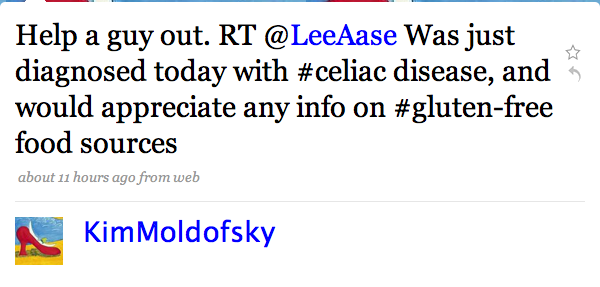
@KimMoldofsky re-tweeted my call for help:

kimtweet

Bonnie Sayers (@autismfamily) alerted me to the #gfree hashtag and the Gluten Free Twitter Party she’s hosting on April 3.

Gluten Free Twitter Party

@FrannLeach shared a Gluten Intolerance group on Squidoo, along with some recipes.

Kayla Eubanks (@BallinOnABudget) told me about Pizza Fusion, and Nina (@lovingyouiseasy) pointed me to @wholefoods and @KarinasKitchen. Karina’s “The Morning after the Diagnosis” post on her blog was particularly helpful. Kristie S. (@KristieTweets) had a couple of suggestions, and Tom Stitt (@tstitt) helped me get an answer as to whether Coke is OK (it is!) I also found out about lots of resources available at celiac.com.

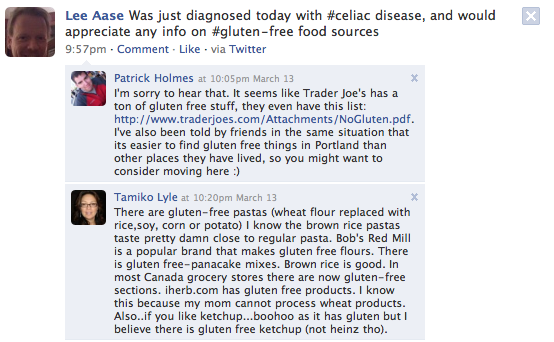
And because I Tweeted about it, my celiac disease diagnosis also was posted to my Facebook profile:

picture-19

…which led to several Wall comments (including a couple you see above that came within a half hour of my Tweet), and also some messages in my Facebook inbox. And I also found a Celiac Disease group in Facebook.

Some people are justifiably concerned about potential dangers of self-diagnosis through the Internet, but once a diagnosis has been made, social media tools are extremely powerful means of getting information and gathering support. 

As I write this, I’ve had my diagnosis of celiac disease for about 34 hours, and the learning about the condition I’ve been able to do in this time has been amazing.

And out of this experience, I’m also going to be getting my wife Lisa (@LisaAase) to use her Twitter account to participate in the #gfree discussions. She set up her account nearly two years ago, but has only done a dozen updates. And right now I’m her only follower. But now she has a reason to use Twitter, and I think she’s going to find it helpful in learning how we deal with gluten in our family diet.

Dueling University TV Ads

A couple of weeks ago I introduced the SMUG Super Bowl TV ad:    

[youtube=http://www.youtube.com/watch?v=9_WIBoEf730] 

This morning I saw a commercial that captures some of the same rationale behind SMUG:

[youtube=http://www.youtube.com/watch?v=e50YBu14j3U]

But I’ll bet Kaplan actually charges tuition!

I know they paid a lot more both for production and distribution.

Education needs to be more about learning what you need, when you need it. That’s the SMUG (and apparently Kaplan) philosophy.

Welcome FIR Listeners!

Earlier this week I had the opportunity to do an interview with Shel Holtz for the For Immediate Release Interviews series.

You can hear the interview here.

I hope you’ll check out the Sharing Mayo Clinic blog, which we discussed in the interview. This earlier SMUG post has more background on all of our Mayo Clinic social media efforts, including Sharing Mayo Clinic.

If you are interested in becoming a SMUGgle, see the Enroll Now page.