Patients and Social Media

In many ways, SMUG has been my personal laboratory for learning about social media and how I can apply these tools to my work at Mayo Clinic. I’ve been able to experiment with blogs, Facebook, Twitter, YouTube and other platforms with my personal accounts, which then helps me see how they can be used for a health care provider like Mayo Clinic.

So we’ve established a Mayo Clinic YouTube channel, a Facebook page, and several podcasts and blogs — including, most recently, Sharing Mayo Clinic.

As of Friday the 13th, however, I’m also approaching social media from the patient perspective: yesterday I was diagnosed as having celiac disease.

So what did I do to find good information about how to cope?

My first step, of course, was the celiac disease section on MayoClinic.com.

And I recalled that my team at work had produced a TV story about living with celiac disease, which is also on our Mayo Clinic YouTube channel:

[youtube=http://www.youtube.com/watch?v=yGmWf0et4hg] 

But I also turned to Twitter, and was amazed at the response.

@KimMoldofsky re-tweeted my call for help:
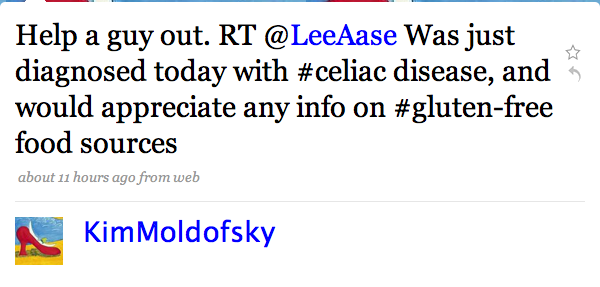
kimtweet

Bonnie Sayers (@autismfamily) alerted me to the #gfree hashtag and the Gluten Free Twitter Party she’s hosting on April 3.

Gluten Free Twitter Party

@FrannLeach shared a Gluten Intolerance group on Squidoo, along with some recipes.

Kayla Eubanks (@BallinOnABudget) told me about Pizza Fusion, and Nina (@lovingyouiseasy) pointed me to @wholefoods and @KarinasKitchen. Karina’s “The Morning after the Diagnosis” post on her blog was particularly helpful. Kristie S. (@KristieTweets) had a couple of suggestions, and Tom Stitt (@tstitt) helped me get an answer as to whether Coke is OK (it is!) I also found out about lots of resources available at celiac.com.

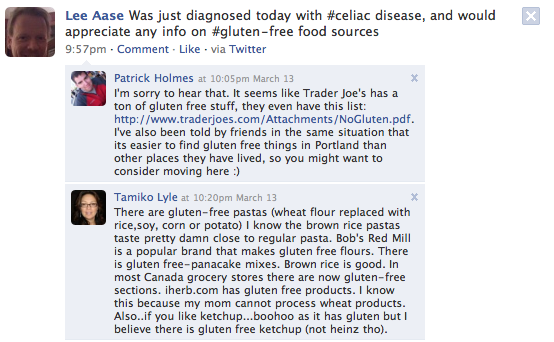
And because I Tweeted about it, my celiac disease diagnosis also was posted to my Facebook profile:
picture-19

…which led to several Wall comments (including a couple you see above that came within a half hour of my Tweet), and also some messages in my Facebook inbox. And I also found a Celiac Disease group in Facebook.

Some people are justifiably concerned about potential dangers of self-diagnosis through the Internet, but once a diagnosis has been made, social media tools are extremely powerful means of getting information and gathering support. 

As I write this, I’ve had my diagnosis of celiac disease for about 34 hours, and the learning about the condition I’ve been able to do in this time has been amazing.

And out of this experience, I’m also going to be getting my wife Lisa (@LisaAase) to use her Twitter account to participate in the #gfree discussions. She set up her account nearly two years ago, but has only done a dozen updates. And right now I’m her only follower. But now she has a reason to use Twitter, and I think she’s going to find it helpful in learning how we deal with gluten in our family diet.

Facebook Pages Get a Major Upgrade

Facebook’s Pages program for businesses and other organizations got a major upgrade this afternoon with the implementation of changes that make pages much more like a personal profile. In fact, I think they are now calling pages “Public Profiles.” And I have added emphasis below to Facebook’s description of what I think is the most important new benefit:

By leveraging the real connections between friends on Facebook, a public profile lets users connect to the entities they care about and allows you to join the conversation. Posts by the public profile will soon start to appear in News Feed, giving you a more dynamic relationship with the public figures and organizations you are interested in.

A big problem with Pages, as opposed to groups or personal profiles, has been that when an organization wants to send information to its “fans” it must send an “Update” as opposed to a message that goes in the regular Facebook Inbox. But most users rarely check their updates; at least not anywhere near as regularly as they view their Inboxes. This has significantly reduced the usefulness of Pages.

Here are some other specific highlights of the changes (again, with emphasis added):

Update and share: Like a user profile, your Page can now update its Fans with statuses—short text-only messages. Soon, these statuses will appear in Fans’ News Feeds.

Tabbed Structure: The tabbed structure multiplies your possibilities. Similar to their functionality in user Profiles, tabs help keep Pages organized so people know where to go to get different pieces of information. The Wall tab is for dynamic content, the Info tab has static information, the Photos tab contains photos albums and Fan photos, etc.

Wall: The Wall tab closely resembles the Wall tab on a user profile. You and your Fans can use the turnkey publisher tool in the main column to share comments and even rich media. Posts by your Page go to your Fans’ News Feeds, and comments by your Fans go to their friends’ News Feeds. Those posts will hyperlink back to your Page.

Facebook has a Step by Step Guide to the new pages that is helpful, and the Best Practices documents for each particular kind of page (Public Figures, Music & Bands and Communities) also provide good guidance.

Check out our Mayo Clinic fan page, which we have adapted and republished with the new format.

Another major improvement is the ability to use the Notes application to import blog posts into your organization’s Facebook public profile. So, for example, we are importing our Sharing Mayo Clinic blog posts into our Mayo Clinic page, which will help create more readership and engagement.

Updates to fans are still available, and can be targeted to certain demographic groups among your fans. So, in the case of Mayo Clinic if we have a notice that only affects one of our three campuses, we could limit the distribution of the update to residents of a certain state.

I understand if some organizations have spent significant time customizing the look of their Pages, that they would not immediately appreciate the changed look. That explains some of the early angst among commenters on the Facebook announcement. But overall it’s a really good thing for organizations to have functionality that feels similar to personal profiles.

And the inclusion of status updates within the news feeds of fans is valuable enough all by itself to make the new Facebook pages a much better value for organizations.

Especially since everything you see on the Mayo Clinic page, for instance, is free!

The big remaining question is:

How soon is “soon?” 

If public profile updates will “soon” be published to the news feed, I’m hoping “soon” means tomorrow or next week.

Anyone have any insight on how soon “soon” is?

[ratings]

World Health Care Congress Consumer Connectivity Summit Presentation

Here’s the presentation I’m giving this afternoon at the World Health Care Congress Consumer Connectivity Summit. Regular SMUGgles will note significant similarities to my previous presentations, but for those attending the Summit or who are unfamiliar with what we’ve been doing with social media at Mayo Clinic, I hope this will be a helpful resource.

Please feel free to chime in with any questions or comments below; it can help illustrate some of the benefits of social media, in that it allows conversations to continue even after the presentation is complete.

You also can follow the stream of tweets at #whcc2.

Mayo Clinic Social Media Guidelines for Employees

As part of the launch of Sharing Mayo Clinic last week, we published guidelines for Mayo Clinic employees involved in blogging, social networking sites and other social media.

We previously had published the guidelines internally; our publishing them externally was inspired by our colleagues at Intel, a fellow member of the Blog Council, publishing their company’s guidelines, which are really well done.

We hadn’t considered publishing our guidelines externally until we learned that Intel had done it, and after some discussion within the Blog Council about the merits of disclosing these policies. It seems like the right thing to do, in the spirit of transparency.

From our perspective, these guidelines for social media aren’t really new policies; they mainly are applications of existing policies to new communications platforms.

So, if you’re looking to create social media policies or guidelines for your company, these are two examples you could consider.

Help Me Help You Fight the FUD

In my presentation at Blogwell, at which I introduced our new Mayo Clinic blog for patients and employees, Sharing Mayo Clinic, I closed with a Jerry Maguire appeal:

[youtube=http://www.youtube.com/watch?v=p-oHuogx6_Y]

Many of the questions I got after the presentation, and that I get in other contexts from people wanting to implement social media programs at work, began something like: “What about the concerns that …” or “What about the fears that ….”

One of my points in response is that it’s extremely helpful to have external consultants who can help reassure leadership that the social media advocates in the organization aren’t crazy, and that lots of other companies and similar groups are using blogs and social media successfully, and without major problems. Shel Holtz and Andy Sernovitz helped us.

It’s also great to be able to point to examples of success, like Nuts about Southwest.

I hope Sharing Mayo Clinic can be the kind of example you can show your leaders, and say “See! If an established organization like Mayo Clinic is using blogs and Facebook and YouTube, we can too.” I’d love it if our example can help you fight the FUD (fear, uncertainty and doubt) barrier in your organization.

Of course, a big part of you being able to use our blog as an example of corporate blogging success is…well…for us to succeed.

You can help me with that in two ways: Suggesting Improvements and Spreading the Word.

Suggesting Improvements. In response to the post I did announcing the blog Thursday, SMUGgle Scott Meis (who I got to finally meet for the first time at BlogWell), left a good suggestion in the comments that I have implemented. It tripled the number of RSS and email subscribers we got in the second full day of the blog’s operation, as compared to the first. So, I hope you’ll check out Sharing Mayo Clinic, and I’d really appreciate any further suggestions you could offer on how we can improve.

Spreading the Word. Obviously building traffic to Sharing Mayo Clinic is our responsibility, and we’re communicating with our Mayo Clinic patients and employees about it. But if you would help spread the word by blogging or tweeting about it, or posting it on your Facebook profile or sending it to your friends, that would be fantastic, too.

And hopefully by helping me, I can help you fight the FUD.